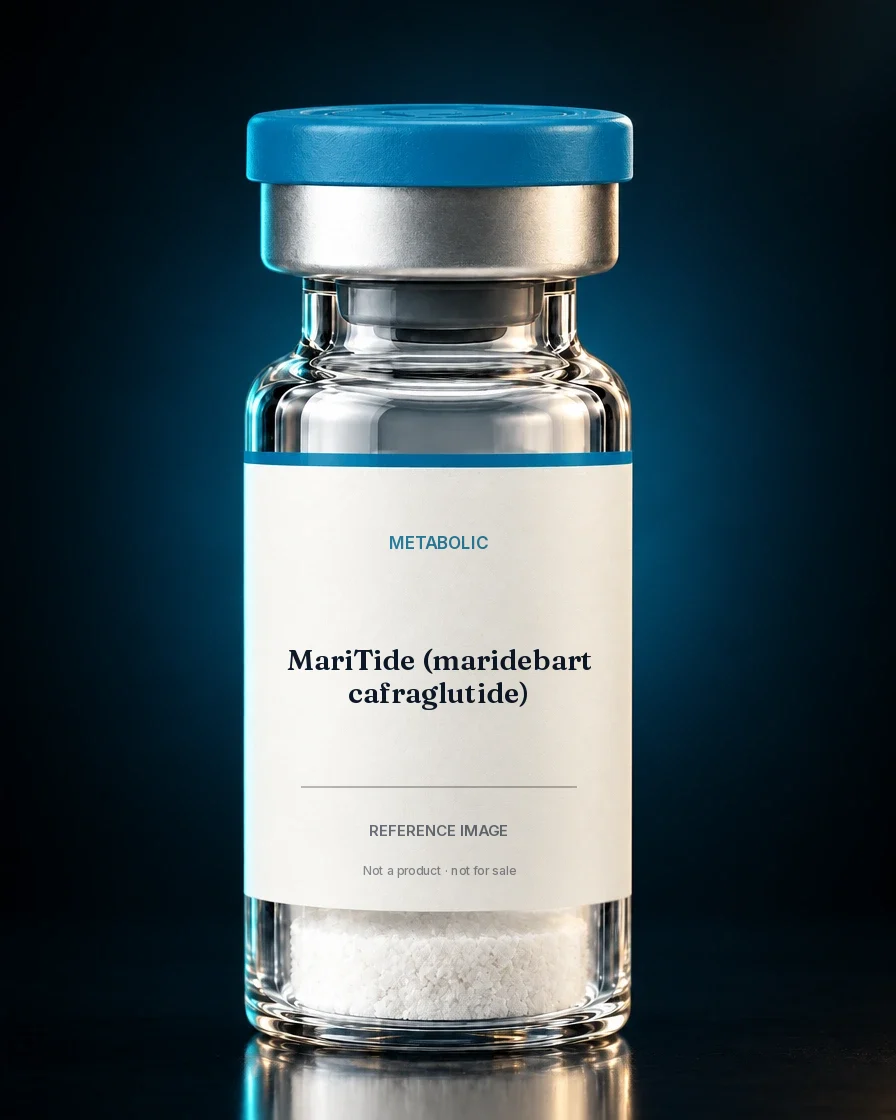
 Metabolic · Dosing reference
MariTide (maridebart cafraglutide) dosage
Doses given in registered human trials, how long they ran, and the arithmetic for working with vials.
- Regulatory status
- Investigational
- Human amounts
- Trial amounts only: 140, 280 or 420 mg subcutaneously every 4 weeks, and 420 mg every 8 weeks, in the phase 2 dose-ranging trial NCT05669599
- Route studied
- Subcutaneous injection
- Frequency
- Every 4 weeks, or every 8 weeks in one phase 2 group
- Half-life
- Not reported numerically in the sources reviewed; the conjugate is described as giving markedly prolonged exposure of the intact GLP-1 peptide
- Evidence grade
- Grade A · Human trial evidence
- Vial sizes on the market
- Not recorded
- Other forms seen
- —
What MariTide (maridebart cafraglutide) is
MariTide (maridebart cafraglutide, AMG 133) is not a peptide but an antibody-peptide conjugate: synthetic GLP-1 receptor agonist peptides chemically attached to an anti-GIP-receptor monoclonal antibody, investigational for obesity, with a 592-participant phase 2 trial reporting body-weight change of -12.3% to -16.2% at 52 weeks and phase 3 trials under way.
Maridebart cafraglutide is built from an IgG monoclonal antibody directed against the GIP receptor, to which synthetic GLP-1 analogue peptides are chemically conjugated 4,6. The design decouples peptide synthesis from antibody expression, which allows non-natural amino acids and other chemical modifications in the peptide portion, while the antibody provides the long circulating exposure that a free peptide cannot… How it works →
Key evidence
- Jastreboff et al. phase 2 trial, N Engl J Med (NCT05669599) · 2025 · Humans (592 participants: 465 with obesity, 127 with obesity and type 2 diabetes)Mean body-weight change at week 52 was -12.3% to -16.2% versus -2.5% with placebo (obesity cohort) and -8.4% to -12.3% versus -1.7% (obesity-diabetes cohort); HbA1c fell 1.2 to 1.6 percentage points versus +0.1 with placebo; gastrointestinal adverse events were common but less frequent with dose escalation and a lower starting amount. 1
- Wu et al., J Med Chem · 2026 · Cells and animals (diet-induced obese mice, obese monkeys)Conjugation of synthetic GLP-1 peptides to anti-GIPR IgG antibodies gave markedly prolonged exposure of the intact peptide and sustained body-weight reduction in both species, culminating in the selection of AMG 133. 6
- Yie et al., Antib Ther (review) · 2026 · Not applicableDescribes the rationale for conjugates over fusion proteins: decoupled synthesis allowing non-proteinogenic residues and cyclic structures, with antibody-like half-life; authors are employees of a company developing conjugates. 4
Doses given in human trials
- In the phase 2 dose-ranging trial (NCT05669599), participants in the obesity cohort were randomly assigned to subcutaneous maridebart cafraglutide 140, 280 or 420 mg every 4 weeks without dose escalation; 420 mg every 8 weeks without dose escalation; 420 mg every 4 weeks with 4-week dose escalation; 420 mg every 4 weeks with 12-week dose escalation; or placebo, for 52 weeks 1.
- In the same trial, participants in the obesity plus type 2 diabetes cohort were randomly assigned to 140, 280 or 420 mg every 4 weeks, all without dose escalation, or placebo 1.
- The first-in-human study (NCT04478708) used single and multiple ascending amounts in participants with obesity to assess safety and tolerability; amounts are not stated in the registry record reviewed 7.
How long did human studies run?
No human study durations are recorded for MariTide (maridebart cafraglutide).
Cycle-length evidence for MariTide (maridebart cafraglutide)Side effects reported in studies
- Gastrointestinal adverse eventsDescribed as common with maridebart cafraglutide, and less frequent in groups using dose escalation and a lower starting amount; exact rates not given in the abstract reviewed · Phase 2 trial, 592 participants, 52 weeks 1
- Unexpected safety signalsNone reported · Phase 2 trial, 52 weeks 1
Supplies and handling
- Lyophilized vialSealed vial with the freeze-dried cake. Check the label, lot and the certificate of analysis before opening.
- Sterile diluentThe diluent named on the product documentation. Bacteriostatic water contains benzyl alcohol; sterile water does not.
- Graduated syringesSized to the volume being measured. U-100 insulin syringes are graduated in units where 100 units = 1 mL.
- Alcohol prep padsFor wiping vial stoppers before each puncture.
- Nitrile glovesClean gloves for aseptic handling.
- Sharps containerPuncture-resistant container for used needles.
Storage
Antibody-based biologics are generally handled cold, protected from freezing, agitation and light, and are sensitive to aggregation; follow the sponsor's or supplier's documentation. No temperatures or preparation steps are given here.
- Lyophilized (unmixed) vials: typically stored cold and dry, away from light, as the documentation directs. Many are stable longer frozen.
- Reconstituted vials: typically refrigerated (about 2–8 °C), protected from light and not frozen.
- Bacteriostatic water contains benzyl alcohol, which inhibits bacterial growth in multi-use vials; sterile water has no preservative.
Handling mistakes and troubleshooting
- Added the wrong volume of diluent
- The concentration changes, not the amount of compound in the vial. Recalculate with the volume actually added and relabel the vial.
- Shook the vial and it foamed
- Let it settle in the refrigerator. Foam is a sign of agitation; some peptides aggregate when shaken. Note it on the label.
- The solution is cloudy or has particles
- Do not use it. Cloudiness can indicate incomplete dissolution, contamination or degradation. Record the lot and contact the supplier with the certificate of analysis.
- The powder cake looks melted or shrunken before reconstitution
- This can indicate the vial was exposed to heat or moisture. Record the lot and condition on arrival.
- Liquid sprayed back when the needle was removed
- Pressure built up in the vial. Withdraw a small volume of air while adding diluent to keep pressure neutral.
Regulatory status
- Status
- Investigational. No Drugs@FDA application record was returned for maridebart cafraglutide on 24 October 2026 8. A phase 2 dose-ranging trial of 592 participants has been published 1, and Amgen has registered a phase 3 programme including a cardiovascular outcomes trial with an estimated 12,800 participants (NCT07037433, recruiting), a type 2 diabetes trial (NCT06858878) and a heart failure trial (NCT07037459) 9,10,11.
- United States (FDA)
- Not approved. An openFDA Drugs@FDA query for maridebart cafraglutide returned no application record on 24 October 2026 8. Phase 3 trials are registered and recruiting 9,10,11.
- Sport (WADA)
- Not named individually in the sources reviewed; S0 covers substances without governmental approval for human therapeutic use, prohibited at all times 13.
Status varies by country and changes over time. How we describe regulatory status.
MariTide (maridebart cafraglutide) compared with related compounds
| Compound | Status | Evidence | Human amounts | Half-life |
|---|---|---|---|---|
| MariTide (maridebart cafraglutide) | Investigational | A | Trial doses | Not reported numerically in the sources |
| PEA | Not approved — research use only | A | None established | — |
| Vesugen | Not approved — research use only | C | None established | — |
| Tesofensine | Investigational | B | Trial doses | About 234 hours (M1 metabolite about 374 |
| Mazdutide | Approved outside the US | A | Trial doses | 150.9 to 403.5 hours (phase 1b in overwe |
| Cagrilintide | Investigational | A | Trial doses | 159 to 195 hours (phase 1b, co-administe |
Frequently asked questions
What doses of MariTide (maridebart cafraglutide) have been studied in humans?
Is there an established MariTide (maridebart cafraglutide) cycle length?
How much bacteriostatic water should be added to a MariTide (maridebart cafraglutide) vial?
How many units is a given amount on an insulin syringe?
What is the half-life of MariTide (maridebart cafraglutide)?
Is MariTide (maridebart cafraglutide) FDA-approved?
References
- Once-Monthly Maridebart Cafraglutide for the Treatment of Obesity - A Phase 2 Trial N Engl J Med. 2025
- Once-Monthly Maridebart Cafraglutide in Obesity - A Phase 2 Trial (correspondence) N Engl J Med. 2025
- Once-Monthly Maridebart Cafraglutide in Obesity - A Phase 2 Trial. Reply N Engl J Med. 2025
- Design and therapeutic rationale of antibody-peptide conjugates: insights from maridebart cafraglutide (AMG133) and emerging applications Antib Ther. 2026
- Bidirectional pharmacology of GIP receptor targeting in obesity: Historical foundations, mechanistic divergence, and translational boundaries Peptides. 2026
- Discovery of AMG 133, a Glucose-Dependent Insulinotropic Polypeptide Receptor Antagonist and Glucagon-Like Peptide 1 Receptor Agonist Antibody-Drug Conjugate for the Treatment of Obesity J Med Chem. 2026
- Single and Multiple Ascending Dose Study of AMG 133 in Participants With Obesity (NCT04478708) ClinicalTrials.gov. 2026
- Drugs@FDA application data queried through openFDA for maridebart cafraglutide (no matching application record returned on 24 October 2026) openFDA / Drugs@FDA. 2026
- Evaluating the Impact of Maridebart Cafraglutide on Cardiovascular Outcomes in Participants With Atherosclerotic Cardiovascular Disease and Overweight or Obesity (NCT07037433) ClinicalTrials.gov. 2026
- Efficacy and Safety of Maridebart Cafraglutide in Adult Participants With Type 2 Diabetes Mellitus and Overweight or Obesity (NCT06858878) ClinicalTrials.gov. 2026
- Maridebart Cafraglutide in Heart Failure With Preserved or Mildly Reduced Ejection Fraction and Obesity (NCT07037459) ClinicalTrials.gov. 2026
- One receptor, two opposite approaches: efficacy and tolerability of GIPR agonism and antagonism in obesity pharmacotherapy Appetite. 2026
- International Standard: Prohibited List 2026 World Anti-Doping Agency. 2026
Last reviewed October 24, 2026 by the Amiravo editorial team. Editorial policy · Report an error