Setmelanotide
Also known as Imcivree · RM-493 · BIM-22493 · Setmelanotide acetate · MC4R agonist RM-493
Setmelanotide is a cyclic eight-residue melanocortin-4 receptor agonist that the FDA approved in 2020 as Imcivree for obesity caused by specific genetic MC4R-pathway disorders, with acquired hypothalamic obesity added to the label by 2026.
- US status
- FDA-approved
- Evidence
- Grade A
- Half-life
- Elimination half-life approximately 11 hours after subcutaneous dosing (label) 1.
- Class
- Cyclic melanocortin-4 receptor agonist peptide (alpha-MSH analog)
More
Research reference, not advice. Label quotes, not a recommendation. Amiravo sells nothing; some links are referrals.Read the full notice
Key takeaways
- Setmelanotide is an MC4 receptor agonist with about 20-fold less activity at MC3 and MC1 receptors, approved only for obesity linked to specific MC4R-pathway defects and acquired hypothalamic obesity 1.
- Single-arm phase 3 trials reported at least 10% body-weight reduction in 80% of people with POMC deficiency and 45% with LEPR deficiency after about a year 3.
- In the randomized TRANSCEND trial in acquired hypothalamic obesity, BMI fell 16.5% versus a 3.3% rise with placebo, with serious adverse events in 28% versus 8% 5.
- MC1 receptor activation causes skin hyperpigmentation and darkening or new nevi; the label also warns about depression and suicidal ideation, sexual arousal disturbances, and adrenal insufficiency and sodium imbalance in hypothalamic obesity 1.
- Setmelanotide is not named in the 2026 Prohibited List text reviewed 6.
Development stage
Where Setmelanotide sits between laboratory work and regulatory approval.
- PreclinicalAnimal and cell work
- Phase 1First human safety studies
- Phase 2Early efficacy signal
- Phase 3Confirmatory trials
- Approved (current)Cleared by a regulator
Stage comes from the regulatory record and ClinicalTrials.gov studies naming the compound (for compounds approved nowhere, only completed trials or trials with posted results count) (checked 2026-10-24). A registered trial is not a result.
Mechanism of action
Setmelanotide activates the melanocortin 4 (MC4) receptor, which is involved in regulating hunger, satiety and energy expenditure in the brain; it has about 20-fold less activity at MC3 and MC1 receptors 1.
Why it targets specific disorders
The label states that, based on nonclinical evidence, it may re-establish MC4 receptor pathway signaling when obesity stems from insufficient MC4 receptor activation, as in POMC, PCSK1 or LEPR deficiency, Bardet-Biedl syndrome or acquired hypothalamic obesity, and that it is not expected to work in general obesity 1.
Pigmentation
MC1 receptors on melanocytes, when activated, increase melanin and skin pigmentation independently of ultraviolet light 1.
Molecular structure
PubChem CID 11993702 ↗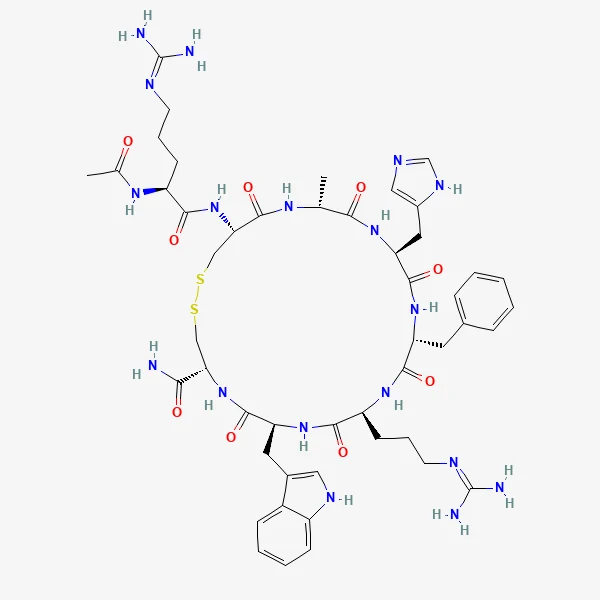
2D depiction generated from the PubChem record. Depictions are schematic and do not show salt form, counter-ions or conformation.
- Formula
- C49H68N18O9S2
- Molecular weight
- 1117.3 g/mol
- CAS
- 920014-72-8
- InChIKey
- HDHDTKMUACZDAA-PHNIDTBTSA-N
Research overview
Human research
Phase 3 trials include two single-arm, open-label trials in POMC (n = 10) and LEPR (n = 11) deficiency 3, a randomized placebo-controlled trial with open-label extension in Bardet-Biedl and Alström syndromes (n = 38) 4, and the randomized TRANSCEND trial in acquired hypothalamic obesity (120 participants in the publication; the label reports 142 analyzed) 1,5.
Animal research
Not reviewed for this entry beyond the label's statement that the proposed mechanism rests on nonclinical evidence 1.
In-vitro research
Receptor selectivity (about 20-fold lower activity at MC3 and MC1) is summarized in the label 1.
Key studies
- Two single-arm, open-label, multicentre phase 3 trials with withdrawal periodModel: Humans (10 with POMC/PCSK1 deficiency, 11 with LEPR deficiency)
80% (POMC) and 45% (LEPR) reached at least 10% body-weight reduction at about 1 year; no serious treatment-related adverse events 3.
- Randomized, double-blind, placebo-controlled phase 3 with open-label periodModel: Humans (38 with Bardet-Biedl or Alström syndrome)
32.3% of patients aged 12 or older with Bardet-Biedl syndrome reached at least 10% body-weight reduction at 52 weeks; hyperpigmentation in 61% 4.
- Randomized 2:1, placebo-controlled phase 3, 52 weeks after dose escalationModel: Humans (120 aged 4-66 with acquired hypothalamic obesity)
BMI change -16.5% versus +3.3% with placebo; hunger scores fell more; serious adverse events 28% versus 8% 5.
Dosing as stated on the FDA label
Quoted from the prescribing information for reference. Prescribing decisions belong to a licensed clinician; this is not a recommendation or instruction for use.
Full dosing reference, study durations and vial arithmetic →- Acquired hypothalamic obesity, age 4 and older (IMCIVREE): starting dosage 0.5 mg subcutaneously once daily for 2 weeks, then titrated per the label's tables 1.
- BBS or POMC, PCSK1 or LEPR deficiency: starting dosage 2 mg once daily for 2 weeks (age 12 and older), 1 mg (age 6 to under 12) or 0.5 mg (age 2 to under 6) 1.
- Recommended maintenance dosage for adults and children aged 6 and older for all indications is 3 mg subcutaneously once daily; for younger children the maintenance dosage is based on body weight 1.
- The label specifies dose reductions if starting or escalated dosages are not tolerated, dosing in renal impairment, and patient selection by clinical or genetic diagnosis; those details are in the prescribing information and not reproduced here 1.
Background viewing
We haven't found a clinician video focused on Setmelanotide yet. Meanwhile, this widely watched talk covers the science of aging in general. It does not discuss Setmelanotide.
These creators are not affiliated with Amiravo and do not endorse Amiravo or any product linked on this site. Nothing here is medical advice. Video views counted on YouTube as of Oct 24, 2026.
Regulatory status
- Status
- FDA-approved as IMCIVREE (NDA 213793, original approval November 25, 2020) 2. The April 2, 2026 label covers people aged 4 years and older with acquired hypothalamic obesity and aged 2 years and older with Bardet-Biedl syndrome or POMC, PCSK1 or LEPR deficiency; it is not indicated for other genetic syndromes or general (polygenic) obesity 1.
- United States (FDA)
- FDA-approved under NDA 213793 (IMCIVREE, Rhythm), original approval November 25, 2020 per Drugs@FDA 2; indications per the April 2, 2026 DailyMed label include acquired hypothalamic obesity, Bardet-Biedl syndrome and POMC, PCSK1 or LEPR deficiency 1.
- Sport (WADA)
- Setmelanotide is not named in the 2026 Prohibited List text reviewed; as an approved drug it falls outside S0, so status should be confirmed with the relevant anti-doping organization 6.
Status varies by country and changes over time. How we describe regulatory status.
Quality and testing notes
Identity should be confirmed against the cyclic acetylated octapeptide with D-Ala and D-Phe and the Cys2-Cys8 disulfide (free base C49H68N18O9S2, 1117.3 Da); setmelanotide is distinct from melanotan II, though both are alpha-MSH-derived [1, 7].
How purity testing works · Reading a certificate of analysis
Check a Setmelanotide certificate of analysis against its expected mass (1,117.3 Da)Storage and handling
Follow the current IMCIVREE label for storage of vials; research material per supplier documentation.
Frequently asked questions
Who is setmelanotide approved for?
Is it approved for general obesity?
How does it act?
Why does it darken the skin?
How large was the effect in hypothalamic obesity?
What is its half-life?
Is it the same as melanotan II?
Is it banned in sport?
Latest indexed research
- Impact of setmelanotide on metabolic syndrome risk in patients with proopiomelanocortin or leptin receptor deficiencies.Other · The Journal of clinical endocrinology and metabolism · 2026-10-19
- Setmelanotide for the Treatment of Acquired Hypothalamic Obesity. Reply.Other · The New England journal of medicine · 2026-10-15
- Setmelanotide for the Treatment of Acquired Hypothalamic Obesity.Other · The New England journal of medicine · 2026-10-15
- Setmelanotide for the Treatment of Acquired Hypothalamic Obesity.Other · The New England journal of medicine · 2026-10-15
Listed by publication type from the index record. Inclusion is not an endorsement; open the source to read the findings.
Revision history
Meaningful changes to this entry, with dates and sources. Last reviewed Oct 24, 2026. Typo and layout fixes are not listed.
- New section· entryOct 24, 2026
New research reference added: Setmelanotide.
References
- IMCIVREE (setmelanotide) injection, prescribing information (DailyMed SPL version 14, published Apr 02, 2026) FDA label (DailyMed). 2026
- Drugs@FDA application NDA 213793 (IMCIVREE, Rhythm; original approval 2020-11-25) via openFDA FDA (openFDA Drugs@FDA). 2026
- Efficacy and safety of setmelanotide, an MC4R agonist, in individuals with severe obesity due to LEPR or POMC deficiency: single-arm, open-label, multicentre, phase 3 trials Lancet Diabetes Endocrinol. 2020
- Efficacy and safety of setmelanotide, a melanocortin-4 receptor agonist, in patients with Bardet-Biedl syndrome and Alström syndrome: a multicentre, randomised, double-blind, placebo-controlled, phase 3 trial with an open-label period Lancet Diabetes Endocrinol. 2022
- Setmelanotide for the Treatment of Acquired Hypothalamic Obesity N Engl J Med. 2026
- Tractatenblad 2026 Nr. 25: Anti-doping convention (ETS No. 135), amendment to the appendix - The 2026 Prohibited List, World Anti-Doping Code (English text; entry into force 1 January 2026) Tractatenblad van het Koninkrijk der Nederlanden (official government publication). 2026
- PubChem compound record for setmelanotide (CID 11993702) PubChem. 2026
Last reviewed October 24, 2026 by the Amiravo editorial team.
Need the math?
Laboratory arithmetic with every formula shown.
For research use only. Not for human or veterinary use. Not a drug, food, or dietary supplement. This page is educational and is not medical advice.
Unbranded reference image. Amiravo does not produce, supply or sell this compound.
Specifications
- Molecular formula
- C49H68N18O9S2
- Molecular weight
- 1,117.3 g/mol
- CAS number
- 920014-72-8
- PubChem CID
- 11993702
- FDA UNII
- N7T15V1FUY
- ChEMBL
- CHEMBL3301624
- DrugBank
- DB11700
- Sequence
- Ac-
Arg- Cys- D- Ala- His- D- Phe- Arg- Trp- Cys- NH2 (disulfide Cys2- Cys8) - Type
- Single compound
Identifiers from PubChem. Verify against the supplier’s documentation for your lot.
Research stats
How much has been published, not how good it is.
- PubMed records
- 227
- Indexed as human research
- 136
- Animal-only research
- 13
- Randomized controlled trials
- 5
- Registered trials
- 27
- Trials with posted results
- 14
- FDA adverse-event reports (FAERS)
- 59
- NIH-funded projects naming it
- 47
Counts from title/abstract searches of PubMed, ClinicalTrials.gov, openFDA and NIH RePORTER, checked 2026-10-24. Names shared with other substances can inflate counts. FAERS reports are spontaneous and do not establish cause. Funding shows interest, not evidence. Method
Follow Setmelanotide
See every new citation, evidence-grade or status change and correction in My Research, with optional email alerts. Free account.