Apelin-13
Also known as (Pyr1)apelin-13 · Pyr-apelin-13 · Pyroglutamyl apelin-13 · APJ receptor agonist peptide · Apelin fragment 65-77 · APLN-13
Apelin-13 is a 13-residue fragment of the endogenous apelin peptide and an agonist at the APJ (apelin) receptor; short randomized human infusion studies report vasodilatation, increased cardiac output and an insulin-sensitising effect, while most disease-level evidence is from cells and rodents and no approved use exists.
- US status
- Not approved — research use only
- Evidence
- Grade B
- Half-life
- Not located as a numeric value in the sources reviewed. Rapid plasma clearance is described as a limitation that motivates delivery work such as microneedle patches 5.
- Class
- Endogenous peptide fragment and APJ (apelin receptor) agonist
More
Research reference, not advice. No administration data. Amiravo sells nothing; some links are referrals.Read the full notice
Key takeaways
- Apelin-13 is a C-terminal fragment of the endogenous peptide apelin and an agonist at the APJ receptor, identified in 1998 6.
- Short randomized, placebo-controlled human infusion studies report peripheral and coronary vasodilatation and increased cardiac output, with the forearm response preserved in chronic heart failure where the acetylcholine response was attenuated 1.
- A randomized crossover clamp study in 16 healthy overweight men reported improved insulin sensitivity at the higher of two levels tested, with no side effects reported on cardiovascular monitoring 2.
- Disease-level evidence is preclinical and mixed: rodent models report protection in neonatal brain injury, doxorubicin cardiac injury and renal ischaemia-reperfusion, while a 2026 study reported that apelin-13 drove vascular smooth muscle proliferation and atherosclerosis 4,8,9,10.
- No approved use exists, rapid clearance is a recognised obstacle, and two papers on apelin-13 and foam cells have been retracted 5,11,13.
Development stage
Where Apelin-13 sits between laboratory work and regulatory approval.
- PreclinicalAnimal and cell work
- Phase 1 (current)First human safety studies
- Phase 2Early efficacy signal
- Phase 3Confirmatory trials
- ApprovedCleared by a regulator
Stage comes from the regulatory record and ClinicalTrials.gov studies naming the compound (for compounds approved nowhere, only completed trials or trials with posted results count) (checked 2026-10-24). A registered trial is not a result.
Mechanism of action
Apelin-13 acts on APJ, a G protein-coupled receptor, as an agonist 6. The receptor and its ligand are expressed in vasculature, heart, kidney, adipose tissue and brain, which is why the reported effects span several organ systems 1,2.
Cardiovascular actions in people
In human studies, intrabrachial (Pyr1)apelin-13 produced forearm vasodilatation in both patients with heart failure and controls; an intracoronary bolus of apelin-36 increased coronary blood flow and the maximum rate of rise in left ventricular pressure and reduced peak and end-diastolic left ventricular pressures; and systemic (Pyr1)apelin-13 infusion raised cardiac index while lowering mean arterial pressure and peripheral vascular resistance 1.
Metabolic actions
Apelin is described as an adipokine, and in rodents it improves glucose tolerance and insulin sensitivity; in a human clamp study, intravenous (Pyr1)apelin-13 raised the glucose infusion rate required to maintain euglycaemia at the higher of two levels tested, which the authors presented as the first demonstration of an insulin-sensitising action in people 2.
Signalling reported in preclinical models
- Neuroprotection: AMPK activation with reduced neuroinflammation in neonatal rat hypoxic-ischaemic brain injury 4, and APJ/mTORC2 signalling in microglia after intracerebral haemorrhage in mice.
- Cardiac and renal: PI3K/AKT and ERK/MAPK signalling in doxorubicin myocardial injury, and attenuated fibrotic remodelling after renal ischaemia-reperfusion in aged animals 8,9.
- Muscle: stimulation of mitochondrial biogenesis and myofibre regeneration is the stated rationale for sarcopenia work, where repeated microneedle delivery improved fibre cross-sectional area and grip strength in aged mice relative to controls 5.
- Vascular, opposite direction: one 2026 study reported apelin-13 driving vascular smooth muscle cell proliferation and atherosclerosis through disrupted ER-mitochondria coupling and a glycolytic shift 10.
Biased agonism
Because APJ signals through both G protein and beta-arrestin pathways, biased agonists have been designed and one has been taken into a first-in-human vascular study, a line of work that treats native apelin-13 as the comparator rather than the candidate 7.
Molecular structure
PubChem CID 25078060 ↗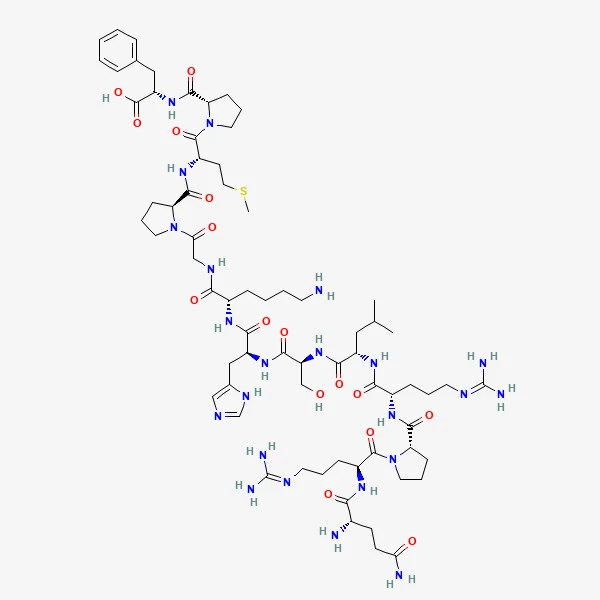
2D depiction generated from the PubChem record. Depictions are schematic and do not show salt form, counter-ions or conformation.
- Formula
- C69H111N23O16S
- Molecular weight
- 1550.8 g/mol
- CAS
- 217082-58-1
- InChIKey
- XXCCRHIAIBQDPX-PEWBXTNBSA-N
Published adverse-event data
Reported in the cited trials or product labels. Frequencies apply to the stated population and do not transfer to other settings.
Emerging safety signals
- Human exposure in the sources reviewed is limited to short infusions. In the clamp study, cardiovascular monitoring and safety reporting revealed no side effect of administration in 16 healthy overweight men; the study was not designed to detect uncommon or delayed events 2. 2 (2018)
- Haemodynamic effects are real and measurable in people: systemic infusion lowered mean arterial pressure and peripheral vascular resistance and raised cardiac index in patients and controls, which is relevant for anyone on blood-pressure-lowering treatment 1. 1 (2010)
- Preclinical direction of effect is not settled in vascular disease; one 2026 study reported pro-atherosclerotic effects, and two earlier papers reporting anti-foam-cell effects have been retracted 10,11. 10 (2026)
What is not known: No clinical outcome trial of apelin-13 was located; human studies measure physiology over minutes to hours, not clinical endpoints 1,2,3. Half-life has not been located as a numeric value, and rapid plasma clearance is described as the central obstacle to use, which is why delivery systems are being developed 5. Whether the insulin-sensitising finding in 16 overweight men generalises, and whether it persists beyond an infusion, is untested 2. The direction of effect in atherosclerosis is contested, with retracted literature in this area 10,11. Long-term safety, immunogenicity and effects of repeated exposure are unaddressed in the sources reviewed.
Background viewing
We haven't found a clinician video focused on Apelin-13 yet. Meanwhile, this widely watched talk covers the science of aging in general. It does not discuss Apelin-13.
These creators are not affiliated with Amiravo and do not endorse Amiravo or any product linked on this site. Nothing here is medical advice. Video views counted on YouTube as of Oct 24, 2026.
Regulatory status
- Status
- Not approved for any use. An openFDA Drugs@FDA query for apelin returned no application record on 24 October 2026 13, and apelin does not appear in any of the three categories of FDA's 503A bulk drug substances list as updated May 14, 2026 14. Human work consists of short mechanistic infusion studies, not treatment trials with clinical endpoints 1,2,3.
- United States (FDA)
- Not approved for any use. An openFDA Drugs@FDA query for apelin returned no application record on 24 October 2026 13, and apelin does not appear in any of the three categories of FDA's 503A bulk drug substances list as updated May 14, 2026 14.
- Sport (WADA)
- Not named individually in the sources reviewed; S0 covers substances without governmental approval for human therapeutic use, prohibited at all times 15.
Status varies by country and changes over time. How we describe regulatory status.
Quality and testing notes
A certificate of analysis should state which apelin species the material is: apelin-13, the pyroglutamyl form (Pyr1)apelin-13, apelin-17 or apelin-36 are different molecules with different stability, and human studies used the pyroglutamyl form or apelin-36 depending on the experiment [1, 2]. Expect identity by mass spectrometry against the expected mass (PubChem lists C69H111N23O16S, about 1551 Da, for apelin-13), purity by reverse-phase HPLC with the trace shown, net peptide content separate from gross weight, counter-ion identity and an endotoxin measurement [12]. The sequence is strongly basic with multiple arginines, so counter-ion content can be a substantial share of gross weight.
How purity testing works · Reading a certificate of analysis
Check a Apelin-13 certificate of analysis against its expected mass (1,550.8 Da)Storage and handling
General research-context handling only. Lyophilised peptides of this type are generally kept dry, cool and protected from light and moisture, and aqueous solutions of a rapidly cleared, protease-sensitive peptide are treated as short-lived. Defer to supplier documentation for the specific lot. No temperatures or preparation steps are given here.
Frequently asked questions
What is apelin-13?
Has it been given to people?
What happened to blood pressure and cardiac output in those studies?
Does it affect insulin sensitivity?
Is the preclinical evidence consistent?
Why is it not a medicine?
Is apelin-13 the same as Pyr-apelin-13?
Is it banned in sport?
Latest indexed research
- Retraction notice to "Corrigendum to "Apelin-13 impedes foam cells formation by activating ClassIIIPI3K/Beclin mediated autophagic pathway"" [Biochem. Biophys. Res. Commun. 575, (2021), 99-100].Other · Biochemical and biophysical research communications · 2026-10-29
- Retraction notice to "Apelin-13 impedes foam cell formation by activating Class III PI3K/Beclin-1-mediated autophagic pathway" [Biochem. Biophys. Res. Commun. 466, (2015), 637-643].Other · Biochemical and biophysical research communications · 2026-10-29
- Apelin-13 exerts neuroprotection through activation of APJ/mTORC2 axis in microglia after Intracerebral Hemorrhage in mice.Other · Brain research bulletin · 2026-10-23
- Apelin-13 Pretreatment Attenuates Age-Associated Renal Fibrotic Remodeling Following I/R Injury.Other · Biomedicines · 2026-09-10
- Apelin-13 prevents GATA4-mediated neuronal senescence by restoring autophagy through mTORC1 inhibition.Other · humans · Cell death & disease · 2026-07-27
Listed by publication type from the index record. Inclusion is not an endorsement; open the source to read the findings.
Revision history
Meaningful changes to this entry, with dates and sources. Last reviewed Oct 24, 2026. Typo and layout fixes are not listed.
- New section· entryOct 24, 2026
New research reference added: Apelin-13.
Last reviewed October 24, 2026 by the Amiravo editorial team.
Need the math?
Laboratory arithmetic with every formula shown.
For research use only. Not for human or veterinary use. Not a drug, food, or dietary supplement. This page is educational and is not medical advice.
Unbranded reference image. Amiravo does not produce, supply or sell this compound.
Specifications
- Molecular formula
- C69H111N23O16S
- Molecular weight
- 1,550.8 g/mol
- CAS number
- 217082-58-1
- PubChem CID
- 25078060
- ChEMBL
- CHEMBL414173
- Sequence
- Gln-
Arg- Pro- Arg- Leu- Ser- His- Lys- Gly- Pro- Met- Pro- Phe (QRPRLSHKGPMPF); the (Pyr1) form carries an N- terminal pyroglutamate in place of the N- terminal glutamine - Type
- Single compound
Identifiers from PubChem. Verify against the supplier’s documentation for your lot.
Research stats
How much has been published, not how good it is.
- PubMed records
- 653
- Indexed as human research
- 231
- Animal-only research
- 307
- Randomized controlled trials
- 6
- Registered trials
- 7
- Trials with posted results
- 0
- NIH-funded projects naming it
- 10
Counts from title/abstract searches of PubMed, ClinicalTrials.gov, openFDA and NIH RePORTER, checked 2026-10-24. Names shared with other substances can inflate counts. FAERS reports are spontaneous and do not establish cause. Funding shows interest, not evidence. Method
Follow Apelin-13
See every new citation, evidence-grade or status change and correction in My Research, with optional email alerts. Free account.