Cerebrolysin
Also known as Cere · Cerebrolysin concentrate
Cerebrolysin is a porcine brain-derived preparation of low-molecular-weight peptides and amino acids given by intravenous infusion or injection. It is authorised in Austria and used in Russia, Eastern Europe, China and other Asian countries for supportive treatment after stroke and head injury and in dementia, but it is not approved by the FDA. Randomized trials and Cochrane reviews report mixed results, including no clear effect on death after acute ischaemic stroke; this entry summarizes them for research reference only.
- US status
- Approved outside the US
- Evidence
- Grade A
- Half-life
- Not measurable directly: the Austrian SmPC states that, as a mixture of short-chain peptides similar or identical to endogenous ones, its pharmacokinetics cannot be measured directly; a neurotrophic effect is detectable in plasma up to 24 hours after a single dose 1
- Class
- Porcine brain-derived peptide preparation (mixture of low-molecular-weight peptides and amino acids); described as neurotrophic
More
Research reference, not advice. Amiravo sells nothing; some links are referrals.Read the full notice
Key takeaways
- Cerebrolysin is a porcine brain-derived peptide and amino-acid mixture authorised in Austria and used widely outside the US; it is not FDA-approved 1,3,9.
- A 2023 Cochrane review of seven trials (1,773 participants) found moderate-certainty evidence of little to no difference in all-cause death after acute ischaemic stroke 3.
- The same review found a possible increase in non-fatal serious adverse events with Cerebrolysin (risk ratio 2.39, 95% CI 1.10 to 5.23; moderate certainty) 3.
- The large CASTA trial (1,070 patients with acute ischaemic stroke) showed no significant difference on its confirmatory endpoint 6.
- The Austrian label lists status epilepticus and severe renal impairment as contraindications and notes seizure frequency may increase in epileptic disorders 1.
Development stage
Where Cerebrolysin sits between laboratory work and regulatory approval.
- PreclinicalAnimal and cell work
- Phase 1First human safety studies
- Phase 2Early efficacy signal
- Phase 3Confirmatory trials
- Approved (current)Cleared by a regulator
Stage comes from the regulatory record and ClinicalTrials.gov studies naming the compound (for compounds approved nowhere, only completed trials or trials with posted results count) (checked 2026-10-24). A registered trial is not a result.
Mechanism of action
Cerebrolysin is described as a mixture of low-molecular-weight peptides and amino acids derived from porcine brain with potential neuroprotective properties 3, and as a preparation said to have neurotrophic and neuroprotective activity 4.
Pharmacology
The Austrian SmPC states that direct pharmacokinetic measurement is not possible because the product is a mixture of short-chain peptides similar or identical to endogenous ones; parameters were inferred from pharmacodynamic data, and preclinical data indirectly suggest that components cross the blood-brain barrier 1.
What is not established
Because the active components are not individually defined, the specific molecular mechanism has not been established in the sources reviewed.
Dosing as stated on non-US labeling
What investigators administered in the cited studies, recorded as a fact about those studies. Not a protocol and not a recommendation.
Full dosing reference, study durations and vial arithmetic →- Austrian SmPC (Zulassungsnummer 1-21380, March 2021) posology: daily doses of 10 to 30 mL for 4 weeks in dementia; 20 to 50 mL for 10 to 21 days in ischaemic stroke; 30 to 50 mL for 10 to 21 days in haemorrhagic stroke; 20 to 50 mL for 7 to 30 days in craniocerebral trauma; given intramuscularly (up to 5 mL), intravenously (up to 10 mL) or, from 10 mL, by slow infusion after dilution; one treatment cycle is 4 weeks with 5 administrations per week, and in dementia cycles may be repeated after 2 months 1. Not recommended under 18 years 1.
- In CASTA (NCT00868283), patients with acute ischaemic stroke were randomized within 12 hours of onset to Cerebrolysin 30 mL daily or saline placebo by intravenous infusion for 10 days, in addition to aspirin 100 mg daily, with 90-day follow-up 6.
- In CARS, patients received Cerebrolysin 30 mL/day or saline placebo once daily for 21 days, starting 24 to 72 hours after stroke onset, alongside a standardized 21-day rehabilitation programme 5.
- In the Alzheimer's disease trial, 279 patients received intravenous infusions of Cerebrolysin 10, 30 or 60 mL or placebo 5 days per week for 4 weeks, then two infusions per week for 8 weeks, with assessment to week 24 7.
- In CAPTAIN I, patients with traumatic brain injury received 50 mL of Cerebrolysin or saline daily for 10 days, followed by two further treatment cycles of 10 mL daily for 10 days, added to standard care 8.
Cerebrolysin draw calculator
Pick the vial strength seen on the research market and how much water is added, then enter an amount to see the units to draw. Arithmetic only, not a recommendation.
Computed from your inputs. Not a dose or a recommendation.
Compare water volumes for this vialShow
More water = lower concentration = a larger, easier-to-measure draw. Tap a row to use it.
| Water | mg/mL | Draw |
|---|---|---|
| 0.5 mL | 120 | — |
| 1 mL | 60 | — |
| 1.5 mL | 40 | — |
| 2 mL | 30 | — |
| 2.5 mL | 24 | — |
| 3 mL | 20 | — |
| 5 mL | 12 | — |
Clinicians and researchers on video
YouTube videos about Cerebrolysin from clinicians and researchers. Their views, in their own words; not reviewed or endorsed by Amiravo. Compare what they say with the evidence above.
- Cerebrolysin Explained: Can It Really Support Brain Repair?Dr. Hany Demian · 597 views · 2026
These creators are not affiliated with Amiravo and do not endorse Amiravo or any product linked on this site. Nothing here is medical advice. Video views counted on YouTube as of Oct 24, 2026.
Regulatory status
- Status
- Authorised in Austria (Zulassungsnummer 1-21380, EVER Neuro Pharma GmbH) as a prescription-only parenteral solution for supportive treatment of cerebrovascular disorders, including Alzheimer-type senile dementia, vascular dementia, post-stroke deficits and craniocerebral trauma, in adults and patients over 65 1. A 2023 Cochrane review states that it is widely used for acute ischaemic stroke in Russia, Eastern Europe, China and other Asian and post-Soviet countries 3. Not approved by the FDA; an openFDA query returned no application record 9.
Status varies by country and changes over time. How we describe regulatory status.
Quality and testing notes
Because Cerebrolysin is a biological mixture, a certificate of analysis cannot rely on a single intact mass. Relevant characterisation includes source and species declaration (porcine brain), the stated concentrate content per mL (215.2 mg/mL in the Austrian product), peptide and free amino-acid profiles, sterility, endotoxin and viral or prion-safety documentation consistent with an animal-derived product, and batch-to-batch fingerprinting [1]. Material sold as 'Cerebrolysin' outside the authorised supply chain cannot be assumed to match the licensed product.
How purity testing works · Reading a certificate of analysis
Check a Cerebrolysin certificate of analysisStorage and handling
The Austrian SmPC states: store below 25 degrees C, do not refrigerate or freeze, and keep in the original packaging to protect from light [1].
Frequently asked questions
Is Cerebrolysin FDA-approved?
What is Cerebrolysin made of?
Does Cerebrolysin reduce death after stroke?
What did the CARS trial report?
What are the label contraindications?
How is it given?
Does it have a half-life?
Latest indexed research
- Combined Acupuncture-Based Therapy for Rehabilitation After Ischemic StrokeRegistered trial · humans · National Hospital of Acupuncture, Vietnam · 2026-09-29
- Adjunctive Cerebrolysin therapy following mechanical thrombectomy for tandem right internal carotid artery and middle cerebral artery occlusion with residual post-procedural perfusion deficit: a case report.Case report · humans · Journal of medicine and life · 2026-08-01
Listed by publication type from the index record. Inclusion is not an endorsement; open the source to read the findings.
Revision history
Meaningful changes to this entry, with dates and sources. Last reviewed Oct 23, 2026. Typo and layout fixes are not listed.
No recorded changes since the change log began on Oct 23, 2026.
Last reviewed October 23, 2026 by the Amiravo editorial team.
Need the math?
Laboratory arithmetic with every formula shown.
For research use only. Not for human or veterinary use. Not a drug, food, or dietary supplement. This page is educational and is not medical advice.
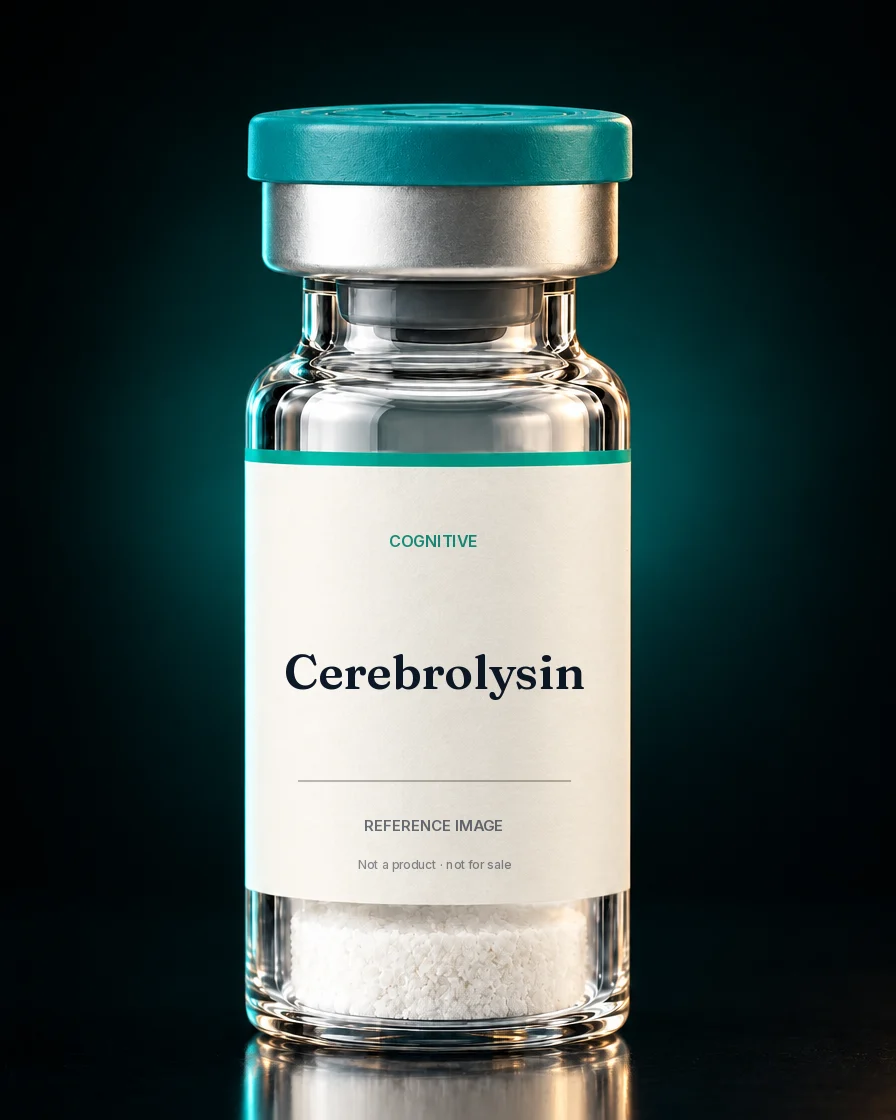
Unbranded reference image. Amiravo does not produce, supply or sell this compound.
Specifications
- Format
- Lyophilized vial
- Vial sizes seen
- 60 mg
- Other forms seen
- Liquid ampoules/vials 215.2 mg/mL (clinical product)
- Type
- Single compound
Chemical identifiers are shown only when verified against PubChem.
Research stats
How much has been published, not how good it is.
- PubMed records
- 639
- Indexed as human research
- 328
- Animal-only research
- 203
- Randomized controlled trials
- 61
- Registered trials
- 43
- Trials with posted results
- 3
- FDA adverse-event reports (FAERS)
- 80
- NIH-funded projects naming it
- 3
Counts from title/abstract searches of PubMed, ClinicalTrials.gov, openFDA and NIH RePORTER, checked 2026-10-24. Names shared with other substances can inflate counts. FAERS reports are spontaneous and do not establish cause. Funding shows interest, not evidence. Method
Follow Cerebrolysin
See every new citation, evidence-grade or status change and correction in My Research, with optional email alerts. Free account.