Orforglipron
Also known as Foundayo · LY3502970 · LY-3502970 · OWL833 · Orforglipron calcium · GLP-1 receptor agonist 1
Orforglipron is an oral, once-daily small-molecule (non-peptide) GLP-1 receptor agonist that the FDA approved in April 2026 as Foundayo for chronic weight management in adults with obesity or overweight with a weight-related condition.
- US status
- FDA-approved
- Evidence
- Grade A
- Half-life
- Elimination half-life approximately 29 to 49 hours after an oral dose; peak concentration 4 to 8 hours post dose (label) 1.
- Class
- Oral small-molecule (non-peptide) GLP-1 receptor agonist
More
Research reference, not advice. Label quotes, not a recommendation. Amiravo sells nothing; some links are referrals.Read the full notice
Key takeaways
- Orforglipron is not a peptide: it is a small-molecule, partial and G protein-biased GLP-1 receptor agonist taken orally once daily 1,3.
- FDA approved it on April 1, 2026 as FOUNDAYO for chronic weight management in adults with obesity, or overweight with a weight-related comorbidity 1,2.
- In the 72-week ATTAIN-1 trial in adults with obesity without diabetes, mean body-weight change was -7.5% to -11.2% across doses versus -2.1% with placebo 4.
- The label carries a boxed warning on thyroid C-cell tumors, noting that orforglipron is not pharmacologically active in rats or mice and did not produce rodent tumors, so human relevance is undetermined 1.
- Orforglipron is not named in the 2026 Prohibited List text reviewed 8.
Development stage
Where Orforglipron sits between laboratory work and regulatory approval.
- PreclinicalAnimal and cell work
- Phase 1First human safety studies
- Phase 2Early efficacy signal
- Phase 3Confirmatory trials
- Approved (current)Cleared by a regulator
Stage comes from the regulatory record and ClinicalTrials.gov studies naming the compound (for compounds approved nowhere, only completed trials or trials with posted results count) (checked 2026-10-24). A registered trial is not a result.
Mechanism of action
Orforglipron binds the human GLP-1 receptor as a partial agonist biased toward G protein activation over beta-arrestin recruitment, occupying a pocket in the upper helical bundle formed by the extracellular domain, extracellular loop 2 and transmembrane helices 1, 2, 3 and 7 3.
Species selectivity
Its interaction with the primate-specific Trp33 of the receptor extracellular domain explains species-selective activity; it was tested in humanized GLP-1 receptor mice and nonhuman primates 3. The label states it is not pharmacologically active in rats or mice 1.
Pharmacokinetics
The label reports absolute bioavailability of 77% after a 0.8 mg dose, dose-proportional exposure, mean clearance of 7.15 L/hour and an elimination half-life of about 29-49 hours; it delays gastric emptying 1.
Molecular structure
PubChem CID 137319706 ↗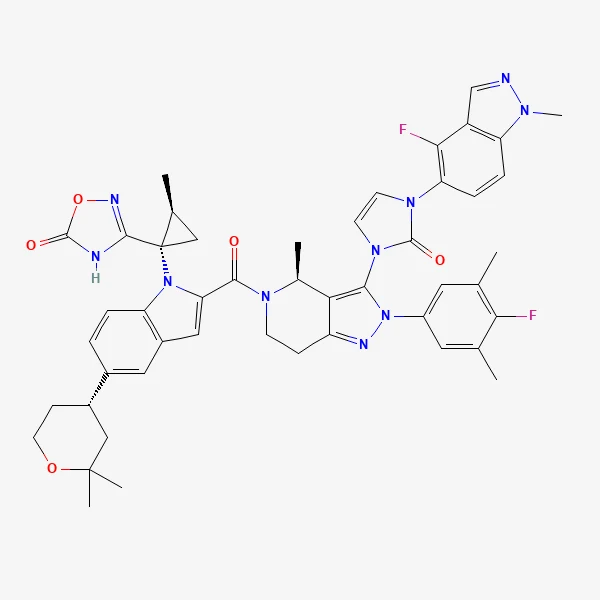
2D depiction generated from the PubChem record. Depictions are schematic and do not show salt form, counter-ions or conformation.
- Formula
- C48H48F2N10O5
- Molecular weight
- 883 g/mol
- CAS
- 2212020-52-3
- InChIKey
- USUWIEBBBWHKNI-KHIFEHGGSA-N
Research overview
Human research
Phase 3 trials in humans include ATTAIN-1 in obesity without diabetes (3127 participants, 72 weeks) 4, ACHIEVE-1 in early type 2 diabetes (559 participants, 40 weeks) 5, ACHIEVE-3 versus oral semaglutide (1698 participants, 52 weeks) 6 and the cardiovascular outcomes trial ACHIEVE-4 versus insulin glargine (2749 participants, median 2 years) 7.
Animal research
Oral administration lowered glucose in humanized GLP-1 receptor transgenic mice and had insulinotropic and food-intake-reducing effects in nonhuman primates 3.
In-vitro research
Cryo-EM and signaling studies showed partial agonism with G protein bias and high selectivity against other class B GPCRs 3.
Dosing as stated on the FDA label
Quoted from the prescribing information for reference. Prescribing decisions belong to a licensed clinician; this is not a recommendation or instruction for use.
Full dosing reference, study durations and vial arithmetic →- For chronic weight management (FOUNDAYO): start at 0.8 mg orally once daily; after at least 30 days increase to 2.5 mg, then after at least 30 days to 5.5 mg once daily 1.
- The dosage may be increased to the next level (9 mg, 14.5 mg or 17.2 mg once daily) after at least 30 days on the current dosage based on response and tolerability; the maximum is 17.2 mg once daily, and no more than one tablet should be taken per day 1.
- With a strong CYP3A4 inhibitor the maximum dosage is 9 mg once daily; strong CYP3A4 inhibitors that also inhibit OATP1B and strong CYP3A4 inducers should be avoided 1.
- If 7 or more consecutive doses are missed, the label advises reinitiating escalation at a lower dosage 1.
- Label efficacy and safety data come from an investigational orforglipron formulation presented as equivalent FOUNDAYO dosages; the trial publications report capsule doses (for example 36 mg), which ACHIEVE-4 states is equivalent to the 17.2 mg tablet 1,7.
Background viewing
We haven't found a clinician video focused on Orforglipron yet. Meanwhile, this widely watched talk covers the science of aging in general. It does not discuss Orforglipron.
These creators are not affiliated with Amiravo and do not endorse Amiravo or any product linked on this site. Nothing here is medical advice. Video views counted on YouTube as of Oct 24, 2026.
Regulatory status
- Status
- FDA-approved as FOUNDAYO tablets (NDA 220934, original approval April 1, 2026) for reducing excess body weight and maintaining reduction long term in adults with obesity, or overweight with at least one weight-related comorbid condition, with diet and physical activity; the label is current as of the August 13, 2026 DailyMed version and does not include a type 2 diabetes indication 1,2.
- United States (FDA)
- FDA-approved under NDA 220934 (FOUNDAYO, Eli Lilly and Co.), original approval April 1, 2026, per Drugs@FDA records retrieved 2026-10-24 2; label reviewed from the August 13, 2026 DailyMed version 1.
- Sport (WADA)
- Orforglipron is not named in the 2026 Prohibited List text reviewed; it is not a peptide hormone and, being approved, is outside the S0 non-approved class 8.
Status varies by country and changes over time. How we describe regulatory status.
Quality and testing notes
Orforglipron is a small molecule supplied as a film-coated calcium-salt tablet; material described as research-grade orforglipron would be expected to show identity against the free-acid formula C48H48F2N10O5 (PubChem MW about 883.0) or the calcium salt (label MW 902.0) [1, 9].
How purity testing works · Reading a certificate of analysis
Check a Orforglipron certificate of analysis against its expected mass (883 Da)Storage and handling
Store approved tablets as directed in the current label; research materials per supplier documentation.
Frequently asked questions
Is orforglipron a peptide?
Is orforglipron FDA-approved?
What is it approved for?
How does it differ from injectable GLP-1 drugs?
How large were body-weight changes in trials?
What are the common side effects?
What is its half-life?
Is it banned in sport?
Latest indexed research
- Establishing cardiovascular safety of the small-molecule GLP-1 receptor agonist orforglipron in type 2 diabetes.Other · Lancet (London, England) · 2026-10-17
- Cardiovascular safety of orforglipron versus insulin glargine in adults with type 2 diabetes at increased cardiovascular risk (ACHIEVE-4): a phase 3, event-driven, randomised, open-label, non-inferiority, active comparator trial.RCT · humans · Lancet (London, England) · 2026-10-17
- Study design, rationale, and baseline characteristics of ATTAIN-HYPERTENSION, a phase 3 trial of the oral GLP-1 receptor agonist orforglipron for hypertension.Other · American journal of preventive cardiology · 2026-08-06
Listed by publication type from the index record. Inclusion is not an endorsement; open the source to read the findings.
Revision history
Meaningful changes to this entry, with dates and sources. Last reviewed Oct 24, 2026. Typo and layout fixes are not listed.
- New section· entryOct 24, 2026
New research reference added: Orforglipron.
Last reviewed October 24, 2026 by the Amiravo editorial team.
Need the math?
Laboratory arithmetic with every formula shown.
For research use only. Not for human or veterinary use. Not a drug, food, or dietary supplement. This page is educational and is not medical advice.
Unbranded reference image. Amiravo does not produce, supply or sell this compound.
Specifications
- Molecular formula
- C48H48F2N10O5
- Molecular weight
- 883 g/mol
- CAS number
- 2212020-52-3
- PubChem CID
- 137319706
- ChEMBL
- CHEMBL4446782
- Type
- Single compound
Identifiers from PubChem. Verify against the supplier’s documentation for your lot.
Research stats
How much has been published, not how good it is.
- PubMed records
- 151
- Indexed as human research
- 90
- Animal-only research
- 0
- Randomized controlled trials
- 19
- Registered trials
- 54
- Trials with posted results
- 29
- FDA adverse-event reports (FAERS)
- 5
Counts from title/abstract searches of PubMed, ClinicalTrials.gov, openFDA and NIH RePORTER, checked 2026-10-24. Names shared with other substances can inflate counts. FAERS reports are spontaneous and do not establish cause. Funding shows interest, not evidence. Method
Follow Orforglipron
See every new citation, evidence-grade or status change and correction in My Research, with optional email alerts. Free account.