Teduglutide
Also known as Gattex · Revestive · ALX-0600 · [Gly2]-GLP-2 · Glucagon-like peptide II (2-glycine) (human) · GLP-2 analog
Teduglutide is a 33-amino-acid GLP-2 analog, FDA-approved since 2012 as Gattex for adults and children aged 1 year and older with short bowel syndrome who depend on parenteral support.
- US status
- FDA-approved
- Evidence
- Grade A
- Half-life
- Mean terminal half-life approximately 2 hours in healthy subjects and 1.3 hours in people with SBS; cleared mainly by the kidney (label) 1.
- Class
- Glucagon-like peptide-2 (GLP-2) analog
More
Research reference, not advice. Label quotes, not a recommendation. Amiravo sells nothing; some links are referrals.Read the full notice
Key takeaways
- Teduglutide is a GLP-2 analog approved for short bowel syndrome in people aged 1 year and older who depend on parenteral support 1.
- In the STEPS trial in adults, 63% versus 30% achieved more than 20% reduction in weekly parenteral support volume at weeks 20 and 24 3.
- Because of its growth-promoting action and rodent tumor findings, the label warns of possible acceleration of neoplastic growth and requires colonoscopy and upper GI endoscopy before and during treatment in adults 1.
- Other label warnings include intestinal obstruction, gallbladder, biliary and pancreatic disease, fluid overload including heart failure, and increased absorption of oral medicines 1.
- Teduglutide is not named in the 2026 Prohibited List text reviewed 4.
Development stage
Where Teduglutide sits between laboratory work and regulatory approval.
- PreclinicalAnimal and cell work
- Phase 1First human safety studies
- Phase 2Early efficacy signal
- Phase 3Confirmatory trials
- Approved (current)Cleared by a regulator
Stage comes from the regulatory record and ClinicalTrials.gov studies naming the compound (for compounds approved nowhere, only completed trials or trials with posted results count) (checked 2026-10-24). A registered trial is not a result.
Mechanism of action
Teduglutide is an analog of GLP-2, a peptide secreted by L-cells of the distal intestine that increases intestinal and portal blood flow and inhibits gastric acid secretion 1.
Receptor actions
It binds GLP-2 receptors on intestinal enteroendocrine cells, subepithelial myofibroblasts and enteric neurons, leading to local release of IGF-1, nitric oxide and keratinocyte growth factor 1.
Clinical correlate
In STEPS, teduglutide raised plasma citrulline, a biomarker of mucosal mass, alongside reductions in parenteral support 3.
Molecular structure
PubChem CID 16139605 ↗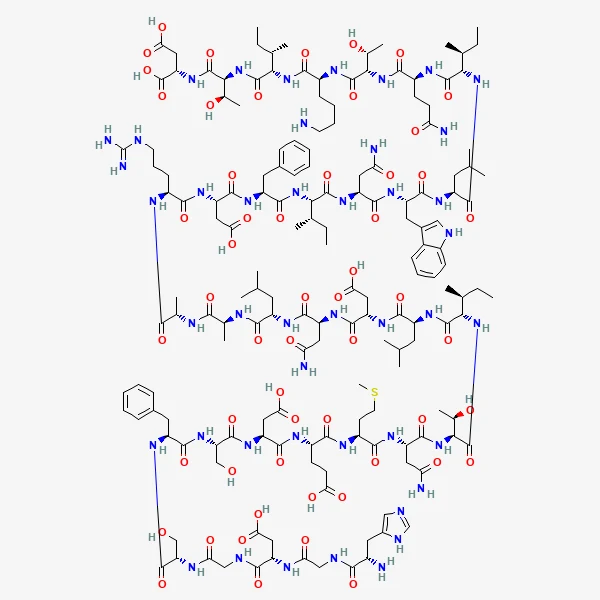
2D depiction generated from the PubChem record. Depictions are schematic and do not show salt form, counter-ions or conformation.
- Formula
- C164H252N44O55S
- Molecular weight
- 3752.1 g/mol
- CAS
- 197922-42-2
- InChIKey
- CILIXQOJUNDIDU-ASQIGDHWSA-N
Research overview
Human research
Two 24-week randomized, double-blind, placebo-controlled trials in adults with SBS (Study 1/STEPS, n = 86; Study 3, n = 84 across three groups) and their extensions support the label, along with 24-week and 12-week pediatric studies in 41 children aged 1 to under 17 years 1,3.
Animal research
In 2-year subcutaneous studies, teduglutide increased adenomas in the bile duct and jejunum of male rats and papillary gallbladder adenomas in mice, with jejunal adenocarcinomas in male mice at the high dose 1.
In-vitro research
Not reviewed separately for this entry.
Key studies
- Randomized, double-blind, placebo-controlled, 24 weeksModel: Humans (86 adults with SBS and intestinal failure)
Responders 63% versus 30% (P = .002); mean parenteral support reduction 4.4 versus 2.3 L/week; 54% versus 23% gained at least one day off per week 3.
- Open-label and blinded uncontrolled extensionsModel: Humans (adults with SBS)
Of 30 patients completing 30 months, 93% had at least 20% reduction in parenteral support and 10 were weaned off; in Study 4, 75% of earlier responders sustained response at 1 year 1.
- 24-week and 12-week studies with extensionsModel: Humans (41 children aged 1 to under 17 with SBS)
Safety profile similar to adults; anti-teduglutide antibodies in 54% at month 12 versus 24% in adults 1.
Dosing as stated on the FDA label
Quoted from the prescribing information for reference. Prescribing decisions belong to a licensed clinician; this is not a recommendation or instruction for use.
Full dosing reference, study durations and vial arithmetic →- Short bowel syndrome dependent on parenteral support (GATTEX): 0.05 mg/kg subcutaneously once daily for adults and pediatric patients aged 1 year and older 1.
- Moderate or severe renal impairment or end-stage renal disease (eGFR below 60 mL/min/1.73 m2): 0.025 mg/kg once daily 1.
- The label requires baseline colonoscopy and upper GI endoscopy with polyp removal (adults) or fecal occult blood testing (children) within 6 months before starting, plus bilirubin, alkaline phosphatase, lipase and amylase at baseline and every 6 months 1.
- Twice the recommended dose (0.1 mg/kg/day), tested in Study 3, is not a recommended dosage per the label 1.
Background viewing
We haven't found a clinician video focused on Teduglutide yet. Meanwhile, this widely watched talk covers the science of aging in general. It does not discuss Teduglutide.
These creators are not affiliated with Amiravo and do not endorse Amiravo or any product linked on this site. Nothing here is medical advice. Video views counted on YouTube as of Oct 24, 2026.
Regulatory status
- Status
- FDA-approved as GATTEX (NDA 203441, original approval December 21, 2012) for adults and pediatric patients 1 year of age and older with short bowel syndrome who are dependent on parenteral support; label reviewed from the September 18, 2025 DailyMed version 1,2.
- United States (FDA)
- FDA-approved under NDA 203441 (GATTEX KIT, Takeda), original approval December 21, 2012 per Drugs@FDA 2; current indication per the September 2025 label covers adults and children aged 1 year and older with SBS dependent on parenteral support 1.
- Sport (WADA)
- Teduglutide is not named in the 2026 Prohibited List text reviewed; as an approved drug it is outside S0, but S2.3 covers other growth factors or modulators affecting tissue regenerative capacity, so status should be confirmed with the relevant anti-doping organization 4.
Status varies by country and changes over time. How we describe regulatory status.
Quality and testing notes
Identity can be confirmed against the 33-residue sequence with Gly at position 2 (PubChem formula C164H252N44O55S, MW about 3752) by mass spectrometry, with HPLC purity, host-cell protein and endotoxin testing for recombinant material [1, 5].
How purity testing works · Reading a certificate of analysis
Check a Teduglutide certificate of analysis against its expected mass (3,752.1 Da)Storage and handling
Follow the current GATTEX label for kit storage and the reconstituted solution; research material per supplier documentation.
Frequently asked questions
What is teduglutide approved for?
How does teduglutide differ from GLP-1 drugs?
How much did it reduce parenteral support in trials?
Why are colonoscopies required?
What is its half-life?
Is teduglutide banned in sport?
Latest indexed research
- Teduglutide for intestinal failure following multivisceral transplantation complicated by graft rejection and PTLD: A case report.Case report · Intestinal Failure (New York, N.Y.) · 2026-10-14
Listed by publication type from the index record. Inclusion is not an endorsement; open the source to read the findings.
Revision history
Meaningful changes to this entry, with dates and sources. Last reviewed Oct 24, 2026. Typo and layout fixes are not listed.
- New section· entryOct 24, 2026
New research reference added: Teduglutide.
References
- GATTEX (teduglutide) for injection, prescribing information (DailyMed SPL version 20, published Sep 18, 2025) FDA label (DailyMed). 2025
- Drugs@FDA application NDA 203441 (GATTEX KIT, Takeda; original approval 2012-12-21) via openFDA FDA (openFDA Drugs@FDA). 2026
- Teduglutide reduces need for parenteral support among patients with short bowel syndrome with intestinal failure Gastroenterology. 2012
- Tractatenblad 2026 Nr. 25: Anti-doping convention (ETS No. 135), amendment to the appendix - The 2026 Prohibited List, World Anti-Doping Code (English text; entry into force 1 January 2026) Tractatenblad van het Koninkrijk der Nederlanden (official government publication). 2026
- PubChem compound record for teduglutide (CID 16139605) PubChem. 2026
Last reviewed October 24, 2026 by the Amiravo editorial team.
Need the math?
Laboratory arithmetic with every formula shown.
For research use only. Not for human or veterinary use. Not a drug, food, or dietary supplement. This page is educational and is not medical advice.
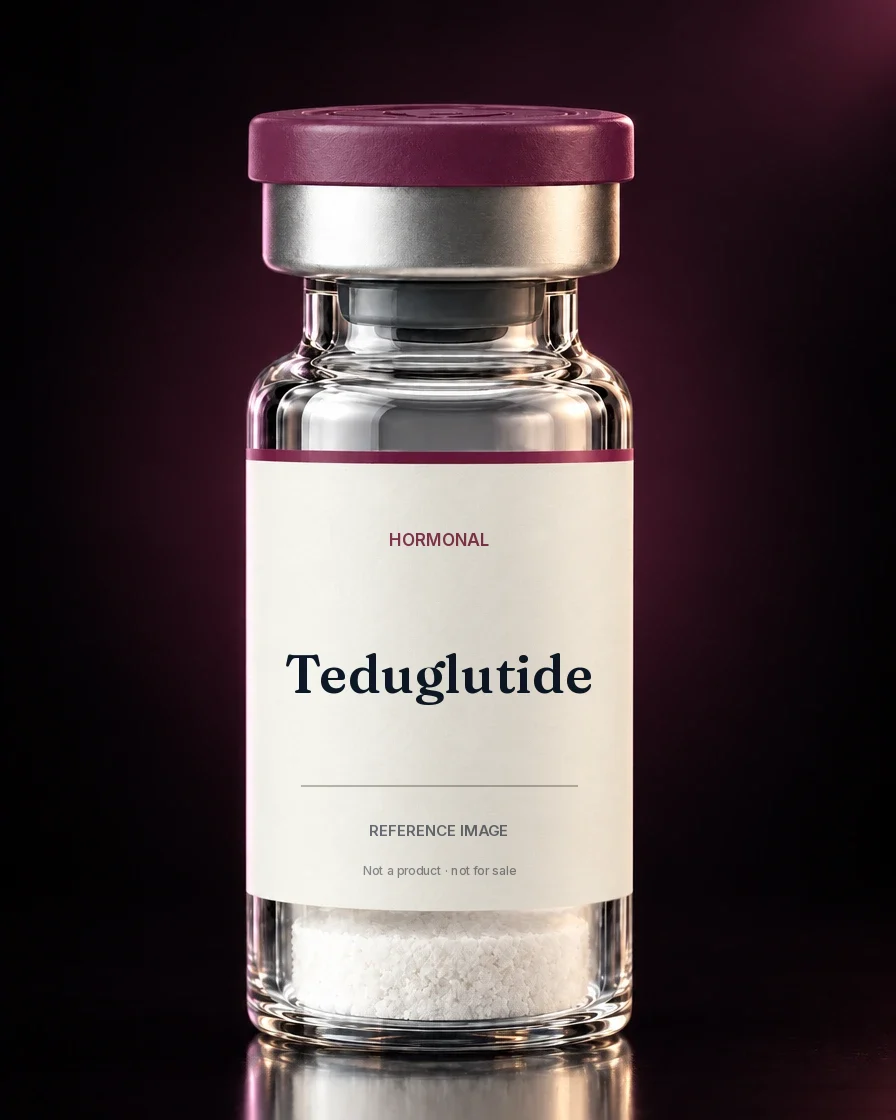
Unbranded reference image. Amiravo does not produce, supply or sell this compound.
Specifications
- Molecular formula
- C164H252N44O55S
- Molecular weight
- 3,752.1 g/mol
- CAS number
- 197922-42-2
- PubChem CID
- 16139605
- FDA UNII
- 7M19191IKG
- Sequence
- HGDGSFSDEMNTILDNLAARDFINWLIQTKITD
- Type
- Single compound
Identifiers from PubChem. Verify against the supplier’s documentation for your lot.
Research stats
How much has been published, not how good it is.
- PubMed records
- 365
- Indexed as human research
- 258
- Animal-only research
- 21
- Randomized controlled trials
- 22
- Registered trials
- 50
- Trials with posted results
- 20
- FDA adverse-event reports (FAERS)
- 9,301
- NIH-funded projects naming it
- 32
Counts from title/abstract searches of PubMed, ClinicalTrials.gov, openFDA and NIH RePORTER, checked 2026-10-24. Names shared with other substances can inflate counts. FAERS reports are spontaneous and do not establish cause. Funding shows interest, not evidence. Method
Follow Teduglutide
See every new citation, evidence-grade or status change and correction in My Research, with optional email alerts. Free account.