HHS says it will not take enforcement action against pharmacies compounding BPC-157 and five other peptides, under conditions
An interim HHS enforcement policy announced on 28 October 2026 covers 503A compounding of BPC-157, TB-500, MOTS-c, KPV, Semax and epitalon. It is not FDA approval, and none of the six is on the 503A bulks list.
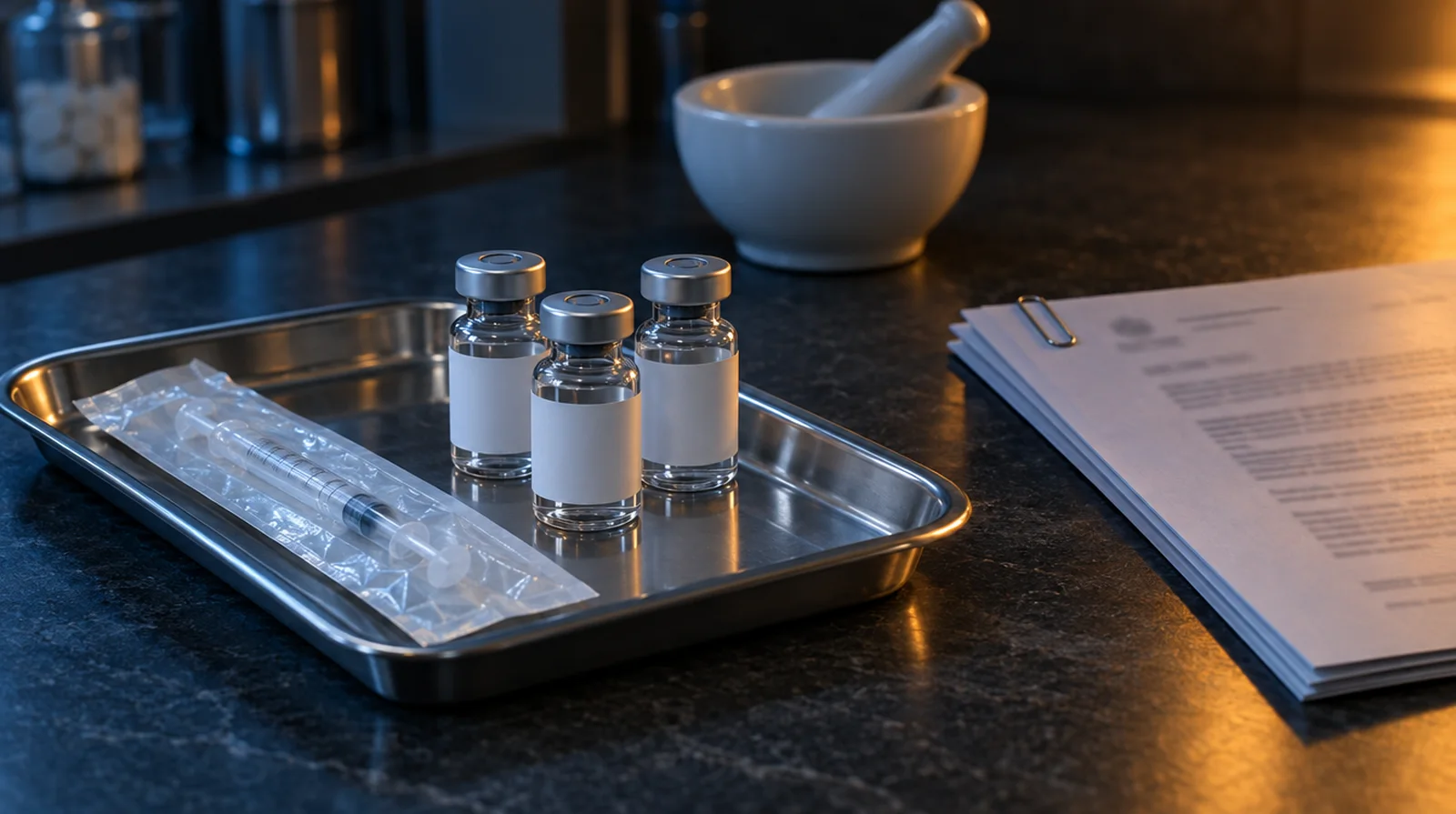
On 28 October 2026 the US Department of Health and Human Services (HHS) announced an interim enforcement policy under which it does not intend to take action against state-licensed pharmacies, federal facilities or licensed physicians that compound drugs from six unapproved peptides: BPC-157, epitalon, KPV, MOTS-c, Semax and TB-500 1,2. The policy is not an FDA approval of any of the six, and none of them has been added to FDA's list of bulk substances that may be used in compounding 1,3.
What HHS announced
The notice, signed by HHS Secretary Robert F. Kennedy Jr., was filed for public inspection at the Federal Register on 28 October and is scheduled for publication on 30 October (FR Doc. 2026-22192, Docket HHS-OASH-2026-0496) 1. The Federal Register notice describes the policy as a draft open for comment; HHS calls it an interim policy 1,2. It covers compounding under section 503A of the Federal Food, Drug, and Cosmetic Act, which applies to state-licensed pharmacies, federal facilities and licensed physicians compounding for individual patients, while FDA builds the 503A bulks list through rulemaking 1.
HHS states that compounded drugs are not FDA-approved, that FDA does not review their safety, effectiveness or quality before they are marketed, and that they may pose risks to patients 1. It cites the July 2026 Pharmacy Compounding Advisory Committee meetings and data on peptide use as showing significant interest in these peptides, and says the policy is meant to expand and improve patient access 1. HHS may revisit the policy in whole or in part if a safety signal or product-quality issue arises, and the document is not binding on HHS or the public 1.
Conditions in the policy
The policy applies only when a set of conditions is met 2. They include 2:
- a patient-specific prescription;
- a single peptide per product (no combinations);
- a bulk substance whose original manufacturer (not a repackager) is registered with FDA and complies with current good manufacturing practice, with the manufacturer's location stated on the certificate of analysis;
- a valid certificate of analysis that characterizes and identifies the substance and reports test results for identity, purity, potency and the absence of harmful contaminants;
- for oral products, documentation that the formulation achieves adequate oral bioavailability in humans;
- reporting of serious adverse events and product-quality problems through FDA's MedWatch system and to the states, along with reporting of the products compounded, and patient labeling that explains how to report problems;
- a label stating "This is a compounded drug product. Not for resale."; and
- no delivery device packaged with the product other than an FDA 510(k)-cleared syringe.
The policy also limits each peptide to specific routes; the oral routes for BPC-157 and KPV are subject to the oral-bioavailability condition above 2:
- BPC-157: subcutaneous, intramuscular, oral or topical
- TB-500: subcutaneous or intramuscular
- MOTS-c: subcutaneous or intramuscular
- Epitalon: subcutaneous or intramuscular, in intermittent courses
- Semax: intranasal
- KPV: topical or oral
The policy sets conditions for compounders. It does not state amounts, and Amiravo does not publish amounts for compounds that no regulator has approved.
How it got here
FDA's Pharmacy Compounding Advisory Committee reviewed seven peptides on 23 and 24 July 2026 4. STAT and Reuters reported that the committee voted to recommend that pharmacies be allowed to compound six of the peptides 3,6. Advisory committee recommendations are not binding on FDA 4. In its briefing documents for the meeting, FDA proposed that none of the seven be included on the 503A bulks list 5, and the HHS policy notes that FDA's drug center recommended against listing 2. An "Interim Access Policy for Compounding Using Certain Peptides" (RIN 0910-ZD94) went to White House review in mid-October, and OIRA records meetings on it between 21 and 27 October 7; the 28 October notice carries the same RIN 1.
According to Reuters, HHS said the policy is meant to discourage widespread use of "research use only" peptides from foreign manufacturers, which it described as a safety risk 3. Reuters also reported that several committee members had ties to peptide businesses or clinics, and that HHS said all had cleared standard ethics checks 3.
What it does not change
- None of the six is FDA-approved, and compounded products made under the policy are not FDA-approved drugs 1.
- None of the six is on the 503A bulks list; FDA's future rulemaking may propose adding some or all of them 1.
- The policy applies only to 503A compounders; it sets no policy for outsourcing facilities under section 503B 1,2.
- State pharmacy boards keep their oversight of compounding, and Jeff Cohen, co-founder of the American Peptide Association, told Reuters that states may not follow the federal move 3.
- Products labeled "for research use only" are not covered; the policy concerns compounding by licensed pharmacies and physicians from bulk substances that meet its manufacturer and certificate-of-analysis conditions 2.
- Sport rules are unchanged: WADA's Prohibited List names BPC-157 under S0 (non-approved substances) and thymosin beta-4 and its derivatives, which include TB-500, under S2; WADA notes that peptides not named on the list may still be prohibited 8 (see the WADA tracker).
Comments
HHS is accepting written comments on regulations.gov under Docket HHS-OASH-2026-0496 until two weeks after the notice is published in the Federal Register 1. The current version of the policy is posted on the HHS website 2.
Amiravo's 503A peptide tracker and the compound pages for the six peptides have been updated with this change.
Frequently asked questions
Did FDA approve BPC-157?
Which peptides are covered?
Does the policy cover research-use-only peptides sold online?
Can the policy change?
References
- Enforcement Discretion Policy Regarding 503A Compounding Using Certain Peptide Bulk Drug Substances (notice of availability, FR Doc. 2026-22192, public inspection 28 Oct 2026) Federal Register. 2026
- Enforcement Discretion Policy Regarding 503A Compounding Using Certain Peptide Bulk Drug Substances, with Appendices A and B (PDF) US Department of Health and Human Services. 2026
- US health department to allow temporary sale of some unapproved peptides Reuters (28 Oct 2026). 2026
- July 23-24, 2026 Meeting of the Pharmacy Compounding Advisory Committee US Food and Drug Administration. 2026
- FDA briefing document, Pharmacy Compounding Advisory Committee, July 2026: introduction US Food and Drug Administration. 2026
- HHS moves to allow compounding of some unapproved peptides STAT (28 Oct 2026). 2026
- Interim Access Policy for Compounding Using Certain Peptides (RIN 0910-ZD94) Reginfo.gov (OIRA). 2026
- World Anti-Doping Code International Standard: Prohibited List 2026 (PDF) World Anti-Doping Agency. 2025
For research use only. Not for human or veterinary use. Not a drug, food, or dietary supplement. This article is educational and is not medical advice.