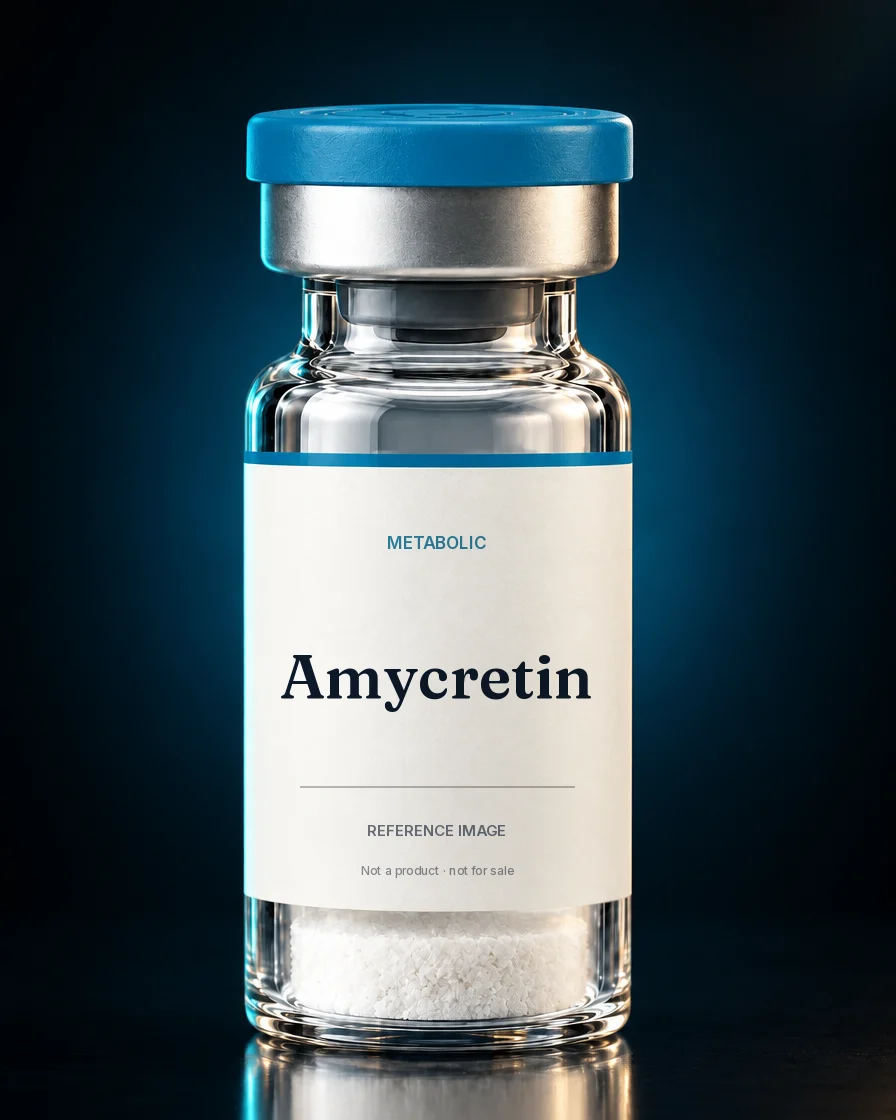
 Metabolic · Dosing reference
Amycretin dosage
Doses given in registered human trials, how long they ran, and the arithmetic for working with vials.
- Regulatory status
- Investigational
- Human amounts
- Subcutaneous: 0.3 mg escalated up to 1.25–60 mg once weekly (phase 1b/2a); 0.2 mg start to maintenance 0.4–40 mg once weekly (phase 2, T2D). Oral: 1.5 mg start to 6, 25 or 50 mg once daily (phase 2, T2D); up to 2 × 50 mg daily in phase 1
- Route studied
- Subcutaneous injection or oral tablet
- Frequency
- Once weekly (subcutaneous); once daily (oral)
- Half-life
- Geometric mean terminal half-life of 88.1 hours after a single 0.3 mg subcutaneous dose in participants with normal renal function (94.0–112.8 hours with renal impairment)
- Evidence grade
- Grade A · Human trial evidence
- Vial sizes on the market
- Not recorded
- Other forms seen
- —
What Amycretin is
Amycretin (now also called zenagamtide) is an investigational single-molecule peptide that activates both GLP-1 and amylin receptors. It has been studied in subcutaneous and oral forms in phase 1 and phase 2 randomized trials, and phase 3 trials are registered. It is not an approved medicine, and this entry is for research information only.
Amycretin is a 68-amino-acid peptide with an average molecular weight of 7847 Da in which a GLP-1 receptor agonist portion and an amylin receptor agonist portion are connected by a linker of four glycine residues and one glutamic acid residue 5. It is acylated with a C18 diacid-based side chain on the GLP-1 portion, which the developers state enables reversible albumin binding and a long systemic half-life 5.… How it works →
Key evidence
- Dahl et al., Lancet · 2025 · Humans (125 adults with overweight or obesity)
- Mora et al., Lancet (subcutaneous) · 2026 · Humans (262 adults with type 2 diabetes)
- Mora et al., Lancet (oral) · 2026 · Humans (186 adults with type 2 diabetes)
Schedules by time period
study arms from registered trials, laid out week by week. Each bar is what the label states or what investigators gave participants; none is a recommendation.
Phase 1b/2a subcutaneous trial (NCT06064006): multiple-ascending-dose parts 2
Adults 18-55 years with BMI 27.0-39.9 (125 randomized across Parts A-E) · 36 weeks
- 60 mg · Timing not reported
Escalated from 0.3 mg to 60 mg over a total treatment duration of 36 weeks; intermediate steps and the length of the 60 mg period not reported in the cited source.
Week-by-week table
| Period | Amount |
|---|---|
| Weeks 24–36 | 20 mg (maintenance) |
Escalated from 0.3 mg; maintenance dose sustained for the last 12 weeks of 36. Intermediate escalation steps not reported in the cited source.
Week-by-week table
| Period | Amount |
|---|---|
| Weeks 16–28 | 5 mg (maintenance) |
Escalated from 0.3 mg; maintenance dose sustained for the last 12 weeks of 28. Intermediate escalation steps not reported in the cited source.
Week-by-week table
| Period | Amount |
|---|---|
| Weeks 8–20 | 1.25 mg (maintenance) |
Escalated from 0.3 mg; maintenance dose sustained for the last 12 weeks of 20. Intermediate escalation steps not reported in the cited source.
Part A was a single ascending dose part. Duration varies by part (36, 36, 28 and 20 weeks for Parts B-E).
Phase 2 type 2 diabetes trial (NCT06542874): subcutaneous arms 3
Adults 18-75 years with type 2 diabetes (HbA1c 7.0-10.0%) on metformin with or without an SGLT2 inhibitor, BMI 23.0 to under 50.0 (262 randomized to subcutaneous zenagamtide or placebo) · 36 weeks
- 0.4 mg · Maintenance (start not reported)
- 1.5 mg · Maintenance (start not reported)
- 5 mg · Maintenance (start not reported)
- 10 mg · Maintenance (start not reported)
- 20 mg · Maintenance (start not reported)
- 40 mg · Maintenance (start not reported)
Zenagamtide is the new name for amycretin. Starting dose 0.2 mg with dose escalations every 4 weeks until the maintenance dose was reached; the intermediate amounts and the week each maintenance dose was reached are not reported in the cited source.
Phase 2 type 2 diabetes trial (NCT06542874): oral arms 4
Adults 18-75 years with type 2 diabetes (HbA1c 7.0-10.0%) on metformin with or without an SGLT2 inhibitor (186 randomized to oral zenagamtide or placebo) · 36 weeks
- 6 mg · Maintenance (start not reported)
- 25 mg · Maintenance (start not reported)
- 50 mg · Maintenance (start not reported)
Starting dose 1.5 mg with dose escalations every 4 weeks until the maintenance dose was reached; intermediate amounts not reported in the cited source.
Doses given in human trials
- In the subcutaneous phase 1b/2a study (NCT06064006), once-weekly amycretin was escalated from 0.3 mg to 60 mg over 36 weeks in Part B, and from 0.3 mg to maintenance doses of 20 mg (36 weeks), 5 mg (28 weeks) or 1.25 mg (20 weeks) in Parts C to E 2.
- In the subcutaneous phase 2 trial in type 2 diabetes (NCT06542874), participants were randomized 6:1 to once-weekly amycretin or placebo and then to maintenance doses of 0.4, 1.5, 5, 10, 20 or 40 mg, starting at 0.2 mg with escalation every 4 weeks 3.
- In the oral phase 2 trial in type 2 diabetes, participants were randomized 5:1 to once-daily oral amycretin or placebo with maintenance doses of 6, 25 or 50 mg, starting at 1.5 mg with escalation every 4 weeks 4.
- In the oral first-in-human study (NCT05369390), single doses of 1 to 25 mg, 10-day multiple doses of 3 to 12 mg once daily, and 12-week fixed titration regimens up to two 50 mg tablets in a single daily dose were tested 1.
- In a single-dose renal impairment study (NCT06559527), 42 adults (14 with normal renal function and 7 per renal impairment group, including end-stage renal disease) received one subcutaneous 0.3 mg dose with 4 weeks of follow-up 11.
- The subcutaneous phase 2 trial in type 2 diabetes randomized 262 participants: 38 to 0.4 mg, 36 to 1.5 mg, 37 to 5 mg, 38 to 10 mg, 38 to 20 mg, 38 to 40 mg and 37 to placebo 3.
- The oral phase 2 trial in type 2 diabetes randomized 186 participants: 54 to 6 mg, 51 to 25 mg, 51 to 50 mg and 30 to placebo 4.
- In the subcutaneous phase 1b/2a study, 125 participants were randomized (101 to amycretin, 24 to placebo); Parts C to E sustained the maintenance dose for the last 12 weeks 2.
- In the oral first-in-human study, 144 participants were enrolled (48 in Part A, 36 in Part B, 60 in Part C/D); the Part C/D fixed-titration groups went from 3 mg to 50 mg, from 6 mg to 2 × 50 mg, and from 3 mg to 2 × 25 mg once daily 1.
- Phase 3 registrations under the name zenagamtide include AMAZE 7 (NCT07668414; once-weekly subcutaneous zenagamtide versus two semaglutide doses, primary endpoint at week 84, estimated 650), AMAZE 9 (NCT07720271; one of 5 oral once-daily dose levels versus placebo, week 76, estimated 950), AMBITION 7 (NCT07797335; once-weekly subcutaneous versus insulin glargine in type 2 diabetes, week 52, estimated 1,778) and AMBIENCE (NCT07861100; once-weekly subcutaneous with dose escalation versus placebo in atherosclerotic cardiovascular disease, estimated 8,500); dose amounts are not stated in the registry fields 6,12,13,7.
How long did human studies run?
- Phase 2 subcutaneous and oral trials in type 2 diabetes: 3-week screening, 36-week intervention and 4-week follow-up 3,4.
- Subcutaneous phase 1b/2a: 36 weeks (Part B, to 60 mg; Part C, to 20 mg), 28 weeks (Part D, 5 mg) and 20 weeks (Part E, 1.25 mg) 2. Oral first-in-human: single dose with 21-day follow-up (Part A), 10 days of dosing (Part B), 12 weeks of dosing with 3-week follow-up (Part C/D) 1.
Who was excluded from the studies
- Phase 2 (NCT06542874) registry exclusion criteria include any diabetes or obesity medication other than those allowed within 90 days before screening, uncontrolled and potentially unstable diabetic retinopathy or maculopathy, and known hypoglycaemic unawareness 14.
- The phase 2 trials enrolled adults aged 18–75 years with type 2 diabetes (HbA1c 7.0–10.0%) on stable metformin with or without an SGLT2 inhibitor and BMI 23.0 to under 50.0 3,4; the phase 1 studies enrolled adults aged 18–55 years with BMI 25.0–39.9 depending on study part 1,2.
Side effects reported in studies
- Treatment-emergent adverse events (any)89 of 144 participants (62%); gastrointestinal events made up 180 of 364 events (49%) · Oral first-in-human phase 1 1
- Gastrointestinal adverse eventsMost common event type (rates per group not given in the abstract) · Subcutaneous phase 1b/2a, overweight or obesity 2
- Serious adverse events21 of 261 participants (8%) overall, including 3 in the placebo group · Subcutaneous phase 2, type 2 diabetes 3
- Gastrointestinal adverse events26% (6 mg), 41% (25 mg), 47% (50 mg) versus 23% placebo · Oral phase 2, type 2 diabetes 4
- Serious adverse events7 of 186 participants (4%) receiving oral amycretin; none with placebo · Oral phase 2, type 2 diabetes 4
Amycretin draw calculator
Pick the vial strength and the water added, enter an amount, and see the concentration, the units to draw and how many draws the vial holds. Arithmetic only.
Computed from your inputs. Not a dose or a recommendation.
Compare water volumes for this vialShow
More water = lower concentration = a larger, easier-to-measure draw. Tap a row to use it.
| Water | mg/mL | Draw |
|---|---|---|
| 0.5 mL | 20 | — |
| 1 mL | 10 | — |
| 1.5 mL | 6.667 | — |
| 2 mL | 5 | — |
| 2.5 mL | 4 | — |
| 3 mL | 3.333 | — |
| 5 mL | 2 | — |
Supplies and handling
- Lyophilized vialSealed vial with the freeze-dried cake. Check the label, lot and the certificate of analysis before opening.
- Sterile diluentThe diluent named on the product documentation. Bacteriostatic water contains benzyl alcohol; sterile water does not.
- Graduated syringesSized to the volume being measured. U-100 insulin syringes are graduated in units where 100 units = 1 mL.
- Alcohol prep padsFor wiping vial stoppers before each puncture.
- Nitrile glovesClean gloves for aseptic handling.
- Sharps containerPuncture-resistant container for used needles.
Storage
Storage conditions for research material are set by the supplier's documentation; lyophilized peptides are generally sensitive to heat, light and moisture.
- Lyophilized (unmixed) vials: typically stored cold and dry, away from light, as the documentation directs. Many are stable longer frozen.
- Reconstituted vials: typically refrigerated (about 2–8 °C), protected from light and not frozen.
- Bacteriostatic water contains benzyl alcohol, which inhibits bacterial growth in multi-use vials; sterile water has no preservative.
Handling mistakes and troubleshooting
- Added the wrong volume of diluent
- The concentration changes, not the amount of compound in the vial. Recalculate with the volume actually added and relabel the vial.
- Shook the vial and it foamed
- Let it settle in the refrigerator. Foam is a sign of agitation; some peptides aggregate when shaken. Note it on the label.
- The solution is cloudy or has particles
- Do not use it. Cloudiness can indicate incomplete dissolution, contamination or degradation. Record the lot and contact the supplier with the certificate of analysis.
- The powder cake looks melted or shrunken before reconstitution
- This can indicate the vial was exposed to heat or moisture. Record the lot and condition on arrival.
- Liquid sprayed back when the needle was removed
- Pressure built up in the vial. Withdraw a small volume of air while adding diluent to keep pressure neutral.
Regulatory status
- Status
- Investigational. The 2026 phase 2 reports describe zenagamtide (formerly amycretin) as a novel agent 3,4, phase 3 trials are registered under the zenagamtide name 6,7, and an openFDA query of Drugs@FDA on 22 October 2026 returned no application record for either name 8.
- United States (FDA)
- Amycretin (zenagamtide) is investigational; openFDA queries of Drugs@FDA application data on 22 October 2026 returned no application record under either name 8, and phase 3 trials were registered 6,7.
- Sport (WADA)
- Amycretin is not named in the 2026 Prohibited List text reviewed. The list's S0 class covers pharmacological substances not addressed elsewhere that have no current approval by any governmental regulatory health authority, including drugs in clinical development; athletes should consult WADA directly 10.
Status varies by country and changes over time. How we describe regulatory status.
Amycretin compared with related compounds
| Compound | Status | Evidence | Human amounts | Half-life |
|---|---|---|---|---|
| Amycretin | Investigational | A | Trial doses | Geometric mean terminal half-life of 88. |
| Tesofensine | Investigational | B | Trial doses | About 234 hours (M1 metabolite about 374 |
| Mazdutide | Approved outside the US | A | Trial doses | 150.9 to 403.5 hours (phase 1b in overwe |
| Cagrilintide | Investigational | A | Trial doses | 159 to 195 hours (phase 1b, co-administe |
| SLU-PP-332 | Not approved — research use only | C | None established | Unknown in humans |
| MariTide (maridebart cafraglutide) | Investigational | A | Trial doses | Not reported numerically in the sources |
Frequently asked questions
What doses of Amycretin have been studied in humans?
Is there an established Amycretin cycle length?
How much bacteriostatic water should be added to a Amycretin vial?
How many units is a given amount on an insulin syringe?
What is the half-life of Amycretin?
Is Amycretin FDA-approved?
References
- Safety, tolerability, pharmacokinetics, and pharmacodynamics of the first-in-class GLP-1 and amylin receptor agonist, amycretin: a first-in-human, phase 1, double-blind, randomised, placebo-controlled trial Lancet. 2025
- Amycretin, a novel, unimolecular GLP-1 and amylin receptor agonist administered subcutaneously: results from a phase 1b/2a randomised controlled study Lancet. 2025
- Efficacy and safety of once-weekly subcutaneous zenagamtide, a novel unimolecular GLP-1 and amylin receptor agonist, in type 2 diabetes: a multicentre, randomised, parallel, double-blind, placebo-controlled, dose-finding, phase 2 trial Lancet. 2026
- Efficacy and safety of once-daily oral zenagamtide, a novel unimolecular GLP-1 and amylin receptor agonist, in adults with type 2 diabetes: a multicentre, randomised, parallel, double-blind, placebo-controlled, dose-finding, phase 2 trial Lancet. 2026
- The effect of amycretin, a unimolecular glucagon-like peptide-1 and amylin receptor agonist, on body weight and metabolic dysfunction in mice and rats EBioMedicine. 2025
- AMAZE 7: zenagamtide compared with semaglutide in people with excess body weight (NCT07668414) ClinicalTrials.gov. 2026
- AMBIENCE: zenagamtide compared with placebo in people with established atherosclerotic cardiovascular disease and overweight or obesity (NCT07861100) ClinicalTrials.gov. 2026
- Drugs@FDA application data queried through openFDA for amycretin and zenagamtide (no matching application record returned on 22 October 2026) openFDA / Drugs@FDA. 2026
- PubChem substance record for amycretin (SID 530736542) PubChem. 2026
- World Anti-Doping Agency International Standard Prohibited List 2026 WADA. 2026
- Renal Impairment Does Not Affect Pharmacokinetics, Safety or Tolerability of Zenagamtide Diabetes Obes Metab. 2026
- AMAZE 9: A Research Study Investigating How Well Zenagamtide Tablets Help People With Excess Body Weight Lose Weight (NCT07720271) ClinicalTrials.gov. 2026
- AMBITION 7: zenagamtide compared to insulin glargine in people with type 2 diabetes and increased cardiovascular risk (NCT07797335) ClinicalTrials.gov. 2026
- Zenagamtide (amycretin) phase 2 dose-finding trial in type 2 diabetes, registry record (NCT06542874) ClinicalTrials.gov. 2024
Last reviewed October 23, 2026 by the Amiravo editorial team. Editorial policy · Report an error