Eloralintide
Also known as LY3841136
Eloralintide (LY3841136) is an investigational once-weekly peptide that selectively activates amylin receptors. It has been studied in phase 1 and phase 2 randomized trials in adults with obesity or overweight, and phase 3 trials are registered. It is not an approved medicine, and this entry is for research information only.
- US status
- Investigational
- Evidence
- Grade A
- Half-life
- In a phase 1 study, the reported half-life across single doses of 0.4 to 12 mg was 310 to 366 hours (12.9 to 15.3 days), with a median time to peak concentration of 72 to 132 hours 3.
- Class
- Selective amylin receptor agonist (investigational)
More
Research reference, not advice. Study facts, not instructions. Amiravo sells nothing; some links are referrals.Read the full notice
Key takeaways
- In a 48-week phase 2 randomized trial in 263 adults without diabetes, mean body-weight change ranged from -9% (lowest dose group) to -20% (highest dose groups) versus -0.4% with placebo (efficacy estimand) 1.
- Eloralintide preferentially activates the AMY1 amylin receptor over the calcitonin receptor in cell assays, unlike non-selective amylin analogs such as cagrilintide 3.
- Nausea and fatigue were the most common adverse events in phase 2, with rates that varied widely by dose group and escalation scheme 1.
- A phase 1 study reported pulse-rate decreases from baseline that grew with dose 2, a pattern that differs from the heart-rate increases described in the semaglutide (Wegovy) label 11.
- Eloralintide is not FDA-approved; phase 3 trials (ENLIGHTEN programme) were recruiting in 2026 and all published human data come from developer-sponsored studies 1,5,6,8.
Development stage
Where Eloralintide sits between laboratory work and regulatory approval.
- PreclinicalAnimal and cell work
- Phase 1First human safety studies
- Phase 2Early efficacy signal
- Phase 3 (current)Confirmatory trials
- ApprovedCleared by a regulator
Stage comes from the regulatory record and ClinicalTrials.gov studies naming the compound (for compounds approved nowhere, only completed trials or trials with posted results count) (checked 2026-10-24). A registered trial is not a result.
Mechanism of action
Eloralintide is a single fatty-acid-acylated amylin analog whose main chain contains 37 amino acids, including three non-coded residues; the disulfide bridge of native amylin is replaced by a methylene thioacetal bridge, and a lysine residue carries a side chain of two gamma-glutamate residues and a 20-carbon diacid 3.
Receptor selectivity
Amylin acts through receptors formed when the calcitonin receptor pairs with a receptor activity-modifying protein. In cells expressing single human receptors, eloralintide activated AMY1R about 12-fold more potently than the calcitonin receptor and about 11-fold more potently than AMY3R, whereas in rat receptor assays both AMY1R and AMY3R were activated more potently than the calcitonin receptor 3. The developers describe cagrilintide, by contrast, as a non-selective amylin receptor agonist 3.
Animal and early human pharmacology
In diet-induced obese rats, eloralintide reduced food intake and body weight in a dose-dependent manner, mainly through loss of fat mass, and it caused significantly less conditioned taste avoidance than cagrilintide in lean rats 3. Pharmacokinetic profiles in rats and monkeys showed higher exposure and a longer half-life than cagrilintide 3. In a 12-week phase 1 study, acetaminophen absorption suggested a modest, transient effect on gastric emptying at higher doses that returned to baseline with continued dosing 2.
Molecular structure
PubChem CID 175663130 ↗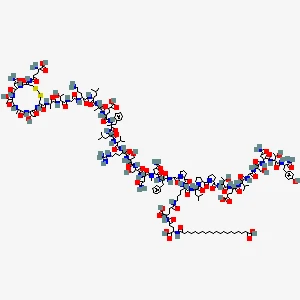
2D depiction generated from the PubChem record. Depictions are schematic and do not show salt form, counter-ions or conformation.
- Formula
- C201H319N49O65S2
- Molecular weight
- 4526 g/mol
- InChIKey
- RLBIFQNAUXZCQB-UHFFFAOYSA-N
Key studies
- Billings et al., Lancet (2025)Randomized, double-blind, placebo-controlled phase 2, 48 weeks, 46 US sitesModel: Humans (263 adults with obesity or overweight, no type 2 diabetes)
Mean body-weight change (efficacy estimand) was -9% (1 mg), -12% (3 mg), -18% (6 mg), -20% (9 mg), -20% (6-9 mg) and -16% (3-9 mg) versus -0.4% with placebo 1.
- Randomized, placebo-controlled, participant- and investigator-blinded multiple-ascending-dose phase 1, 12 weeksModel: Humans (100 participants with obesity or overweight)
Least-squares mean body-weight reduction at week 12 ranged from 2.6% to 11.3% across dose groups; gastrointestinal events were infrequent and most adverse events were mild 2.
- Briere et al., Mol Metab (2025)Translational pharmacology plus single-ascending-dose phase 1 (NCT05295940)Model: Cells, rats, monkeys and 48 healthy humans
Eloralintide preferentially activated human AMY1R; at week 4 after single 4 mg or 12 mg doses, mean body-weight change was -2.5% and -4.4% versus +0.6% with placebo 3.
Doses used in published trials
What investigators administered in the cited studies, recorded as a fact about those studies. Not a protocol and not a recommendation.
Full dosing reference, study durations and vial arithmetic →- In the phase 2 trial (NCT06230523), participants were randomized 2:1:1:1:2:1:2 to once-weekly subcutaneous placebo or eloralintide 1 mg, 3 mg, 6 mg or 9 mg, or dose escalations of 6-9 mg or 3-9 mg, for 48 weeks 1,4.
- In the 12-week multiple-ascending-dose phase 1 study, cohorts received once-weekly subcutaneous eloralintide 1.2 mg, 3 mg, 6 mg or 12 mg (two cohorts) or placebo, without dose escalation 2.
- In the single-ascending-dose phase 1 study (NCT05295940), healthy participants received single doses from 0.04 mg to 12 mg 3.
- The phase 2 trial randomized 263 participants: eloralintide 1 mg (n=28), 3 mg (n=24), 6 mg (n=28), 9 mg (n=54), 6–9 mg escalation (n=24), 3–9 mg escalation (n=52) or placebo (n=53) 1.
- In the single-ascending-dose phase 1 study, 48 healthy participants were enrolled in six cohorts (0.04, 0.12, 0.4, 1.2, 4 and 12 mg), each with 6 participants assigned to a single subcutaneous eloralintide injection and 2 to placebo, with follow-up to day 60 3.
- In the multiple-ascending-dose study, 100 participants with overweight or obesity were enrolled; eloralintide cohorts were 1.2 mg (n=8), 3 mg (n=6), 6 mg (n=23) and 12 mg (two cohorts combined, n=36) 2.
- The phase 3 ENLIGHTEN-1 (NCT07321886; adults with obesity or overweight without type 2 diabetes, estimated 1,980) and ENLIGHTEN-2 (NCT07282600; with type 2 diabetes, estimated 1,035) registry records list four subcutaneous eloralintide dose levels versus placebo with a week-64 body-weight primary endpoint; the dose amounts are not stated in the registry fields 5,6.
Eloralintide draw calculator
Pick the vial strength and how much water is added, then enter an amount to see the units to draw. Arithmetic only, not a recommendation.
Computed from your inputs. Not a dose or a recommendation.
Compare water volumes for this vialShow
More water = lower concentration = a larger, easier-to-measure draw. Tap a row to use it.
| Water | mg/mL | Draw |
|---|---|---|
| 0.5 mL | 20 | — |
| 1 mL | 10 | — |
| 1.5 mL | 6.667 | — |
| 2 mL | 5 | — |
| 2.5 mL | 4 | — |
| 3 mL | 3.333 | — |
| 5 mL | 2 | — |
Clinicians and researchers on video
YouTube videos about Eloralintide from clinicians and researchers. Their views, in their own words; not reviewed or endorsed by Amiravo. Compare what they say with the evidence above.
- GLP-1 Alternative? Eloralintide (Amylin) Phase 2 Results ExplainedMark Charbonneau, PhD · 7K views
These creators are not affiliated with Amiravo and do not endorse Amiravo or any product linked on this site. Nothing here is medical advice. Video views counted on YouTube as of Oct 24, 2026.
Regulatory status
- Status
- Investigational. Published trials describe eloralintide as under development for obesity 1,2, phase 3 trials are registered as recruiting 5,6, and an openFDA query of Drugs@FDA on 22 October 2026 returned no application record for it 8.
- United States (FDA)
- Eloralintide is investigational; an openFDA query of Drugs@FDA application data on 22 October 2026 returned no application record 8, and phase 3 trials were listed as recruiting 5,6.
- Sport (WADA)
- Eloralintide is not named in the 2026 Prohibited List text reviewed. The list's S0 class covers pharmacological substances not addressed elsewhere that have no current approval by any governmental regulatory health authority for human therapeutic use, including drugs in clinical development; athletes should consult WADA directly 10.
Status varies by country and changes over time. How we describe regulatory status.
Quality and testing notes
A certificate of analysis for an eloralintide research material would be expected to show HPLC purity, identity by mass spectrometry against the expected mass (PubChem lists a molecular formula of C201H319N49O65S2 and a molecular weight of about 4526 g/mol) [9], an endotoxin result and net peptide content. Because the molecule carries a fatty-acid side chain and a non-native thioacetal bridge [3], the report should state that these modifications were confirmed.
How purity testing works · Reading a certificate of analysis
Check a Eloralintide certificate of analysis against its expected mass (4,526 Da)Storage and handling
Storage conditions for research material are set by the supplier's documentation; lyophilized peptides are generally sensitive to heat, light and moisture.
Frequently asked questions
What is eloralintide?
Is eloralintide approved by the FDA?
How does it differ from cagrilintide?
What body-weight changes were reported in phase 2?
What adverse events were most common?
Is it being studied with other drugs?
Latest indexed research
No new studies were filed in the last sweep.
Search all studies on Eloralintide (PubMed, Europe PMC, ClinicalTrials.gov)Listed by publication type from the index record. Inclusion is not an endorsement; open the source to read the findings.
Revision history
Meaningful changes to this entry, with dates and sources. Last reviewed Oct 23, 2026. Typo and layout fixes are not listed.
- New section· Schedules by time periodOct 23, 2026
Added week-by-week schedules from registered trials (1 group, 6 arms).
Source: A Study of LY3841136 Compared With Placebo in Adult Participants With Obesity or Overweight
Last reviewed October 23, 2026 by the Amiravo editorial team.
Need the math?
Laboratory arithmetic with every formula shown.
For research use only. Not for human or veterinary use. Not a drug, food, or dietary supplement. This page is educational and is not medical advice.
Unbranded reference image. Amiravo does not produce, supply or sell this compound.
Specifications
- Molecular formula
- C201H319N49O65S2
- Molecular weight
- 4,526 g/mol
- PubChem CID
- 175663130
- Format
- Lyophilized vial
- Type
- Single compound
Identifiers from PubChem. Verify against the supplier’s documentation for your lot.
Research stats
How much has been published, not how good it is.
- PubMed records
- 10
- Indexed as human research
- 7
- Animal-only research
- 0
- Randomized controlled trials
- 3
- Registered trials
- 24
- Trials with posted results
- 1
Counts from title/abstract searches of PubMed, ClinicalTrials.gov, openFDA and NIH RePORTER, checked 2026-10-24. Names shared with other substances can inflate counts. FAERS reports are spontaneous and do not establish cause. Funding shows interest, not evidence. Method
Follow Eloralintide
See every new citation, evidence-grade or status change and correction in My Research, with optional email alerts. Free account.