MariTide (maridebart cafraglutide)
Also known as Maridebart cafraglutide · AMG 133 · AMG133 · MariTide · Anti-GIPR antibody / GLP-1 peptide conjugate · GIPR antagonist / GLP-1R agonist antibody-peptide conjugate
MariTide (maridebart cafraglutide, AMG 133) is not a peptide but an antibody-peptide conjugate: synthetic GLP-1 receptor agonist peptides chemically attached to an anti-GIP-receptor monoclonal antibody, investigational for obesity, with a 592-participant phase 2 trial reporting body-weight change of -12.3% to -16.2% at 52 weeks and phase 3 trials under way.
- US status
- Investigational
- Evidence
- Grade A
- Half-life
- Not reported numerically in the sources reviewed. The conjugate design is described as giving markedly prolonged systemic exposure of the structurally intact GLP-1 peptide, and the phase 2 trial administered it once every 4 or 8 weeks 1,6.
- Class
- Antibody-peptide conjugate: anti-GIP-receptor monoclonal IgG antibody conjugated to synthetic GLP-1 receptor agonist peptides (not a peptide drug)
More
Research reference, not advice. Study facts, not instructions. Amiravo sells nothing; some links are referrals.Read the full notice
Key takeaways
- MariTide is an antibody-peptide conjugate, not a peptide: synthetic GLP-1 receptor agonist peptides attached to an anti-GIP-receptor monoclonal antibody, so it has no single peptide sequence 4,6.
- It combines two opposite-direction incretin actions in one molecule: GLP-1 receptor agonism and GIP receptor antagonism 1,5.
- In the published phase 2 trial, mean body-weight change at week 52 was -12.3% to -16.2% versus -2.5% with placebo in the obesity cohort, and -8.4% to -12.3% versus -1.7% in the obesity plus type 2 diabetes cohort 1.
- Gastrointestinal adverse events were common and were less frequent with dose escalation and a lower starting amount; the authors reported no unexpected safety signals in phase 2 1.
- It is not approved anywhere in the sources reviewed; a large phase 3 cardiovascular outcomes trial is recruiting 8,9.
Development stage
Where MariTide (maridebart cafraglutide) sits between laboratory work and regulatory approval.
- PreclinicalAnimal and cell work
- Phase 1First human safety studies
- Phase 2Early efficacy signal
- Phase 3 (current)Confirmatory trials
- ApprovedCleared by a regulator
Stage comes from the regulatory record and ClinicalTrials.gov studies naming the compound (for compounds approved nowhere, only completed trials or trials with posted results count) (checked 2026-10-24). A registered trial is not a result.
Mechanism of action
Maridebart cafraglutide is built from an IgG monoclonal antibody directed against the GIP receptor, to which synthetic GLP-1 analogue peptides are chemically conjugated 4,6. The design decouples peptide synthesis from antibody expression, which allows non-natural amino acids and other chemical modifications in the peptide portion, while the antibody provides the long circulating exposure that a free peptide cannot 4.
Dual, opposite-direction incretin action
- GLP-1 receptor agonism: the conjugated peptides act as GLP-1 receptor agonists, the mechanism shared with established incretin drugs 1.
- GIP receptor antagonism: the antibody blocks rather than activates the GIP receptor, which is the opposite of the GIP-agonist component in dual GIP/GLP-1 agonists; reviews note that both GIP agonism and GIP antagonism have produced body-weight reduction in trials and that the reasons are still debated 5,12.
Exposure
The discovery paper reports that conjugation gave markedly prolonged systemic exposure of the structurally intact GLP-1 peptide, with once-weekly administration producing sustained effects in diet-induced obese mice and obese monkeys, and a profile the authors said may support monthly administration in people 6. The phase 2 trial used 4-weekly and 8-weekly administration accordingly 1.
Doses used in published trials
What investigators administered in the cited studies, recorded as a fact about those studies. Not a protocol and not a recommendation.
Full dosing reference, study durations and vial arithmetic →- In the phase 2 dose-ranging trial (NCT05669599), participants in the obesity cohort were randomly assigned to subcutaneous maridebart cafraglutide 140, 280 or 420 mg every 4 weeks without dose escalation; 420 mg every 8 weeks without dose escalation; 420 mg every 4 weeks with 4-week dose escalation; 420 mg every 4 weeks with 12-week dose escalation; or placebo, for 52 weeks 1.
- In the same trial, participants in the obesity plus type 2 diabetes cohort were randomly assigned to 140, 280 or 420 mg every 4 weeks, all without dose escalation, or placebo 1.
- The first-in-human study (NCT04478708) used single and multiple ascending amounts in participants with obesity to assess safety and tolerability; amounts are not stated in the registry record reviewed 7.
Published adverse-event data
Reported in the cited trials or product labels. Frequencies apply to the stated population and do not transfer to other settings.
- Gastrointestinal adverse eventsDescribed as common with maridebart cafraglutide, and less frequent in groups using dose escalation and a lower starting amount; exact rates not given in the abstract reviewed
- Unexpected safety signalsNone reported
Emerging safety signals
- Tolerability in phase 2 depended on how administration was started: gastrointestinal events were less frequent with dose escalation and a lower starting amount, and two of the eleven groups were included specifically to test 4-week and 12-week escalation schemes 1. 1 (2025)
- As an antibody-based molecule with prolonged exposure, adverse effects cannot be stopped quickly by withdrawal in the way a short-acting peptide allows; the sources reviewed report no immunogenicity data for the conjugate 4,6. 4 (2026)
What is not known: No phase 3 efficacy or safety results were available in the sources reviewed; the cardiovascular outcomes, type 2 diabetes and heart failure trials are ongoing without posted results 9,10,11. Published half-life values, immunogenicity data and long-term safety for the conjugate were not located 4,6. Whether GIP receptor antagonism contributes to the observed body-weight change, and how it compares with GIP agonism as used in dual agonists, remains debated in the reviews reviewed 5,12. No head-to-head trial against an approved incretin drug was located, so the phase 2 percentages cannot be read as a comparison 1.
Background viewing
We haven't found a clinician video focused on MariTide (maridebart cafraglutide) yet. Meanwhile, this widely watched talk covers the science of aging in general. It does not discuss MariTide (maridebart cafraglutide).
These creators are not affiliated with Amiravo and do not endorse Amiravo or any product linked on this site. Nothing here is medical advice. Video views counted on YouTube as of Oct 24, 2026.
Regulatory status
- Status
- Investigational. No Drugs@FDA application record was returned for maridebart cafraglutide on 24 October 2026 8. A phase 2 dose-ranging trial of 592 participants has been published 1, and Amgen has registered a phase 3 programme including a cardiovascular outcomes trial with an estimated 12,800 participants (NCT07037433, recruiting), a type 2 diabetes trial (NCT06858878) and a heart failure trial (NCT07037459) 9,10,11.
- United States (FDA)
- Not approved. An openFDA Drugs@FDA query for maridebart cafraglutide returned no application record on 24 October 2026 8. Phase 3 trials are registered and recruiting 9,10,11.
- Sport (WADA)
- Not named individually in the sources reviewed; S0 covers substances without governmental approval for human therapeutic use, prohibited at all times 13.
Status varies by country and changes over time. How we describe regulatory status.
Quality and testing notes
This molecule is a biologic manufactured by antibody expression plus peptide synthesis and conjugation, so the quality questions are different from those for a synthetic peptide: identity and integrity of the antibody, the peptide-to-antibody ratio and conjugation site, aggregate and fragment content, host-cell protein and residual DNA, and endotoxin [4, 6]. Material offered as a research peptide version of MariTide cannot be the same molecule, since a conjugate of this kind cannot be produced by peptide synthesis alone; no sequence, formula or PubChem identifier is listed in this entry for that reason [4].
How purity testing works · Reading a certificate of analysis
Check a MariTide (maridebart cafraglutide) certificate of analysisStorage and handling
Antibody-based biologics are generally handled cold, protected from freezing, agitation and light, and are sensitive to aggregation; follow the sponsor's or supplier's documentation. No temperatures or preparation steps are given here.
Frequently asked questions
Is MariTide a peptide?
How does it differ from tirzepatide-style dual agonists?
What did the phase 2 trial report?
How often was it given in trials?
What were the main adverse events?
Is it approved?
Can research suppliers sell MariTide?
Is it banned in sport?
Latest indexed research
- Home Self-administration of Maridebart Cafraglutide With Autoinjector in Adults Living With Obesity or OverweightRegistered trial · humans · Amgen · 2026-10-13
Listed by publication type from the index record. Inclusion is not an endorsement; open the source to read the findings.
Revision history
Meaningful changes to this entry, with dates and sources. Last reviewed Oct 24, 2026. Typo and layout fixes are not listed.
- New section· entryOct 24, 2026
New research reference added: MariTide (maridebart cafraglutide).
Last reviewed October 24, 2026 by the Amiravo editorial team.
Need the math?
Laboratory arithmetic with every formula shown.
For research use only. Not for human or veterinary use. Not a drug, food, or dietary supplement. This page is educational and is not medical advice.
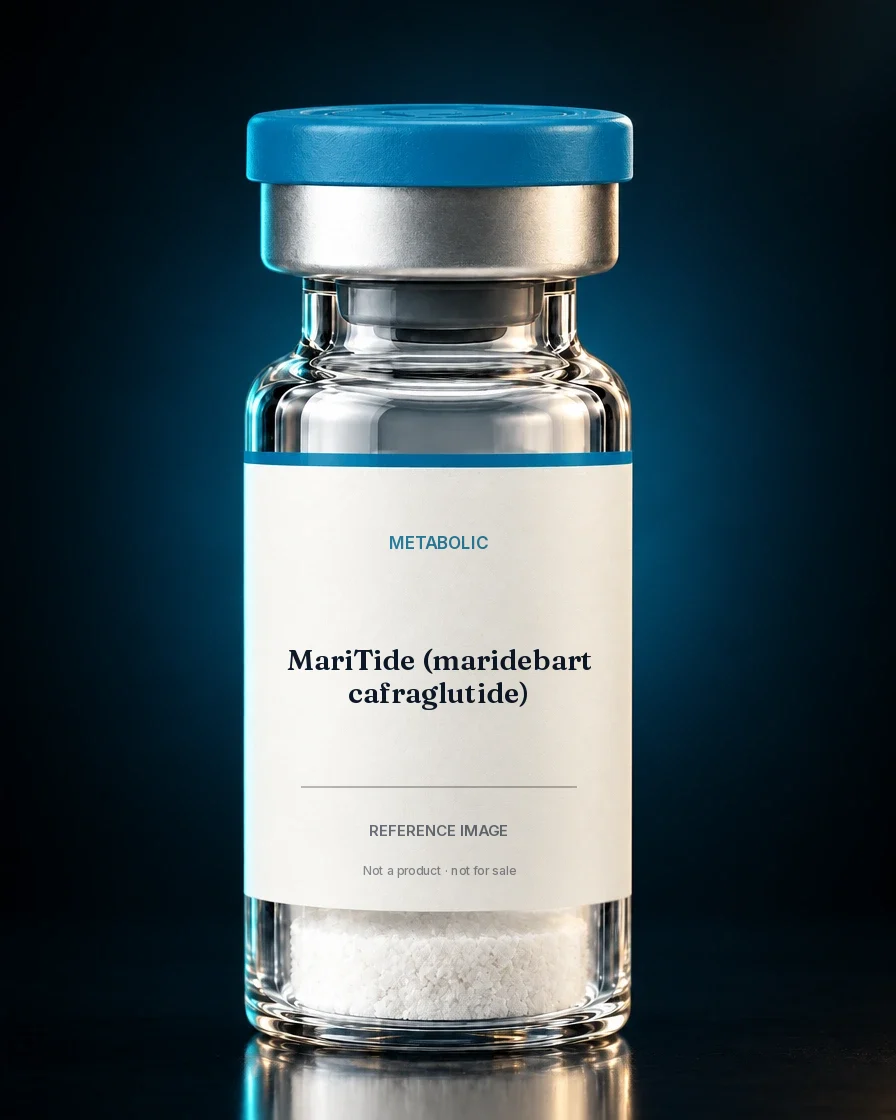
Unbranded reference image. Amiravo does not produce, supply or sell this compound.
Specifications
- Type
- Single compound
Chemical identifiers are shown only when verified against PubChem.
Research stats
How much has been published, not how good it is.
- PubMed records
- 27
- Indexed as human research
- 15
- Animal-only research
- 2
- Randomized controlled trials
- 2
- Registered trials
- 30
- Trials with posted results
- 2
Counts from title/abstract searches of PubMed, ClinicalTrials.gov, openFDA and NIH RePORTER, checked 2026-10-24. Names shared with other substances can inflate counts. FAERS reports are spontaneous and do not establish cause. Funding shows interest, not evidence. Method
Follow MariTide (maridebart cafraglutide)
See every new citation, evidence-grade or status change and correction in My Research, with optional email alerts. Free account.