Cagrilintide
Also known as CagriSema (combination with semaglutide)
Cagrilintide is an investigational long-acting, lipidated analogue of the pancreatic hormone amylin that acts at amylin and calcitonin receptors and is given by once-weekly subcutaneous injection in clinical trials. It has been studied alone in a phase 2 weight-management trial and, most extensively, in combination with semaglutide (CagriSema) in phase 3 trials, with gastrointestinal events the most commonly reported adverse events. It is not approved by the FDA, and this entry summarizes published and registered trials for research reference only.
- US status
- Investigational
- Evidence
- Grade A
- Half-life
- 159 to 195 hours (phase 1b, co-administered with semaglutide 2.4 mg) 2
- Class
- Long-acting amylin analogue; dual amylin and calcitonin receptor agonist (investigational)
Research reference, not advice. Study facts, not instructions. Amiravo sells nothing; some links are referrals.Read the full notice
Key takeaways
- Cagrilintide is an investigational once-weekly amylin analogue that binds amylin receptors (AMY1R, AMY2R, AMY3R) and the calcitonin receptor; it is not FDA-approved 8,13.
- In a 26-week phase 2 trial of cagrilintide alone (706 adults with overweight or obesity), mean weight reduction was 6.0% to 10.8% across five dose levels versus 3.0% with placebo 1.
- In a 32-week phase 2 trial in type 2 diabetes, the cagrilintide-only arm reached an HbA1c change of -0.9 percentage points and a body-weight change of -8.1% 3.
- In REDEFINE 1 (3,417 adults without diabetes), the cagrilintide-semaglutide combination produced a mean weight change of -20.4% at 68 weeks versus -3.0% with placebo; the trial also randomized 302 participants to cagrilintide alone 4.
- Gastrointestinal events were the most frequent adverse events; in the phase 2 monotherapy trial they affected 41% to 63% of cagrilintide groups versus 32% with placebo 1.
Development stage
Where Cagrilintide sits between laboratory work and regulatory approval.
- PreclinicalAnimal and cell work
- Phase 1First human safety studies
- Phase 2Early efficacy signal
- Phase 3 (current)Confirmatory trials
- ApprovedCleared by a regulator
Stage comes from the regulatory record and ClinicalTrials.gov studies naming the compound (for compounds approved nowhere, only completed trials or trials with posted results count) (checked 2026-10-24). A registered trial is not a result.
Mechanism of action
Natural amylin is a pancreatic hormone co-secreted with insulin that induces satiety; cagrilintide is a stable, lipidated, long-acting amylin analogue 1,7.
Receptor pharmacology
Cryo-electron microscopy structures show cagrilintide bound to Gs-coupled amylin receptors (AMY1R, AMY2R, AMY3R) and the calcitonin receptor, with an amylin-like binding mode but distinct conformational dynamics compared with other peptides 8.
Animal pharmacology
In diet-induced obese mice, cagrilintide reduced body weight and early food intake, and its potency was impaired in mice lacking RAMP1 and RAMP3, indicating dependence on AMY1R and AMY3R; neuronal activation was observed in the dorsal vagal complex and lateral parabrachial nucleus 9.
Human pharmacokinetics
In a phase 1b trial, cagrilintide exposure was proportional to dose, did not affect semaglutide exposure, and had a half-life of 159 to 195 hours 2.
Molecular structure
PubChem CID 171397054 ↗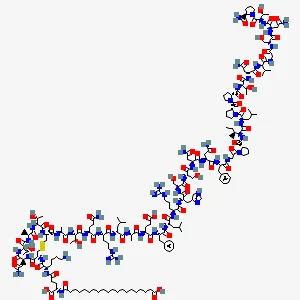
2D depiction generated from the PubChem record. Depictions are schematic and do not show salt form, counter-ions or conformation.
- Formula
- C194H312N54O59S2
- Molecular weight
- 4409 g/mol
- CAS
- 1415456-99-3
- InChIKey
- LDERDVMBIYGIOI-IZVMHKDJSA-N
Doses used in published trials
What investigators administered in the cited studies, recorded as a fact about those studies. Not a protocol and not a recommendation.
Full dosing reference, study durations and vial arithmetic →- In the phase 2 dose-finding trial (NCT03856047), adults with overweight or obesity self-injected subcutaneous cagrilintide 0.3, 0.6, 1.2, 2.4 or 4.5 mg once weekly, once-daily liraglutide 3.0 mg, or volume-matched placebo for 26 weeks, including a dose-escalation period of up to 6 weeks, followed by 6 weeks without treatment 1.
- In the phase 1b trial (NCT03600480), participants received once-weekly subcutaneous cagrilintide 0.16, 0.30, 0.60, 1.2, 2.4 or 4.5 mg or placebo together with once-weekly semaglutide 2.4 mg; doses were co-escalated at 4-week intervals over 16 weeks, then held at target for 4 weeks 2.
- In the phase 2 type 2 diabetes trial (NCT04982575), participants were randomized 1:1:1 to once-weekly subcutaneous cagrilintide-semaglutide, semaglutide or cagrilintide, all escalated to 2.4 mg, for 32 weeks 3.
- In REDEFINE 1 (NCT05567796), participants received once-weekly cagrilintide 2.4 mg plus semaglutide 2.4 mg, semaglutide 2.4 mg alone, cagrilintide 2.4 mg alone, or placebo for 68 weeks; the registry describes a 16-week dose-escalation period followed by maintenance 4,12.
- In REDEFINE 2 (NCT05394519), adults with type 2 diabetes received once-weekly cagrilintide-semaglutide (2.4 mg each) or placebo for 68 weeks 5.
- In REIMAGINE 2 (NCT06065540), participants received once-weekly subcutaneous cagrilintide 2.4 mg plus semaglutide 2.4 mg, semaglutide 2.4 mg, cagrilintide 2.4 mg, cagrilintide 1.0 mg plus semaglutide 1.0 mg, semaglutide 1.0 mg, or placebo for 68 weeks 6.
Cagrilintide draw calculator
Pick the vial strength seen on the research market and how much water is added, then enter an amount to see the units to draw. Arithmetic only, not a recommendation.
Computed from your inputs. Not a dose or a recommendation.
Compare water volumes for this vialShow
More water = lower concentration = a larger, easier-to-measure draw. Tap a row to use it.
| Water | mg/mL | Draw |
|---|---|---|
| 0.5 mL | 20 | — |
| 1 mL | 10 | — |
| 1.5 mL | 6.667 | — |
| 2 mL | 5 | — |
| 2.5 mL | 4 | — |
| 3 mL | 3.333 | — |
| 5 mL | 2 | — |
Clinicians and researchers on video
YouTube videos about Cagrilintide from clinicians and researchers. Their views, in their own words; not reviewed or endorsed by Amiravo. Compare what they say with the evidence above.
- S5 Ep. 3 | The Dr. Kris Podcast | Cagrilintide For Weight Loss: Is It Right For You?The Resurge Clinic · 12K views
These creators are not affiliated with Amiravo and do not endorse Amiravo or any product linked on this site. Nothing here is medical advice. Video views counted on YouTube as of Oct 24, 2026.
Regulatory status
- Status
- Not approved by the FDA; an openFDA Drugs@FDA query for cagrilintide returned no application record 13. Cagrilintide is described in trial reports as a long-acting amylin analogue under investigation for weight management 1, and the REDEFINE 1 phase 3 trial (NCT05567796) is listed on ClinicalTrials.gov as active, not recruiting, with an extension phase 12.
- United States (FDA)
- Not approved; an openFDA Drugs@FDA query for cagrilintide returned no application record 13. Phase 3 trials are registered on ClinicalTrials.gov 12.
- Sport (WADA)
- Cagrilintide is not named on the WADA 2026 Prohibited List 15. Class S0 prohibits at all times any pharmacological substance not addressed elsewhere on the List and with no current approval by any governmental regulatory health authority for human therapeutic use, such as drugs under clinical development 15.
Status varies by country and changes over time. How we describe regulatory status.
Quality and testing notes
Cagrilintide is a 37-residue amylin analogue carrying an N-terminal C20 fatty diacid attached through a gamma-glutamyl linker and an intramolecular disulfide bond, with a PubChem molecular formula of C194H312N54O59S2 [14]. A certificate of analysis for reference material would typically show HPLC purity with chromatogram, intact mass by mass spectrometry against that formula, confirmation of the disulfide (for example by non-reduced versus reduced mapping), net peptide content, counter-ion and residual solvent content, and related-substance profiling for deamidation and oxidation. Because amylin analogues are prone to aggregation, data on aggregate or fibril content add value [7].
How purity testing works · Reading a certificate of analysis
Check a Cagrilintide certificate of analysis against its expected mass (4,409 Da)Storage and handling
No approved-product storage instructions exist because cagrilintide has no FDA label. Handling of research material should follow the supplier's documentation and certificate of analysis, including temperature, light protection and freeze-thaw limits.
Frequently asked questions
Is cagrilintide FDA-approved?
What is CagriSema?
Has cagrilintide been studied on its own?
What weight change was reported with cagrilintide alone?
How long does cagrilintide stay in the body?
Which receptors does it act on?
What adverse events were most common?
Latest indexed research
- Correction to 'Efficacy of CagriSema for Reaching Anthropometric Treatment Targets and Cardiometabolic Outcomes: A Secondary, Post Hoc Analysis of REDEFINE 1'.Other · Diabetes, obesity & metabolism · 2026-10-20
- Design and baseline characteristics of the CagriSema cardiovascular outcomes trial (REDEFINE 3).Other · American heart journal · 2026-10-06
- CagriSema versus Semaglutide 2.4 mg monotherapy for weight management in adults with overweight or obesity, with or without type 2 diabetes: a systematic review, meta-analysis, and trial sequential analysis.Systematic review · humans · Frontiers in endocrinology · 2026-10-02
Listed by publication type from the index record. Inclusion is not an endorsement; open the source to read the findings.
Revision history
Meaningful changes to this entry, with dates and sources. Last reviewed Oct 23, 2026. Typo and layout fixes are not listed.
- New section· Schedules by time periodOct 23, 2026
Added week-by-week schedules from registered trials (1 group, 5 arms).
Source: Research Study Investigating How Well NNC0174-0833 Works in People Suffering From Overweight or Obesity (registry results: participant flow group descriptions) - Correction· Quick reference: half-lifeOct 23, 2026
Re-cited the half-life to the phase 1b study that measured it, and noted it was measured alongside semaglutide.
Source: PubMed 34798060
Last reviewed October 23, 2026 by the Amiravo editorial team.
Need the math?
Laboratory arithmetic with every formula shown.
For research use only. Not for human or veterinary use. Not a drug, food, or dietary supplement. This page is educational and is not medical advice.
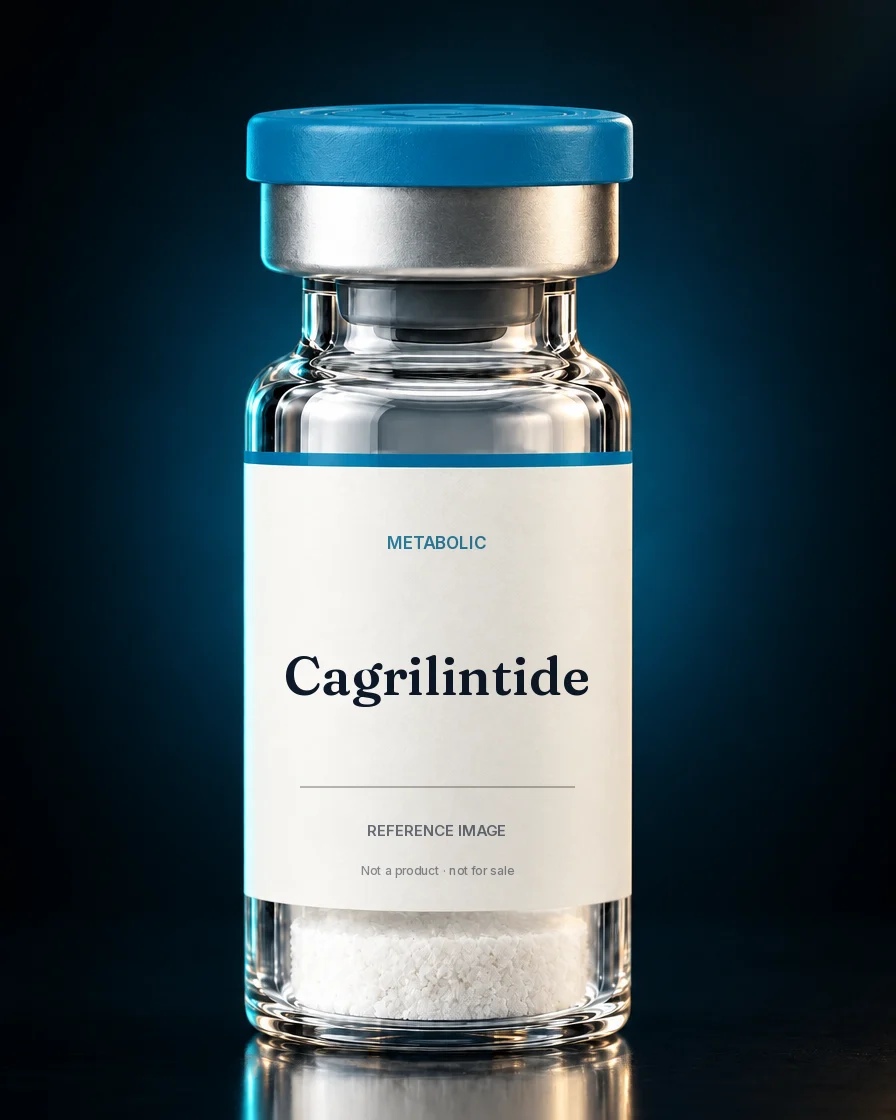
Unbranded reference image. Amiravo does not produce, supply or sell this compound.
Specifications
- Molecular formula
- C194H312N54O59S2
- Molecular weight
- 4,409 g/mol
- CAS number
- 1415456-99-3
- PubChem CID
- 171397054
- Sequence
- (C20 diacid-
gamma- Glu)- KCNTATCATQRLAEFLRHSSNNFGPILPPTNVGSNTP- NH2 (lipidated N- terminus; disulfide between the two Cys residues; PubChem sequence string XKCNTATCATQRLAEFLRHSSNNFGPILPPTNVGSNTP) - Format
- Lyophilized vial
- Vial sizes seen
- 5 mg · 10 mg
- Type
- Single compound
Identifiers from PubChem. Verify against the supplier’s documentation for your lot.
Research stats
How much has been published, not how good it is.
- PubMed records
- 122
- Indexed as human research
- 77
- Animal-only research
- 6
- Randomized controlled trials
- 15
- Registered trials
- 44
- Trials with posted results
- 1
- FDA adverse-event reports (FAERS)
- 4
- NIH-funded projects naming it
- 4
Counts from title/abstract searches of PubMed, ClinicalTrials.gov, openFDA and NIH RePORTER, checked 2026-10-24. Names shared with other substances can inflate counts. FAERS reports are spontaneous and do not establish cause. Funding shows interest, not evidence. Method
Follow Cagrilintide
See every new citation, evidence-grade or status change and correction in My Research, with optional email alerts. Free account.