Larazotide
Also known as Larazotide acetate · AT-1001 · AT1001 · AT-2347 · Gly-Gly-Val-Leu-Val-Gln-Pro-Gly · INN larazotide
Larazotide acetate is an investigational oral 8-amino-acid tight-junction regulator peptide that has been tested in randomized trials in celiac disease, where a phase 3 study was terminated by its sponsor.
- US status
- Investigational
- Evidence
- Grade B
- Class
- Tight-junction regulator peptide (8-mer)
More
Research reference, not advice. Study facts, not instructions. Amiravo sells nothing; some links are referrals.Read the full notice
Key takeaways
- Larazotide acetate is an oral 8-mer peptide designed to regulate intestinal epithelial tight junctions and has been studied mainly in adults with celiac disease 1,5.
- In a 342-patient phase 2b trial, only the lowest dose tested met the primary symptom endpoint versus placebo; the two higher doses did not differ from placebo 1.
- Across gluten-challenge trials, the lactulose-to-mannitol permeability ratio did not differ significantly from placebo 2,3,7.
- The phase 3 celiac trial (NCT03569007) was terminated by the sponsor, and no FDA approval has been granted 10.
- Larazotide is not named on the WADA 2026 list; substances without any governmental approval for human therapeutic use fall under S0, which is prohibited at all times 14.
Development stage
Where Larazotide sits between laboratory work and regulatory approval.
- PreclinicalAnimal and cell work
- Phase 1First human safety studies
- Phase 2Early efficacy signal
- Phase 3 (current)Confirmatory trials
- ApprovedCleared by a regulator
Stage comes from the regulatory record and ClinicalTrials.gov studies naming the compound (for compounds approved nowhere, only completed trials or trials with posted results count) (checked 2026-10-24). A registered trial is not a result.
Mechanism of action
Larazotide acetate is described as a tight-junction (TJ) regulator that, in vitro, prevents the opening of intestinal epithelial tight junctions 3,5.
Cell and animal findings
- Tight-junction disassembly: In Caco-2 and IEC6 cells, larazotide inhibited ZO-1 and actin redistribution caused by gliadin fragments and by AT-1002, a peptide derived from the V. cholerae zonula occludens toxin, and inhibited the AT-1002-induced fall in transepithelial electrical resistance 5.
- Gliadin translocation: It inhibited translocation of a gliadin 13-mer peptide across Caco-2 monolayers 5.
- Tight-junction assembly: In MDCK cells it promoted TJ assembly in a calcium-switch assay, and in 'leaky' Caco-2 cells it decreased paracellular permeability 6.
- Animal model: In gliadin-sensitized HLA-HCD4/DQ8 transgenic mice it inhibited gliadin-induced macrophage accumulation and preserved TJ structure 5.
Zonulin
Larazotide is often described as a zonulin antagonist 7,8; a 2021 correspondence in Gut questioned the relationship of AT1001 to zonulin and prehaptoglobin-2 9.
Molecular structure
PubChem CID 9810532 ↗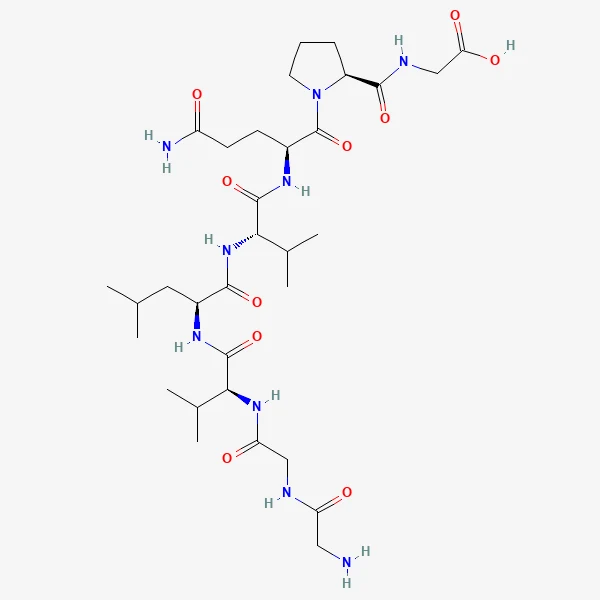
2D depiction generated from the PubChem record. Depictions are schematic and do not show salt form, counter-ions or conformation.
- Formula
- C32H55N9O10
- Molecular weight
- 725.8 g/mol
- CAS
- 258818-34-7
- InChIKey
- ORFLZNAGUTZRLQ-ZMBVWFSWSA-N
Doses used in published trials
What investigators administered in the cited studies, recorded as a fact about those studies. Not a protocol and not a recommendation.
Full dosing reference, study durations and vial arithmetic →- In the phase 2b trial NCT01396213 (342 adults), participants received larazotide acetate 0.5, 1 or 2 mg capsules three times daily or placebo for 12 weeks, after a 4-week placebo run-in and before a 4-week placebo run-out 1,11.
- In the phase 3 trial NCT03569007 (307 enrolled; terminated by sponsor), arms were larazotide 0.25 mg or 0.50 mg capsules three times daily, or matching placebo 10.
- In the gluten-challenge trial by Kelly et al. (184 patients), arms were 1, 4 or 8 mg three times daily or placebo, with 2.7 g of gluten daily for 6 weeks 2.
- In the long COVID phase 2a trial NCT05747534, participants received 250 or 500 micrograms orally four times daily for 21 days (by body weight below or at least 25.0 kg), or placebo 12.
Published adverse-event data
Reported in the cited trials or product labels. Frequencies apply to the stated population and do not transfer to other settings.
- HeadacheAmong the most common adverse events (rates not given in the abstract)
- Urinary tract infectionAmong the most common adverse events (rates not given in the abstract)
- Overall adverse eventsSimilar to placebo184 adults with celiac disease undergoing 6-week gluten challenge; 342 adults over 12 weeks 2 · Not graded in the abstracts
Emerging safety signals
What is not known: Whether larazotide changes intestinal permeability in humans has not been shown; trials found no significant difference in the lactulose-to-mannitol ratio 2,3,7. Phase 3 efficacy results were not identified in the registry, which records the trial as terminated by the sponsor 10. Results of the completed long COVID phase 2a trial were not posted as of 2026-10-24 12. Long-term safety, human pharmacokinetics and half-life were not reported in the sources reviewed. The proposed link to zonulin has been questioned 9.
Background viewing
We haven't found a clinician video focused on Larazotide yet. Meanwhile, this widely watched talk covers the science of aging in general. It does not discuss Larazotide.
These creators are not affiliated with Amiravo and do not endorse Amiravo or any product linked on this site. Nothing here is medical advice. Video views counted on YouTube as of Oct 24, 2026.
Regulatory status
- Status
- Investigational; not FDA-approved for any use as of 2026-10-24. The phase 3 celiac disease trial (NCT03569007) is recorded as terminated by the sponsor, and phase 2a trials in long COVID and MIS-C have been run by Massachusetts General Hospital 10,12,13.
- United States (FDA)
- No FDA approval was identified as of 2026-10-24; the phase 3 trial NCT03569007 is recorded as terminated by the sponsor (last update July 2022) 10.
- Sport (WADA)
- Larazotide is not named on the WADA 2026 Prohibited List; S0 prohibits at all times any pharmacological substance not addressed elsewhere on the List with no current governmental approval for human therapeutic use, such as drugs under clinical development 14.
Status varies by country and changes over time. How we describe regulatory status.
Quality and testing notes
A certificate of analysis for research material would be expected to show HPLC purity, identity by mass spectrometry against the expected mass of the free peptide (PubChem molecular weight 725.8 g/mol) [15], acetate and net peptide content, and endotoxin level. The clinical product was an oral formulation [1, 10].
How purity testing works · Reading a certificate of analysis
Check a Larazotide certificate of analysis against its expected mass (725.8 Da)Storage and handling
Follow the supplier's documentation for the specific lot; peptides of this kind are generally kept dry and protected from heat, light and moisture.
Frequently asked questions
What is larazotide?
Is larazotide approved?
What did the celiac disease trials find?
Does larazotide reduce intestinal permeability in humans?
How is it thought to act?
Has it been studied outside celiac disease?
Is larazotide prohibited in sport?
Latest indexed research
- The impact of α3β4 partial agonist AT-1001 on oxycodone withdrawal.Other · Drug and alcohol dependence · 2026-10-08
Listed by publication type from the index record. Inclusion is not an endorsement; open the source to read the findings.
Revision history
Meaningful changes to this entry, with dates and sources. Last reviewed Oct 24, 2026. Typo and layout fixes are not listed.
- New section· entryOct 24, 2026
New research reference added: Larazotide.
Last reviewed October 24, 2026 by the Amiravo editorial team.
Need the math?
Laboratory arithmetic with every formula shown.
For research use only. Not for human or veterinary use. Not a drug, food, or dietary supplement. This page is educational and is not medical advice.
Unbranded reference image. Amiravo does not produce, supply or sell this compound.
Specifications
- Molecular formula
- C32H55N9O10
- Molecular weight
- 725.8 g/mol
- CAS number
- 258818-34-7
- PubChem CID
- 9810532
- FDA UNII
- ZN3R5560ZV
- ChEMBL
- CHEMBL2105646
- DrugBank
- DB05645
- Sequence
- Gly-
Gly- Val- Leu- Val- Gln- Pro- Gly - Type
- Single compound
Identifiers from PubChem. Verify against the supplier’s documentation for your lot.
Research stats
How much has been published, not how good it is.
- PubMed records
- 99
- Indexed as human research
- 61
- Animal-only research
- 16
- Randomized controlled trials
- 5
- Registered trials
- 31
- Trials with posted results
- 12
- FDA adverse-event reports (FAERS)
- 2
- NIH-funded projects naming it
- 4
Counts from title/abstract searches of PubMed, ClinicalTrials.gov, openFDA and NIH RePORTER, checked 2026-10-24. Names shared with other substances can inflate counts. FAERS reports are spontaneous and do not establish cause. Funding shows interest, not evidence. Method
Follow Larazotide
See every new citation, evidence-grade or status change and correction in My Research, with optional email alerts. Free account.