Thymulin
Also known as Serum thymic factor (FTS) · Facteur thymique serique · Zinc-FTS · Circulating thymic factor · Thymuline · Thymulin acetate
Thymulin is a nonapeptide produced by thymic epithelial cells whose biological activity exists only when the peptide is bound to zinc; it is studied as a biomarker of zinc and thymic status and in animal models of inflammation, with no approved drug use.
- US status
- Not approved — research use only
- Evidence
- Grade C
- Half-life
- Not located in the sources reviewed for any species.
- Class
- Zinc-bound thymic nonapeptide hormone (metallopeptide)
More
Research reference, not advice. No administration data. Amiravo sells nothing; some links are referrals.Read the full notice
Key takeaways
- Thymulin is the zinc-bound form of the thymic nonapeptide FTS: biological activity is strictly zinc-dependent, and the zinc-coupled molecule has a distinct conformation recognised by antibodies that ignore the zinc-free peptide 2,10.
- Its most firmly established use is as a biomarker. Serum thymulin activity was 61% lower in rats on restricted zinc, more sensitive than four other zinc-status measures 3, and it has been used as a proxy for thymic size and function in children 5.
- Reported anti-inflammatory effects converge on NF-kappaB: in alveolar epithelial cells thymulin reduced endotoxin-induced IL-1beta release and NF-kappaB nuclear translocation 4, and in aged mice it suppressed myeloid pro-inflammatory cytokine production through NF-kappaB inhibition 1.
- Animal models cover inflammatory pain, chronic septic inflammation, experimental autoimmune encephalomyelitis, type 1 diabetes models and allergic asthma gene therapy; no human treatment trial was identified 1,6,7,8,9.
- No approved use exists; "Thymulin acetate" sits in Category 3 of FDA's 503A bulk substances list, nominated without adequate support 12,13.
Development stage
Where Thymulin sits between laboratory work and regulatory approval.
- Preclinical (current)Animal and cell work
- Phase 1First human safety studies
- Phase 2Early efficacy signal
- Phase 3Confirmatory trials
- ApprovedCleared by a regulator
Stage comes from the regulatory record and ClinicalTrials.gov studies naming the compound (for compounds approved nowhere, only completed trials or trials with posted results count) (checked 2026-10-24). A registered trial is not a result.
Mechanism of action
Thymulin is the nonapeptide pGlu-Ala-Lys-Ser-Gln-Gly-Gly-Ser-Asn complexed with zinc 10,11. NMR work on the Zn(II)-nonapeptide complex and immunological work with monoclonal antibodies both indicate that the zinc-bound molecule adopts a specific conformation, and that activity is lost without the metal, so zinc is part of the active entity rather than a cofactor added later 2,10.
Reported actions
- Inflammatory signalling: in fetal alveolar type II epithelial cells, thymulin reduced endotoxin-induced IL-1beta release, raised cAMP, and reduced nuclear translocation and DNA binding of NF-kappaB subunits, with zinc contributing independently 4.
- Myeloid ageing: in aged mice, thymulin was identified as a circulating factor that declines with age and restrains pro-inflammatory cytokine production by myeloid cells through NF-kappaB inhibition, with reported effects on antitumour T-cell responses 1.
- Neuroendocrine links: reviews describe thymulin as a hypophysiotropic peptide interacting with the neuroendocrine system, and a synthetic analogue (metFTS) has been expressed from adenovectors in gene-therapy experiments 6.
- Nociception: in a rat inflammatory pain model, thymulin treatment was associated with attenuated pain behaviour and changes in spinal signalling pathways 7.
Zinc dependence as a measurement problem
Because activity requires zinc, assays of "thymulin activity" in serum partly report zinc status; this is why thymulin activity tracks marginal zinc restriction more sensitively than serum zinc itself in rats 3.
Molecular structure
PubChem CID 71300623 ↗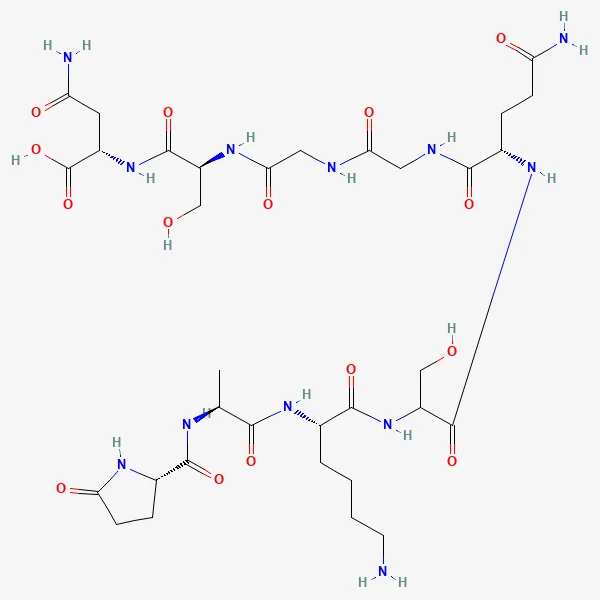
2D depiction generated from the PubChem record. Depictions are schematic and do not show salt form, counter-ions or conformation.
- Formula
- C33H54N12O15
- Molecular weight
- 858.9 g/mol
- CAS
- 78922-62-0
- InChIKey
- LIFNDDBLJFPEAN-YTAPOSPOSA-N
Published adverse-event data
Reported in the cited trials or product labels. Frequencies apply to the stated population and do not transfer to other settings.
Emerging safety signals
- No human safety data were identified; no treatment trial in people was located in the sources reviewed 5,6. 6 (2026)
- FDA places "Thymulin acetate" in Category 3 of its 503A bulk drug substances list, the category for substances nominated for compounding without adequate support, as updated May 14, 2026 12. 12 (2026)
What is not known: Whether exogenous thymulin does anything in people is untested in the sources reviewed: the human literature is observational biomarker work 5. Pharmacokinetics and half-life were not located for any species. Because activity requires bound zinc, how much of any reported effect is attributable to the peptide rather than to zinc is a recurring question, and one cell study found zinc active on its own 3,4. Whether the ageing-related findings in mice extend to humans, how stable the zinc complex is in a research preparation, and whether gene-therapy approaches translate are all open 1,6,9.
Background viewing
We haven't found a clinician video focused on Thymulin yet. Meanwhile, this widely watched talk covers the science of aging in general. It does not discuss Thymulin.
These creators are not affiliated with Amiravo and do not endorse Amiravo or any product linked on this site. Nothing here is medical advice. Video views counted on YouTube as of Oct 24, 2026.
Regulatory status
- Status
- Not approved for any use. No Drugs@FDA application record was returned on 24 October 2026 13, and "Thymulin acetate" appears in Category 3 of FDA's 503A bulk drug substances list, the category for substances nominated for compounding without adequate support, as updated May 14, 2026 12. Human work located is observational, using circulating thymulin as a biomarker rather than giving it as a treatment 5.
- United States (FDA)
- Not approved for any use. An openFDA Drugs@FDA query for thymulin returned no application record on 24 October 2026 13. "Thymulin acetate" appears in Category 3 of FDA's 503A bulk drug substances list, substances nominated for use in compounding without adequate support, as updated May 14, 2026 12.
- Sport (WADA)
- Not named individually in the sources reviewed; S0 covers substances without governmental approval for human therapeutic use, prohibited at all times 14.
Status varies by country and changes over time. How we describe regulatory status.
Quality and testing notes
The decisive question for this molecule is zinc. Activity requires zinc bound within the peptide, so a certificate of analysis should state whether material is supplied as the apo-peptide (serum thymic factor, FTS) or as the zinc complex, and should report zinc content if the complex is claimed [2, 10]. Expect identity by mass spectrometry against the expected mass for the nonapeptide (PubChem lists C33H54N12O15, about 859 Da, for the metal-free entry), confirmation of the N-terminal pyroglutamate, purity by reverse-phase HPLC with the trace shown, net peptide content separate from gross weight, counter-ion identity (acetate forms are listed) and an endotoxin measurement [11]. Bioassay-based "thymulin activity" figures are not interchangeable with peptide mass, since the assays respond to the zinc-bound conformation [2, 3].
How purity testing works · Reading a certificate of analysis
Check a Thymulin certificate of analysis against its expected mass (858.9 Da)Storage and handling
General research-context handling only. Lyophilised peptides of this type are generally kept dry, cool and protected from light and moisture; a metal-peptide complex also raises questions of metal loss or exchange in solution and in the presence of chelators, so aqueous preparations are treated as short-lived. Defer to supplier documentation for the specific lot. No temperatures or preparation steps are given here.
Frequently asked questions
What is thymulin?
Why does the zinc matter?
Has thymulin been given to people in a trial?
What is it used for in research?
What does the 2026 ageing study report?
Does zinc supplementation raise thymulin?
Is thymulin approved or available by prescription?
Is it banned in sport?
Latest indexed research
No new studies were filed in the last sweep.
Search all studies on Thymulin (PubMed, Europe PMC, ClinicalTrials.gov)Listed by publication type from the index record. Inclusion is not an endorsement; open the source to read the findings.
Revision history
Meaningful changes to this entry, with dates and sources. Last reviewed Oct 24, 2026. Typo and layout fixes are not listed.
- New section· entryOct 24, 2026
New research reference added: Thymulin.
Last reviewed October 24, 2026 by the Amiravo editorial team.
Need the math?
Laboratory arithmetic with every formula shown.
For research use only. Not for human or veterinary use. Not a drug, food, or dietary supplement. This page is educational and is not medical advice.
Unbranded reference image. Amiravo does not produce, supply or sell this compound.
Specifications
- Molecular formula
- C33H54N12O15
- Molecular weight
- 858.9 g/mol
- CAS number
- 78922-62-0
- PubChem CID
- 71300623
- Sequence
- pGlu-
Ala- Lys- Ser- Gln- Gly- Gly- Ser- Asn (zinc- bound in the biologically active form) - Type
- Single compound
Identifiers from PubChem. Verify against the supplier’s documentation for your lot.
Research stats
How much has been published, not how good it is.
- PubMed records
- 547
- Indexed as human research
- 245
- Animal-only research
- 275
- Randomized controlled trials
- 5
- Registered trials
- 0
- Trials with posted results
- 0
- FDA adverse-event reports (FAERS)
- 1
- NIH-funded projects naming it
- 26
Counts from title/abstract searches of PubMed, ClinicalTrials.gov, openFDA and NIH RePORTER, checked 2026-10-24. Names shared with other substances can inflate counts. FAERS reports are spontaneous and do not establish cause. Funding shows interest, not evidence. Method
Follow Thymulin
See every new citation, evidence-grade or status change and correction in My Research, with optional email alerts. Free account.