Methylene Blue
Also known as PROVAYBLUE · Methylthioninium chloride · Basic Blue 9
Methylene blue is a thiazine dye and oxidation-reduction agent, not a peptide. It is FDA-approved as PROVAYBLUE injection for treating acquired methemoglobinemia in children and adults, with a boxed warning for serotonin syndrome when combined with serotonergic drugs or opioids, and it is contraindicated in G6PD deficiency. It has also been studied in small human trials, for example in septic shock and brain imaging; this entry summarizes the label and selected studies for research reference only.
- US status
- FDA-approved
- Evidence
- Grade A
- Half-life
- Approximately 24 hours in humans; about 40% excreted unchanged in urine 1
- Class
- Small molecule (not a peptide); thiazine (phenothiazinium) dye and oxidation-reduction agent
More
Research reference, not advice. Label quotes, not a recommendation. Amiravo sells nothing; some links are referrals.Read the full notice
Key takeaways
- Methylene blue is an FDA-approved oxidation-reduction agent (PROVAYBLUE) for acquired methemoglobinemia in children and adults; it is not a peptide 1.
- The label carries a boxed warning: serious or fatal serotonin syndrome can occur with serotonergic drugs and opioids, and concomitant use with SSRIs, SNRIs, MAOIs and opioids should be avoided 1.
- It is contraindicated in G6PD deficiency because of the risk of hemolytic anemia, and in severe hypersensitivity to thiazine dyes 1.
- In the label's clinical studies, 26 of 28 adults with a baseline measurement had at least a 50% reduction in methemoglobin at the first post-dose assessment 1.
- In a randomized trial in 91 patients with septic shock, early adjunctive methylene blue shortened time to vasopressor discontinuation (69 vs 94 hours) 4.
Development stage
Where Methylene Blue sits between laboratory work and regulatory approval.
- PreclinicalAnimal and cell work
- Phase 1First human safety studies
- Phase 2Early efficacy signal
- Phase 3Confirmatory trials
- Approved (current)Cleared by a regulator
Stage comes from the regulatory record and ClinicalTrials.gov studies naming the compound (for compounds approved nowhere, only completed trials or trials with posted results count) (checked 2026-10-24). A registered trial is not a result.
Mechanism of action
Methylene blue promotes non-enzymatic redox conversion of methemoglobin to hemoglobin: it is first converted to leucomethylene blue by NADPH reductase, and leucomethylene blue reduces the ferric iron of methemoglobin to the ferrous state 1.
Monoamine oxidase inhibition
The label cites literature describing methylene blue as a potent reversible inhibitor of monoamine oxidase, which underlies the risk of serotonin syndrome with serotonergic drugs 1.
G6PD deficiency
Patients with G6PD deficiency may not reduce methylene blue to its active form and are at risk of severe hemolysis 1.
Molecular structure
PubChem CID 6099 ↗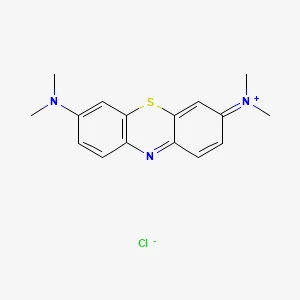
2D depiction generated from the PubChem record. Depictions are schematic and do not show salt form, counter-ions or conformation.
- Formula
- C16H18ClN3S
- Molecular weight
- 319.9 g/mol
- CAS
- 61-73-4
- InChIKey
- CXKWCBBOMKCUKX-UHFFFAOYSA-M
Key studies
- Prospective open-label single-arm study and prospective multicenter observational registryModel: Humans (adults with acquired methemoglobinemia, n=31)
Of 28 subjects with a baseline methemoglobin value (mean 18.4%), 26 (92.9%) had at least a 50% reduction at the first post-dose assessment (median 2.7 hours) 1.
- Single-centre randomized placebo-controlled trial, 91 patients (NCT04446871)Model: Humans (patients with septic shock, Sepsis-3)
Time to vasopressor discontinuation was 69 versus 94 hours; vasopressor-free days, ICU stay and hospital stay favoured methylene blue; mortality and ventilator days were similar; no serious adverse effects related to methylene blue were reported 4.
- Rodriguez et al., Radiology (2016)Randomized, double-blind, placebo-controlled fMRI study before and 1 hour after a single low oral doseModel: Humans (healthy adults aged 22 to 62, n=26)
Methylene blue increased insular cortex response during a sustained-attention task and prefrontal, parietal and occipital responses during a short-term memory task, with a 7% increase in correct retrieval responses 3.
Dosing as stated on the FDA label
Quoted from the prescribing information for reference. Prescribing decisions belong to a licensed clinician; this is not a recommendation or instruction for use.
Full dosing reference, study durations and vial arithmetic →- PROVAYBLUE for acquired methemoglobinemia: administer 1 mg/kg intravenously over 5 to 30 minutes. If the methemoglobin level remains greater than 30% or if clinical signs and symptoms persist, a repeat dose of 1 mg/kg may be given one hour after the first dose. If methemoglobinemia does not resolve after 2 doses, consider initiating alternative interventions. 1
- Renal impairment: the recommended dosage in patients with moderate or severe renal impairment (eGFR 15 to 59 mL/min/1.73 m2) is a single dose of 1 mg/kg; no adjustment is recommended for mild renal impairment. 1
- Per the label, the recommended dose is 1 mg/kg (lower or greater doses are not recommended), the maximum recommended number of doses is two, ensure patent venous access, do not administer subcutaneously, and the injection may be diluted in 50 mL 5% Dextrose Injection (avoid sodium chloride solutions). 1
- Dosage forms per the label: 50 mg/10 mL and 10 mg/2 mL (5 mg/mL) single-dose ampules or vials; strength is expressed in terms of the trihydrate. 1
- In the label's clinical studies, most doses administered were 1 mg/kg (82.9%), with doses from 0.78 mg/kg to 2 mg/kg; two patients received two doses and one received three 1.
- In SHOCKEM-Blue (NCT04446871), patients with septic shock received an intravenous infusion of 100 mg methylene blue in 500 mL of 0.9% sodium chloride over 6 hours once a day for 3 doses, or a saline placebo infusion 4,5.
- In the fMRI study, healthy adults received a single low oral dose of methylene blue or placebo, with imaging 1 hour later; the amount is not stated in the abstract 3.
Clinicians and researchers on video
YouTube videos about Methylene Blue from clinicians and researchers. Their views, in their own words; not reviewed or endorsed by Amiravo. Compare what they say with the evidence above.
- 👉 Methylene blue isn’t the miracle biohack people claim. Here’s the science behind it. 💊 #pharmacyDr. Ethan Melillo, PharmD · 1.4M views
These creators are not affiliated with Amiravo and do not endorse Amiravo or any product linked on this site. Nothing here is medical advice. Video views counted on YouTube as of Oct 24, 2026.
Regulatory status
- Status
- Approved by the FDA as PROVAYBLUE (methylene blue) injection, NDA 204630, original approval 8 April 2016, for the treatment of pediatric and adult patients with acquired methemoglobinemia 1,2.
- United States (FDA)
- Approved under NDA 204630 (PROVAYBLUE, original approval 8 April 2016) per the Drugs@FDA application record 2; the current label was reviewed from DailyMed 1.
- Sport (WADA)
- Methylene blue is not named on the WADA 2026 Prohibited List 7.
Status varies by country and changes over time. How we describe regulatory status.
Quality and testing notes
Methylene blue is a small molecule. Pharmaceutical-grade (USP) injection should be distinguished from industrial, laboratory-stain or aquarium grades, which DailyMed shows are also marketed under 'methylene blue' names [1]. A certificate of analysis should state the hydrate form (the label expresses strength as the trihydrate; anhydrous molecular weight 319.86), assay, related substances including azure B (which the label identifies as a minor impurity and metabolite), heavy-metal content and, for injectables, sterility and endotoxin [1].
How purity testing works · Reading a certificate of analysis
Check a Methylene Blue certificate of analysis against its expected mass (319.9 Da)Storage and handling
Per the PROVAYBLUE label: store at 20 to 25 degrees C (excursions 15 to 30 degrees C permitted); do not refrigerate or freeze; keep the ampule or vial in the original package to protect from light [1].
Frequently asked questions
Is methylene blue FDA-approved?
Is methylene blue a peptide?
Why does it have a boxed warning?
Who should not receive it?
What is its half-life?
Has it been studied for brain function?
Does it affect pulse oximetry?
Latest indexed research
No new studies were filed in the last sweep.
Search all studies on Methylene Blue (PubMed, Europe PMC, ClinicalTrials.gov)Listed by publication type from the index record. Inclusion is not an endorsement; open the source to read the findings.
Revision history
Meaningful changes to this entry, with dates and sources. Last reviewed Oct 23, 2026. Typo and layout fixes are not listed.
No recorded changes since the change log began on Oct 23, 2026.
References
- PROVAYBLUE (methylene blue) injection, USP, for intravenous use. Prescribing information, American Regent / Provepharm (SPL published June 12, 2025) DailyMed (FDA label). 2025
- Drugs@FDA application record for PROVAYBLUE (methylene blue), NDA 204630, original approval 8 April 2016 openFDA / Drugs@FDA. 2026
- Multimodal Randomized Functional MR Imaging of the Effects of Methylene Blue in the Human Brain Radiology. 2016
- Early adjunctive methylene blue in patients with septic shock: a randomized controlled trial Crit Care. 2023
- Methylene Blue in Early Septic Shock (SHOCKEM-Blue, NCT04446871) ClinicalTrials.gov. 2021
- PubChem compound record for methylene blue (CID 6099; CAS 61-73-4) PubChem. 2026
- International Standard: Prohibited List 2026 World Anti-Doping Agency. 2026
Last reviewed October 23, 2026 by the Amiravo editorial team.
Need the math?
Laboratory arithmetic with every formula shown.
For research use only. Not for human or veterinary use. Not a drug, food, or dietary supplement. This page is educational and is not medical advice.
Unbranded reference image. Amiravo does not produce, supply or sell this compound.
Specifications
- Molecular formula
- C16H18ClN3S
- Molecular weight
- 319.9 g/mol
- CAS number
- 61-73-4
- PubChem CID
- 6099
- FDA UNII
- 8NAP7826UB
- ChEMBL
- CHEMBL405110
- DrugBank
- DB09241
- Format
- Bottle
- Other forms seen
- Oral solution (drops) 0.5% · Oral solution (drops) 1% (10 mg/mL) · Oral solution (drops) 2%
- Type
- Single compound
Identifiers from PubChem. Verify against the supplier’s documentation for your lot.
Research stats
How much has been published, not how good it is.
- PubMed records
- 27,908
- Indexed as human research
- 7,772
- Animal-only research
- 4,842
- Randomized controlled trials
- 398
- Registered trials
- 343
- Trials with posted results
- 32
- FDA adverse-event reports (FAERS)
- 1,605
- NIH-funded projects naming it
- 342
Counts from title/abstract searches of PubMed, ClinicalTrials.gov, openFDA and NIH RePORTER, checked 2026-10-24. Names shared with other substances can inflate counts. FAERS reports are spontaneous and do not establish cause. Funding shows interest, not evidence. Method
Follow Methylene Blue
See every new citation, evidence-grade or status change and correction in My Research, with optional email alerts. Free account.