Pemvidutide
Also known as ALT-801
Pemvidutide (ALT-801) is an investigational once-weekly peptide that activates both the GLP-1 and glucagon receptors with closely matched potency. It has been studied in randomized placebo-controlled trials in fatty liver disease, and a phase 3 trial in MASH was registered in 2026. It is not an approved medicine, and this entry is for research information only.
- US status
- Investigational
- Evidence
- Grade A
- Half-life
- A numerical human half-life was not located in the sources reviewed
- Class
- Dual GLP-1 receptor / glucagon receptor agonist (investigational)
More
Research reference, not advice. Study facts, not instructions. Amiravo sells nothing; some links are referrals.Read the full notice
Key takeaways
- In a 12-week randomized phase 1 trial in 94 adults with MASLD, relative liver-fat reductions were 46.6% (1.2 mg), 68.5% (1.8 mg) and 57.1% (2.4 mg) versus 4.4% with placebo 1.
- In a 12-week blinded extension (64 participants, 24 weeks of treatment in total), relative liver-fat reductions were 56.3%, 75.2% and 76.4% versus 14.0% with placebo, and body weight fell by 6.2% in the 1.8 mg group 2.
- In the 24-week IMPACT phase 2b trial in biopsy-confirmed MASH with F2-F3 fibrosis, MASH resolution without fibrosis worsening was reported in 58% (1.2 mg) and 52% (1.8 mg) versus 20% with placebo; the second primary endpoint, fibrosis improvement, was not met 3.
- Adverse events in IMPACT were reported in 78% and 81% of pemvidutide recipients versus 67% with placebo, mostly mild or moderate 3.
- Pemvidutide has not been approved by the FDA, and peer-reviewed results of its obesity trial (MOMENTUM) were not located for this entry 5,9.
Development stage
Where Pemvidutide sits between laboratory work and regulatory approval.
- PreclinicalAnimal and cell work
- Phase 1First human safety studies
- Phase 2Early efficacy signal
- Phase 3 (current)Confirmatory trials
- ApprovedCleared by a regulator
Stage comes from the regulatory record and ClinicalTrials.gov studies naming the compound (for compounds approved nowhere, only completed trials or trials with posted results count) (checked 2026-10-24). A registered trial is not a result.
Mechanism of action
Pemvidutide (ALT-801) is described as a dual GLP-1 receptor (GLP-1R) and glucagon receptor (GCGR) peptide agonist conjugated to a glycolipid moiety that slows absorption into the plasma and prolongs half-life 4.
Balanced receptor potency
The preclinical report gives closely matched potencies of 39 pM at GLP-1R and 42 pM at GCGR, and contrasts this with other dual agonists that the authors describe as biased towards GLP-1R 4. The authors cite earlier work in which a dual agonist with near-balanced activity at both receptors was associated with the greatest body-weight reduction and glycaemic control 4.
Rationale for liver disease
The trial authors describe glucagon receptor agonists as acting directly on the liver to stimulate fatty acid oxidation and inhibit lipogenesis, whereas GLP-1R agonists act mainly through central and peripheral effects on appetite 1,2. This rationale comes from the developer's publications, and the relative contribution of each receptor in people has not been isolated in the sources reviewed 1,2.
Doses used in published trials
What investigators administered in the cited studies, recorded as a fact about those studies. Not a protocol and not a recommendation.
Full dosing reference, study durations and vial arithmetic →- In the phase 1 MASLD trial (NCT05006885), participants were randomized 1:1:1:1 to once-weekly subcutaneous pemvidutide at 1.2 mg, 1.8 mg or 2.4 mg, or placebo, for 12 weeks 1.
- In the extension trial (NCT05292911), completers continued their originally assigned dose without titration for a further 12 weeks 2.
- In IMPACT (NCT05989711), participants were randomized 1:2:2 to once-weekly subcutaneous pemvidutide 1.2 mg or 1.8 mg, given without dose titration, or placebo 3,12.
- The PERFORMA phase 3 registration (NCT07795164) lists pemvidutide 1.8 mg and 2.4 mg and placebo arms, an estimated enrolment of 1,800 and histological endpoints at week 52 6.
- In the phase 1 MASLD trial, 94 participants were randomized and dosed 1; 64 completers entered the 12-week extension 2.
- IMPACT randomized 212 participants with biopsy-confirmed MASH and fibrosis stage F2 or F3: 41 to pemvidutide 1.2 mg, 85 to 1.8 mg and 86 to placebo 3.
- The MOMENTUM obesity trial registry record (NCT05295875) lists three ALT-801 (pemvidutide) dose levels and placebo, 391 participants enrolled and a week-48 body-weight primary endpoint; dose amounts are not stated in the registry fields and no results are posted 5.
- The RECLAIM phase 2 registry record (NCT06987513) lists pemvidutide 2.4 mg versus placebo in 100 participants with alcohol use disorder and obesity or overweight, with the primary endpoint over weeks 21–24 7.
- The RESTORE phase 2 registry record (NCT07009860) lists pemvidutide 2.4 mg versus placebo in 121 participants with alcohol-associated liver disease, with liver-stiffness endpoints at weeks 24 and 48 8.
Pemvidutide draw calculator
Pick the vial strength and how much water is added, then enter an amount to see the units to draw. Arithmetic only, not a recommendation.
Computed from your inputs. Not a dose or a recommendation.
Compare water volumes for this vialShow
More water = lower concentration = a larger, easier-to-measure draw. Tap a row to use it.
| Water | mg/mL | Draw |
|---|---|---|
| 0.5 mL | 20 | — |
| 1 mL | 10 | — |
| 1.5 mL | 6.667 | — |
| 2 mL | 5 | — |
| 2.5 mL | 4 | — |
| 3 mL | 3.333 | — |
| 5 mL | 2 | — |
Background viewing
We haven't found a clinician video focused on Pemvidutide yet. Meanwhile, this widely watched talk covers the science of aging in general. It does not discuss Pemvidutide.
These creators are not affiliated with Amiravo and do not endorse Amiravo or any product linked on this site. Nothing here is medical advice. Video views counted on YouTube as of Oct 24, 2026.
Regulatory status
- Status
- Investigational as of 22 October 2026. An openFDA query of Drugs@FDA on that date returned no application record for pemvidutide 9, and a phase 3 trial in MASH is registered as recruiting 6.
- United States (FDA)
- Pemvidutide is investigational; an openFDA query of Drugs@FDA application data on 22 October 2026 returned no application record for it 9.
- Sport (WADA)
- Pemvidutide is not named in the 2026 Prohibited List text reviewed. Section S0 covers pharmacological substances not addressed elsewhere on the List that have no current approval by any governmental regulatory health authority for human therapeutic use, including drugs under clinical development; athletes should consult WADA directly 10.
Status varies by country and changes over time. How we describe regulatory status.
Quality and testing notes
No PubChem compound record for pemvidutide was returned on 22 October 2026, so a reference molecular weight could not be verified for this entry [11]. A certificate of analysis for a pemvidutide research material would be expected to show HPLC purity, mass-spectrometry identity, endotoxin and net peptide content, and should state how the glycolipid conjugation described in the literature was confirmed [4].
How purity testing works · Reading a certificate of analysis
Check a Pemvidutide certificate of analysisStorage and handling
Storage conditions for research material are set by the supplier's documentation; lyophilized peptides are generally sensitive to heat, light and moisture.
Frequently asked questions
What is pemvidutide?
Is pemvidutide approved by the FDA?
What does "balanced" dual agonism mean here?
What did the MASH trial show?
Has it been studied for obesity?
Latest indexed research
No new studies were filed in the last sweep.
Search all studies on Pemvidutide (PubMed, Europe PMC, ClinicalTrials.gov)Listed by publication type from the index record. Inclusion is not an endorsement; open the source to read the findings.
Revision history
Meaningful changes to this entry, with dates and sources. Last reviewed Oct 23, 2026. Typo and layout fixes are not listed.
- New section· Schedules by time periodOct 23, 2026
Added week-by-week schedules from registered trials (1 group, 2 arms).
Source: Safety and efficacy of weekly pemvidutide versus placebo for metabolic dysfunction-associated steatohepatitis (IMPACT): 24-week results from a multicentre, randomised, double-blind, phase 2b study
Last reviewed October 23, 2026 by the Amiravo editorial team.
Need the math?
Laboratory arithmetic with every formula shown.
For research use only. Not for human or veterinary use. Not a drug, food, or dietary supplement. This page is educational and is not medical advice.
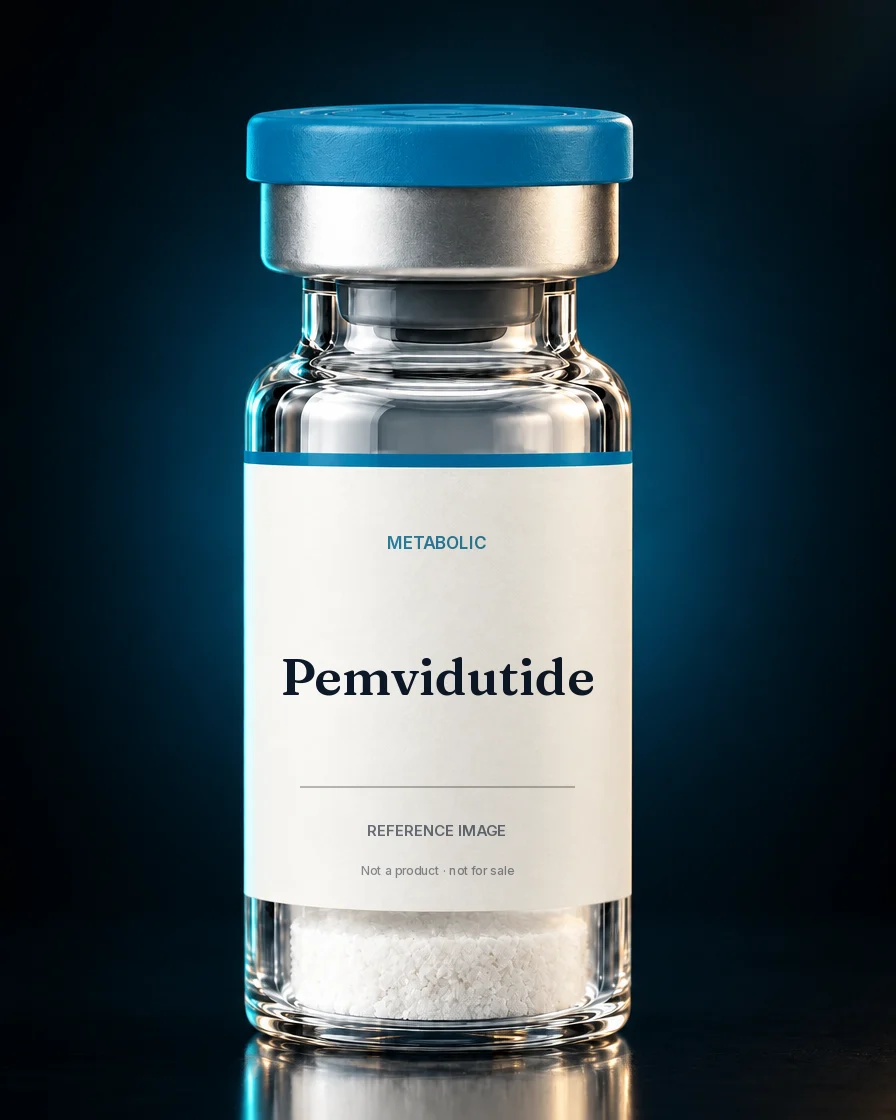
Unbranded reference image. Amiravo does not produce, supply or sell this compound.
Specifications
- Format
- Lyophilized vial
- Type
- Single compound
Chemical identifiers are shown only when verified against PubChem.
Research stats
How much has been published, not how good it is.
- PubMed records
- 16
- Indexed as human research
- 9
- Animal-only research
- 1
- Randomized controlled trials
- 2
- Registered trials
- 16
- Trials with posted results
- 5
- NIH-funded projects naming it
- 6
Counts from title/abstract searches of PubMed, ClinicalTrials.gov, openFDA and NIH RePORTER, checked 2026-10-24. Names shared with other substances can inflate counts. FAERS reports are spontaneous and do not establish cause. Funding shows interest, not evidence. Method
Follow Pemvidutide
See every new citation, evidence-grade or status change and correction in My Research, with optional email alerts. Free account.