Pramlintide
Also known as Symlin · SymlinPen · Pramlintide acetate · Tripro-amylin · AC137 · AC-0137
Pramlintide is a synthetic 37-amino-acid analog of human amylin, FDA-approved in 2005 as Symlin for adjunctive use with mealtime insulin in type 1 and type 2 diabetes; Drugs@FDA now lists all Symlin products as discontinued.
- US status
- Approved, no longer marketed
- Evidence
- Grade A
- Half-life
- Approximately 48 minutes in healthy individuals; elimination half-life 48-55 minutes across single subcutaneous doses in the label's PK table 1.
- Class
- Amylin analog
More
Research reference, not advice. Label quotes, not a recommendation. Amiravo sells nothing; some links are referrals.Read the full notice
Key takeaways
- Pramlintide is a synthetic amylin analog approved as Symlin for use with mealtime insulin in type 1 and type 2 diabetes; all Symlin products are now listed as discontinued 1,2.
- The label's boxed warning states that use with insulin increases the risk of severe hypoglycemia, particularly in type 1 diabetes, usually within 3 hours of injection 1.
- Placebo-subtracted HbA1c reductions in the label trials were about 0.25-0.34% at 6 months 1.
- Nausea was the most common adverse reaction (48% versus 17% placebo in type 1 diabetes) and tended to decrease over time 1.
- Contraindications include hypoglycemia unawareness and confirmed gastroparesis 1.
Development stage
Where Pramlintide sits between laboratory work and regulatory approval.
- PreclinicalAnimal and cell work
- Phase 1First human safety studies
- Phase 2Early efficacy signal
- Phase 3Confirmatory trials
- Approved (current)Cleared by a regulator
Stage comes from the regulatory record and ClinicalTrials.gov studies naming the compound (for compounds approved nowhere, only completed trials or trials with posted results count) (checked 2026-10-24). A registered trial is not a result.
Mechanism of action
Pramlintide is an analog of human amylin, which is co-located with insulin in beta-cell secretory granules and co-secreted in response to food intake 1.
Actions
- In human studies, pramlintide slowed gastric emptying, reduced the postprandial rise in plasma glucagon and modulated satiety, decreasing caloric intake 1.
- In nonclinical studies amylin suppresses glucagon secretion and regulates food intake through centrally mediated modulation of appetite 1.
- Controlled hypoglycemic-challenge studies showed no change in the counter-regulatory hormonal response to insulin-induced hypoglycemia 1.
Pharmacokinetics
Absolute bioavailability after subcutaneous injection is about 30-40%; the main metabolite, des-Lys1 pramlintide, is active in vitro 1.
Molecular structure
PubChem CID 70691388 ↗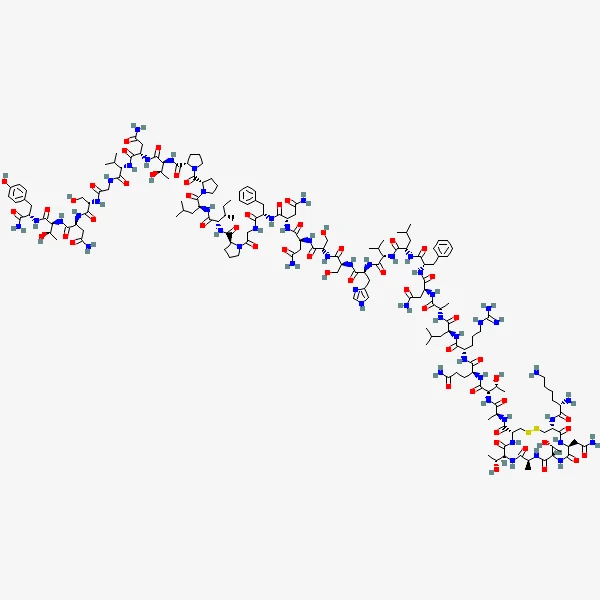
2D depiction generated from the PubChem record. Depictions are schematic and do not show salt form, counter-ions or conformation.
- Formula
- C171H267N51O53S2
- Molecular weight
- 3949.4 g/mol
- CAS
- 151126-32-8
- InChIKey
- TZIRZGBAFTZREM-MKAGXXMWSA-N
Research overview
Human research
Randomized placebo-controlled trials of 26 to 52 weeks in people with type 1 diabetes and insulin-treated type 2 diabetes support the labeled indication 1,3. A 12-month dose-ranging study in adults with obesity without diabetes reported body-weight changes, outside the labeled indication 4.
Animal research
The label summarizes nonclinical findings that amylin slows gastric emptying, suppresses glucagon secretion and regulates food intake through central appetite pathways 1.
In-vitro research
The primary metabolite, des-Lys1 pramlintide (2-37 pramlintide), is biologically active in vitro 1.
Dosing as stated on the FDA label
Quoted from the prescribing information for reference. Prescribing decisions belong to a licensed clinician; this is not a recommendation or instruction for use.
Full dosing reference, study durations and vial arithmetic →- Type 2 diabetes using mealtime insulin: reduce mealtime insulin (including premixed) by 50%, then start at 60 micrograms subcutaneously immediately before each major meal; increase to 120 micrograms when no clinically significant nausea has occurred for at least 3 days; reduce to 60 micrograms if significant nausea persists 1.
- Type 1 diabetes: reduce mealtime insulin by 50%, then start at 15 micrograms before each major meal; increase to the next increment (30, 45 or 60 micrograms) when no clinically significant nausea has occurred for at least 3 days; decrease to 30 micrograms if nausea persists at 45 or 60 micrograms 1.
- A major meal is defined in the label as at least 250 kcal or at least 30 g of carbohydrate. Administration instructions are in the label and are not reproduced here 1.
Background viewing
We haven't found a clinician video focused on Pramlintide yet. Meanwhile, this widely watched talk covers the science of aging in general. It does not discuss Pramlintide.
These creators are not affiliated with Amiravo and do not endorse Amiravo or any product linked on this site. Nothing here is medical advice. Video views counted on YouTube as of Oct 24, 2026.
Regulatory status
- Status
- FDA-approved (initial U.S. approval 2005) as Symlin under NDA 021332; as of 2026-10-24 Drugs@FDA lists all Symlin products as discontinued 1,2.
- United States (FDA)
- FDA-approved (initial U.S. approval 2005) as Symlin, NDA 021332; Drugs@FDA lists all three Symlin products as discontinued as of 2026-10-24 1,2.
- Sport (WADA)
- Amylin analogs, including pramlintide, were not mentioned on the WADA 2026 Prohibited List page reviewed 5.
Status varies by country and changes over time. How we describe regulatory status.
Quality and testing notes
A certificate of analysis for pramlintide material would be expected to show HPLC purity, identity by mass spectrometry against the label's molecular weight of 3949.4 (free base), confirmation of the C-terminal amide, acetate and net peptide content, and endotoxin level [1, 6].
How purity testing works · Reading a certificate of analysis
Check a Pramlintide certificate of analysis against its expected mass (3,949.4 Da)Storage and handling
The label directs refrigerated storage (2-8°C) protected from light for unopened pens, not frozen; after first use, pens may be refrigerated or kept up to 30°C and used within 30 days [1].
Frequently asked questions
What is pramlintide?
What was it approved for?
Is Symlin still marketed in the U.S.?
What is the main safety concern?
How does it act?
How long does it last?
Was it studied in obesity?
Latest indexed research
No new studies were filed in the last sweep.
Search all studies on Pramlintide (PubMed, Europe PMC, ClinicalTrials.gov)Listed by publication type from the index record. Inclusion is not an endorsement; open the source to read the findings.
Revision history
Meaningful changes to this entry, with dates and sources. Last reviewed Oct 24, 2026. Typo and layout fixes are not listed.
- New section· entryOct 24, 2026
New research reference added: Pramlintide.
References
- SYMLIN (pramlintide acetate) injection, prescribing information (SymlinPen; DailyMed, label revised 12/2019) FDA label (DailyMed). 2019
- Drugs@FDA (openFDA) application record NDA 021332, SYMLIN U.S. FDA. 2026
- A randomized study and open-label extension evaluating the long-term efficacy of pramlintide as an adjunct to insulin therapy in type 1 diabetes Diabetes Care. 2002
- Sustained weight loss following 12-month pramlintide treatment as an adjunct to lifestyle intervention in obesity Diabetes Care. 2008
- World Anti-Doping Agency Prohibited List 2026 (online version) WADA. 2026
- PubChem compound record for pramlintide PubChem. 2026
Last reviewed October 24, 2026 by the Amiravo editorial team.
Need the math?
Laboratory arithmetic with every formula shown.
For research use only. Not for human or veterinary use. Not a drug, food, or dietary supplement. This page is educational and is not medical advice.
Unbranded reference image. Amiravo does not produce, supply or sell this compound.
Specifications
- Molecular formula
- C171H267N51O53S2
- Molecular weight
- 3,949.4 g/mol
- CAS number
- 151126-32-8
- PubChem CID
- 70691388
- FDA UNII
- D3FM8FA78T
- ChEMBL
- CHEMBL2103758
- Sequence
- Lys-
Cys- Asn- Thr- Ala- Thr- Cys- Ala- Thr- Gln- Arg- Leu- Ala- Asn- Phe- Leu- Val- His- Ser- Ser- Asn- Asn- Phe- Gly- Pro- Ile- Leu- Pro- Pro- Thr- Asn- Val- Gly- Ser- Asn- Thr- Tyr- NH2 - Type
- Single compound
Identifiers from PubChem. Verify against the supplier’s documentation for your lot.
Research stats
How much has been published, not how good it is.
- PubMed records
- 445
- Indexed as human research
- 352
- Animal-only research
- 28
- Randomized controlled trials
- 64
- Registered trials
- 64
- Trials with posted results
- 15
- FDA adverse-event reports (FAERS)
- 84
- NIH-funded projects naming it
- 128
Counts from title/abstract searches of PubMed, ClinicalTrials.gov, openFDA and NIH RePORTER, checked 2026-10-24. Names shared with other substances can inflate counts. FAERS reports are spontaneous and do not establish cause. Funding shows interest, not evidence. Method
Follow Pramlintide
See every new citation, evidence-grade or status change and correction in My Research, with optional email alerts. Free account.