Vasopressin
Also known as Arginine vasopressin (AVP) · Argipressin · 8-L-arginine vasopressin · Antidiuretic hormone (ADH) · Vasostrict · Vasopressin injection, USP
Vasopressin (8-L-arginine vasopressin) is a nine-residue cyclic peptide hormone that the FDA has approved as Vasostrict, an intravenous infusion to raise blood pressure in adults with vasodilatory shock who remain hypotensive despite fluids and catecholamines.
- US status
- FDA-approved
- Evidence
- Grade A
- Half-life
- Apparent half-life of 10 minutes or less at infusion rates used in vasodilatory shock (0.01 to 0.1 units/minute); clearance increases up to about 5-fold by term in pregnancy because of placental vasopressinase 1.
- Class
- Neurohypophyseal nonapeptide hormone (V1/V2 receptor agonist)
More
Research reference, not advice. Label quotes, not a recommendation. Amiravo sells nothing; some links are referrals.Read the full notice
Key takeaways
- Vasopressin is a cyclic nine-residue peptide hormone; Vasostrict is FDA-approved only as an intravenous infusion to raise blood pressure in adults with vasodilatory shock unresponsive to fluids and catecholamines 1.
- It acts on V1 receptors to constrict blood vessels and on V2 receptors to reduce water excretion; at pressor doses it also acts at V3 receptors releasing ACTH and prolactin 1.
- In septic-shock trials in humans, vasopressin did not lower 28-day mortality versus norepinephrine (VASST) or increase kidney-failure-free days (VANISH) 2,3.
- Label warnings are worsening cardiac function and reversible diabetes insipidus after stopping; literature-reported reactions include ischemia of the gut, digits and heart, hyponatremia and arrhythmias 1.
- Vasopressin is not named in the 2026 Prohibited List text reviewed, while its analog desmopressin is listed under S5 as a masking agent 4.
Development stage
Where Vasopressin sits between laboratory work and regulatory approval.
- PreclinicalAnimal and cell work
- Phase 1First human safety studies
- Phase 2Early efficacy signal
- Phase 3Confirmatory trials
- Approved (current)Cleared by a regulator
Stage comes from the regulatory record and ClinicalTrials.gov studies naming the compound (for compounds approved nowhere, only completed trials or trials with posted results count) (checked 2026-10-24). A registered trial is not a result.
Mechanism of action
Vasopressin binds V1 receptors on vascular smooth muscle, coupled to the Gq/11-phospholipase C pathway, releasing intracellular calcium and causing vasoconstriction; it stimulates antidiuresis via adenylyl-cyclase-coupled V2 receptors 1.
Pharmacodynamics (label)
- Constricts splanchnic, renal and cutaneous beds; can also cause vasodilation in some beds via V2, V3, oxytocin and P2 receptors 1.
- In vasodilatory shock it raises systemic vascular resistance and mean arterial pressure and reduces norepinephrine requirement; it tends to lower heart rate and cardiac output 1.
- The pressor effect peaks within 15 minutes and fades within 20 minutes of stopping; no tachyphylaxis is described 1.
Elimination
It is cleaved by serine protease, carboxypeptidase and disulfide oxido-reductase, with about 6% excreted unchanged in urine 1.
Molecular structure
PubChem CID 644077 ↗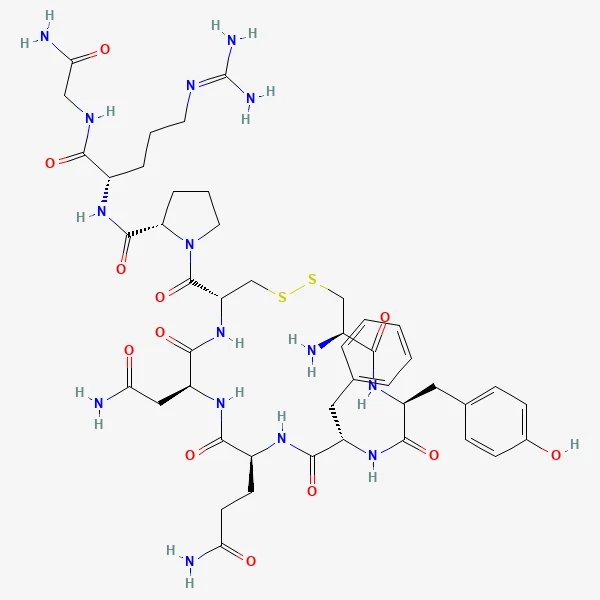
2D depiction generated from the PubChem record. Depictions are schematic and do not show salt form, counter-ions or conformation.
- Formula
- C46H65N15O12S2
- Molecular weight
- 1084.2 g/mol
- CAS
- 113-79-1
- InChIKey
- KBZOIRJILGZLEJ-LGYYRGKSSA-N
Research overview
Human research
The label cites blood-pressure increases in 7 septic-shock and 8 post-cardiotomy shock studies 1. VASST randomized 778 adults with septic shock to low-dose vasopressin or norepinephrine 2; VANISH randomized 409 adults in a 2x2 design with hydrocortisone 3.
Animal research
The label states no toxicology studies were conducted and that in mice vasopressin has been reported to affect sperm function and fertilizing ability 1.
In-vitro research
Vasopressin was negative in the Ames test and the CHO cell chromosome aberration test 1.
Key studies
- Multicenter, randomized, double-blindModel: Humans (778 adults with septic shock on norepinephrine)
28-day mortality 35.4% versus 39.3% (P = 0.26); serious adverse events 10.3% versus 10.5%; lower mortality in the less-severe stratum (26.5% vs 35.7%, P = 0.05) without significant heterogeneity 2.
- Gordon et al., JAMA (VANISH) (2016)Factorial 2x2, double-blind, randomized, 18 UK ICUsModel: Humans (409 adults with septic shock)
Survivors without kidney failure 57.0% versus 59.2% with norepinephrine; less renal replacement therapy with vasopressin (25.4% vs 35.3%); no significant mortality difference 3.
- Summary of published clinical studiesModel: Humans (septic and post-cardiotomy vasodilatory shock)
Increases in systolic and mean blood pressure were observed in 7 septic-shock and 8 post-cardiotomy studies 1.
Dosing as stated on the FDA label
Quoted from the prescribing information for reference. Prescribing decisions belong to a licensed clinician; this is not a recommendation or instruction for use.
Full dosing reference, study durations and vial arithmetic →- Post-cardiotomy shock (Vasostrict): initial 0.03 units/minute intravenously; labeled range 0.03 to 0.1 units/minute 1.
- Septic shock (Vasostrict): initial 0.01 units/minute intravenously; labeled range 0.01 to 0.07 units/minute 1.
- The label advises titrating up by 0.005 units/minute at 10- to 15-minute intervals to target blood pressure, notes limited data above 0.1 (post-cardiotomy) and 0.07 (septic) units/minute, and, after 8 hours at target without catecholamines, tapering by 0.005 units/minute every hour as tolerated 1.
- Vial contents of 20 units/mL are diluted to 0.1 or 1 unit/mL before intravenous use; the premixed 50 mL and 100 mL presentations do not require dilution. Preparation details are in the label and not reproduced here 1.
Background viewing
We haven't found a clinician video focused on Vasopressin yet. Meanwhile, this widely watched talk covers the science of aging in general. It does not discuss Vasopressin.
These creators are not affiliated with Amiravo and do not endorse Amiravo or any product linked on this site. Nothing here is medical advice. Video views counted on YouTube as of Oct 24, 2026.
Regulatory status
- Status
- FDA-approved as Vasostrict (initial U.S. approval 2014) to increase blood pressure in adults with vasodilatory shock who remain hypotensive despite fluids and catecholamines; label reviewed from the May 20, 2026 DailyMed version 1.
- United States (FDA)
- FDA-approved as Vasostrict (initial U.S. approval 2014) for vasodilatory shock; label current in DailyMed as of May 20, 2026 1.
- Sport (WADA)
- Vasopressin is not named in the 2026 Prohibited List text reviewed; desmopressin, a vasopressin analog, is listed under S5 (diuretics and masking agents), and S5 also covers substances with similar chemical structure or biological effect, so status should be confirmed with the relevant anti-doping organization 4.
Status varies by country and changes over time. How we describe regulatory status.
Quality and testing notes
Approved vasopressin is labeled by activity (one mg is equivalent to 530 units per the label) and identity is defined as the 1-6 disulfide-cyclized nonapeptide amide C46H65N15O12S2 (MW 1084.23) [1].
How purity testing works · Reading a certificate of analysis
Check a Vasopressin certificate of analysis against its expected mass (1,084.2 Da)Storage and handling
Follow the current Vasostrict label for vial storage; the label allows unopened vials up to 12 months at room temperature after removal from refrigeration, within the labeled shelf life, and sets discard times for diluted solutions [1].
Frequently asked questions
What is vasopressin approved for?
How does vasopressin raise blood pressure?
Is vasopressin the same as antidiuretic hormone?
Did vasopressin reduce deaths in septic shock trials?
How long does it act?
What happens when the infusion stops?
Is vasopressin banned in sport?
Latest indexed research
No new studies were filed in the last sweep.
Search all studies on Vasopressin (PubMed, Europe PMC, ClinicalTrials.gov)Listed by publication type from the index record. Inclusion is not an endorsement; open the source to read the findings.
Revision history
Meaningful changes to this entry, with dates and sources. Last reviewed Oct 24, 2026. Typo and layout fixes are not listed.
- New section· entryOct 24, 2026
New research reference added: Vasopressin.
References
- VASOSTRICT (vasopressin) injection, prescribing information (DailyMed SPL version 49, published May 20, 2026) FDA label (DailyMed). 2026
- Vasopressin versus norepinephrine infusion in patients with septic shock N Engl J Med. 2008
- Effect of Early Vasopressin vs Norepinephrine on Kidney Failure in Patients With Septic Shock: The VANISH Randomized Clinical Trial JAMA. 2016
- Tractatenblad 2026 Nr. 25: Anti-doping convention (ETS No. 135), amendment to the appendix - The 2026 Prohibited List, World Anti-Doping Code (English text; entry into force 1 January 2026) Tractatenblad van het Koninkrijk der Nederlanden (official government publication). 2026
- PubChem compound record for argipressin (arginine vasopressin; CID 644077) PubChem. 2026
Last reviewed October 24, 2026 by the Amiravo editorial team.
Need the math?
Laboratory arithmetic with every formula shown.
For research use only. Not for human or veterinary use. Not a drug, food, or dietary supplement. This page is educational and is not medical advice.
Unbranded reference image. Amiravo does not produce, supply or sell this compound.
Specifications
- Molecular formula
- C46H65N15O12S2
- Molecular weight
- 1,084.2 g/mol
- CAS number
- 113-79-1
- PubChem CID
- 644077
- FDA UNII
- Y4907O6MFD
- ChEMBL
- CHEMBL373742
- Sequence
- Cys-
Tyr- Phe- Gln- Asn- Cys- Pro- Arg- Gly- NH2 (disulfide Cys1- Cys6) - Type
- Single compound
Identifiers from PubChem. Verify against the supplier’s documentation for your lot.
Research stats
How much has been published, not how good it is.
- PubMed records
- 38,095
- Indexed as human research
- 15,138
- Animal-only research
- 20,005
- Randomized controlled trials
- 916
- Registered trials
- 434
- Trials with posted results
- 70
- FDA adverse-event reports (FAERS)
- 4,677
- NIH-funded projects naming it
- 6,325
Counts from title/abstract searches of PubMed, ClinicalTrials.gov, openFDA and NIH RePORTER, checked 2026-10-24. Names shared with other substances can inflate counts. FAERS reports are spontaneous and do not establish cause. Funding shows interest, not evidence. Method
Follow Vasopressin
See every new citation, evidence-grade or status change and correction in My Research, with optional email alerts. Free account.