Adipotide
Also known as Prohibitin-TP01 · Prohibitin targeting peptide 1 · CKGGRAKDC-GG-D(KLAKLAK)2 · Adipotide FTPP · CAS 859216-15-2 · HKPao
Adipotide is a synthetic peptidomimetic designed to deliver a pro-apoptotic sequence to blood vessels of white fat; the primate study that defined it reported reversible renal proximal tubule changes at the doses judged optimal, and its single registered human trial was terminated after 4 participants with no results posted.
- US status
- Not approved — research use only
- Evidence
- Grade C
- Half-life
- Not located in the sources reviewed; no pharmacokinetic half-life for any species was reported in the sources used for this entry.
- Class
- Ligand-directed pro-apoptotic peptidomimetic (prohibitin-binding homing motif fused to D(KLAKLAK)2)
More
Research reference, not advice. No administration data. Amiravo sells nothing; some links are referrals.Read the full notice
Key takeaways
- The primate study that established adipotide reported its primary side effect as renal injury: monkeys of three species showed predictable, reversible changes in proximal tubule function at the doses judged optimal, with glucosuria, proteinuria, falls in serum phosphorus and potassium and dose-dependent creatinine rises 2.
- The only registered human study, phase 1 trial NCT01262664 in metastatic prostate cancer and obesity, was terminated per the principal investigator's request after 4 participants enrolled, with no results posted 5.
- It was designed as a two-part molecule: a motif binding prohibitin on white-fat blood vessels, joined to a sequence reported to disrupt mitochondrial membranes and cause apoptosis after internalization 1,2.
- In obese monkeys and mice it was associated with reduced body weight, reduced fat mass and improved insulin or glucose measures; a published letter disputes whether this reflects vascular ablation or reduced food consumption 2,3,4.
- No FDA application record was identified and it is not named individually in the WADA sources reviewed; S0 covers substances without governmental approval for human therapeutic use 7,8.
Development stage
Where Adipotide sits between laboratory work and regulatory approval.
- Preclinical (current)Animal and cell work
- Phase 1First human safety studies
- Phase 2Early efficacy signal
- Phase 3Confirmatory trials
- ApprovedCleared by a regulator
Stage comes from the regulatory record and ClinicalTrials.gov studies naming the compound (for compounds approved nowhere, only completed trials or trials with posted results count) (checked 2026-10-24). A registered trial is not a result.
Mechanism of action
Adipotide is a cyclic CKGGRAKDC homing motif linked by Gly-Gly to D(KLAKLAK)2 2. The homing motif was identified by in vivo phage display in mice and reported to associate with prohibitin, which the authors established as a marker of white adipose tissue vasculature and described as also expressed in blood vessels of human white fat 1.
Proposed sequence of events
- Targeting: the CKGGRAKDC portion directs the molecule to prohibitin on endothelial cells of white fat vasculature 1,2.
- Cell killing: D(KLAKLAK)2 is described as an amphipathic peptidomimetic that disrupts mitochondrial membranes after receptor-mediated internalization, causing targeted apoptosis 2.
- Fat resorption: loss of the vascular supply was proposed to lead to resorption of white adipose tissue 1,2.
Contested points
In obese monkeys, body-weight change occurred together with reduced food intake, and lean monkeys given the therapeutic dose did not lose weight, which the authors read as an obesity-specific mechanism 2. A published letter argued instead that the monkey findings may reflect a direct effect on food consumption 4. In mice, glucose tolerance improved within days in a manner the authors reported as independent of food intake and body-weight change 3. The primate authors also noted that renal D-amino acid oxidase is the only known mammalian enzyme that can use the D(KLAKLAK)2 moiety as a substrate, which they suggested may link the molecule's catabolism to the kidney findings 2.
Molecular structure
PubChem CID 163360068 ↗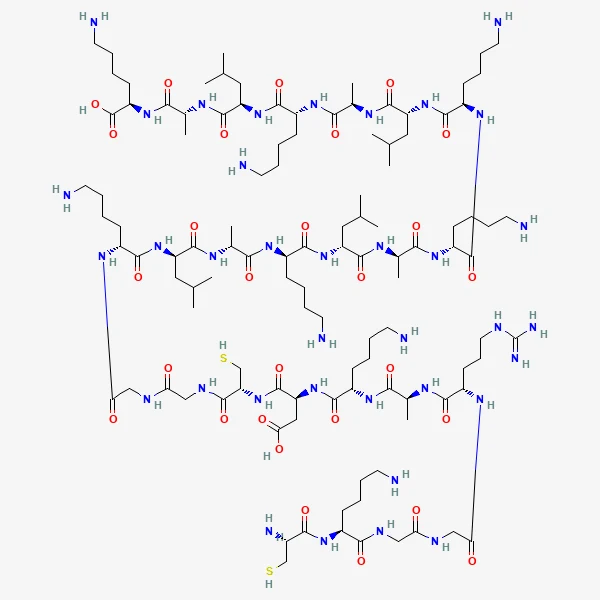
2D depiction generated from the PubChem record. Depictions are schematic and do not show salt form, counter-ions or conformation.
- Formula
- C111H206N36O28S2
- Molecular weight
- 2557.2 g/mol
- CAS
- 859216-15-2
- InChIKey
- GZESIPHLGJDZRG-VCWDIOOSSA-N
Published adverse-event data
Reported in the cited trials or product labels. Frequencies apply to the stated population and do not transfer to other settings.
Emerging safety signals
- Renal proximal tubule injury in obese and lean monkeys: mild-to-marked glucosuria, mild-to-moderate proteinuria, increased transitional/renal epithelial cells in urine, decreased serum phosphorus and potassium, and dose-dependent rises in serum creatinine without matching rises in blood urea nitrogen. Most changes reversed within 28 days of stopping, though one treated monkey in each study had slight residual creatinine and urinary glucose elevation after the recovery period. Animal data 2. 2 (2011)
- Increased urine output and clinical evidence of mild dehydration at the highest amounts tested in monkeys; the authors judged a reduced glomerular filtration rate suggestive but not established. Animal data 2. 2 (2011)
- No human safety data exist: the single registered phase 1 trial enrolled 4 participants, was terminated per the investigator's request and posted no results 5. 5 (2019)
What is not known: Human safety, tolerability, pharmacokinetics and any human effect are unknown, because the single registered trial posted no results 5. The relative contributions of adipose vascular apoptosis and reduced food consumption to the animal body-weight findings are disputed 2,4. Whether the renal tubule changes remain reversible with longer or repeated exposure, what the long-term consequences of destroying adipose vasculature would be, and the half-life in any species were not addressed in the sources reviewed 2,3.
Background viewing
We haven't found a clinician video focused on Adipotide yet. Meanwhile, this widely watched talk covers the science of aging in general. It does not discuss Adipotide.
These creators are not affiliated with Amiravo and do not endorse Amiravo or any product linked on this site. Nothing here is medical advice. Video views counted on YouTube as of Oct 24, 2026.
Regulatory status
- Status
- Not approved anywhere in the sources reviewed; no Drugs@FDA application record was returned for adipotide 7. The defining primate study reported that monkeys at the doses the authors judged optimal showed predictable and reversible changes in renal proximal tubule function 2. The only registered human study, phase 1 trial NCT01262664 at MD Anderson in men with metastatic castrate-resistant prostate cancer and obesity, began in 2012, enrolled 4 participants and was terminated per the principal investigator's request, with no results posted 5.
- United States (FDA)
- Not approved. An openFDA Drugs@FDA query for adipotide returned no application record on 24 October 2026 7. The only registered human study, phase 1 trial NCT01262664, was terminated in 2019 with no results posted 5.
- Sport (WADA)
- Not named individually in the sources reviewed; S0 covers substances without governmental approval for human therapeutic use, prohibited at all times 8.
Status varies by country and changes over time. How we describe regulatory status.
Quality and testing notes
A certificate of analysis should confirm the full sequence including the D-configuration of the KLAKLAK residues, since an all-L impurity would be indistinguishable by mass, and should confirm the Cys-Cys cyclization of the homing motif. Expect identity by mass spectrometry against the expected value (PubChem lists C111H206N36O28S2, about 2557 Da, for the free-thiol form) [6], purity by reverse-phase HPLC with the trace shown, net peptide content separate from gross weight, counter-ion identity and an endotoxin measurement.
How purity testing works · Reading a certificate of analysis
Check a Adipotide certificate of analysis against its expected mass (2,557.2 Da)Storage and handling
General research-context handling only: cysteine-containing peptides are sensitive to oxidation, and lyophilized material is generally kept dry and protected from light and moisture. Defer to supplier documentation for the specific lot. No temperatures, concentrations or preparation steps are given here.
Frequently asked questions
Has adipotide been tested in people?
What happened to the kidneys in the monkey study?
How is adipotide supposed to act?
What did the monkey study report about body composition?
Is the proposed mechanism settled?
Is adipotide approved or in active development?
Is it banned in sport?
Latest indexed research
No new studies were filed in the last sweep.
Search all studies on Adipotide (PubMed, Europe PMC, ClinicalTrials.gov)Listed by publication type from the index record. Inclusion is not an endorsement; open the source to read the findings.
Revision history
Meaningful changes to this entry, with dates and sources. Last reviewed Oct 24, 2026. Typo and layout fixes are not listed.
- New section· entryOct 24, 2026
New research reference added: Adipotide.
References
- Reversal of obesity by targeted ablation of adipose tissue Nat Med. 2004
- A peptidomimetic targeting white fat causes weight loss and improved insulin resistance in obese monkeys Sci Transl Med. 2011
- Rapid and weight-independent improvement of glucose tolerance induced by a peptide designed to elicit apoptosis in adipose tissue endothelium Diabetes. 2012
- Comment on "A peptidomimetic targeting white fat causes weight loss and improved insulin resistance in obese monkeys" Sci Transl Med. 2012
- A First-in-Man, Phase I Evaluation of A Single Cycle of Prohibitin Targeting Peptide 1 in Patients With Metastatic Prostate Cancer and Obesity (NCT01262664) ClinicalTrials.gov. 2019
- Adipotide (CID 163360068) PubChem. 2026
- Drugs@FDA application data queried through openFDA for adipotide (no matching application record returned on 24 October 2026) openFDA / Drugs@FDA. 2026
- International Standard: Prohibited List 2026 World Anti-Doping Agency. 2026
Last reviewed October 24, 2026 by the Amiravo editorial team.
Need the math?
Laboratory arithmetic with every formula shown.
For research use only. Not for human or veterinary use. Not a drug, food, or dietary supplement. This page is educational and is not medical advice.
Unbranded reference image. Amiravo does not produce, supply or sell this compound.
Specifications
- Molecular formula
- C111H206N36O28S2
- Molecular weight
- 2,557.2 g/mol
- CAS number
- 859216-15-2
- PubChem CID
- 163360068
- Sequence
- CKGGRAKDC-
GG- D(KLAKLAK)2 (cyclic Cys- Lys- Gly- Gly- Arg- Ala- Lys- Asp- Cys homing motif, Gly- Gly linker, D- enantiomer Lys- Leu- Ala- Lys- Leu- Ala- Lys repeat) - Type
- Single compound
Identifiers from PubChem. Verify against the supplier’s documentation for your lot.
Research stats
How much has been published, not how good it is.
- PubMed records
- 5
- Indexed as human research
- 4
- Animal-only research
- 1
- Randomized controlled trials
- 0
- Registered trials
- 1
- Trials with posted results
- 0
Counts from title/abstract searches of PubMed, ClinicalTrials.gov, openFDA and NIH RePORTER, checked 2026-10-24. Names shared with other substances can inflate counts. FAERS reports are spontaneous and do not establish cause. Funding shows interest, not evidence. Method
Follow Adipotide
See every new citation, evidence-grade or status change and correction in My Research, with optional email alerts. Free account.