IGF-1 LR3
Also known as Long R3 IGF-I · LR3-IGF-I · Long [Arg3]-IGF-I · LR3IGF-I
IGF-1 LR3 (Long R3 IGF-I) is a recombinant analogue of human insulin-like growth factor I with an arginine substitution at position 3 and a 13-amino-acid N-terminal extension, designed as a laboratory reagent that binds poorly to IGF-binding proteins. It has been studied in cell culture and animals, but no published human administration study was identified. It is not approved for human use, is distinct from the FDA-approved drug mecasermin, and is prohibited in sport; this entry is for research reference only.
- US status
- Not approved — research use only
- Evidence
- Grade C
- Class
- Recombinant insulin-like growth factor I analogue (N-terminally extended, Arg3-substituted fusion protein); research reagent
More
Research reference, not advice. No administration data. Amiravo sells nothing; some links are referrals.Read the full notice
Key takeaways
- IGF-1 LR3 is an engineered IGF-I analogue with an Arg3 substitution and an N-terminal extension, created as a laboratory reagent 1.
- In rat myoblasts and other cells, the Long IGF-I analogues were more potent than native IGF-I, attributed mainly to reduced binding to IGF-binding proteins 1.
- In pigs, LR3IGF-I lowered plasma glucose more potently and for longer than native IGF-I 2.
- No published human administration study and no registered clinical trial were identified 6; the effects of a His-tagged form found in a black-market vial have not been described in humans 3.
- WADA's 2026 List prohibits IGF-1 and its analogues at all times under S2.3 9.
Development stage
Where IGF-1 LR3 sits between laboratory work and regulatory approval.
- Preclinical (current)Animal and cell work
- Phase 1First human safety studies
- Phase 2Early efficacy signal
- Phase 3Confirmatory trials
- ApprovedCleared by a regulator
Stage comes from the regulatory record and ClinicalTrials.gov studies naming the compound (for compounds approved nowhere, only completed trials or trials with posted results count) (checked 2026-10-24). A registered trial is not a result.
Mechanism of action
IGF-1 LR3 is an analogue of insulin-like growth factor I. Its design combines an Arg-for-Glu substitution at position 3 with a hydrophobic N-terminal extension 1.
Binding properties
The original characterisation reported that N-terminal IGF-I analogues show increased biological potency because of changes in their interaction with IGF-binding proteins (IGFBPs), rather than higher receptor affinity; in a cell line that does not secrete IGFBPs, Long [Arg3]-IGF-I was less potent than IGF-I 1.
Metabolic effects in animals
In pigs, variants with low IGFBP affinity, including LR3IGF-I, produced deeper and more prolonged reductions in plasma glucose than IGF-I, and LR3IGF-I alone was more potent than IGF-I in lowering plasma amino acids 2.
IGF-1 LR3 draw calculator
Pick the vial strength seen on the research market and how much water is added, then enter an amount to see the units to draw. Arithmetic only, not a recommendation.
Computed from your inputs. Not a dose or a recommendation.
Compare water volumes for this vialShow
More water = lower concentration = a larger, easier-to-measure draw. Tap a row to use it.
| Water | mg/mL | Draw |
|---|---|---|
| 0.5 mL | 2 | — |
| 1 mL | 1 | — |
| 1.5 mL | 0.6667 | — |
| 2 mL | 0.5 | — |
| 2.5 mL | 0.4 | — |
| 3 mL | 0.3333 | — |
| 5 mL | 0.2 | — |
Published adverse-event data
Reported in the cited trials or product labels. Frequencies apply to the stated population and do not transfer to other settings.
Emerging safety signals
- In pigs, LR3IGF-I produced more potent and prolonged hypoglycaemia than native IGF-I, a mechanistic reason for concern about glucose lowering (animal evidence) 2. 2 (1997)
- Black-market material has been found to contain a His-tagged research form of Long R3 IGF-I whose effects in humans are undescribed (analytical case report) 3. 3 (2010)
- A 2026 clinical review lists dysglycaemia and biologically plausible but unproven mitogenic concerns for IGF-1-axis peptides used without regulatory approval (narrative review) 5. 5 (2026)
What is not known: No human pharmacokinetic, safety or efficacy data exist for IGF-1 LR3 in the sources reviewed 3,6; its human half-life is unknown. Animal and cell findings cannot be assumed to translate. Long-term effects, including on glucose regulation and on tissue growth, have not been characterised in any controlled study identified 2,5. Findings for mecasermin do not apply, because it is a different molecule 7.
Clinicians and researchers on video
YouTube videos about IGF-1 LR3 from clinicians and researchers. Their views, in their own words; not reviewed or endorsed by Amiravo. Compare what they say with the evidence above.
- The IGF-1 Trade-Off: Performance vs. LongevityFoundMyFitness · 516K views
- Every Popular Peptide Ranked | GLP-1, Growth Hormone, HCG, NAD+, IGF-1, Peptide Tier ListDr. Alex Tatem · 421K views
These creators are not affiliated with Amiravo and do not endorse Amiravo or any product linked on this site. Nothing here is medical advice. Video views counted on YouTube as of Oct 24, 2026.
Regulatory status
- Status
- Not approved for any human use. No registered clinical study was returned by a ClinicalTrials.gov search 6, and IGF-1 LR3 does not appear in any category of FDA's May 14, 2026 503A bulk drug substances list 8. It is a different molecule from mecasermin (INCRELEX), the FDA-approved recombinant human IGF-1 7. An anti-doping laboratory report describes Long R3 IGF-I as a product usually made for biochemical studies, found in a black-market injection vial 3.
- United States (FDA)
- Not approved. IGF-1 LR3 does not appear in any category of FDA's May 14, 2026 503A bulk drug substances list 8. The FDA-approved IGF-1 product is mecasermin (INCRELEX, application 021839), which is a different molecule 7.
- Sport (WADA)
- Prohibited at all times. Section S2.3, Growth Factors and Growth Factor Modulators, names insulin-like growth factor 1 (IGF-1, mecasermin) and its analogues 9.
Status varies by country and changes over time. How we describe regulatory status.
Quality and testing notes
IGF-1 LR3 is a recombinant protein rather than a short synthetic peptide, so a certificate of analysis should show identity by intact mass and peptide mapping against the expected fusion sequence, correct disulfide pairing (IGF-I has three disulfides), SDS-PAGE and HPLC purity, host-cell protein and endotoxin content, and a bioassay where available [1]. A His-tagged variant has been found in black-market material, so mass data should exclude tag-containing forms [3].
How purity testing works · Reading a certificate of analysis
Check a IGF-1 LR3 certificate of analysisStorage and handling
No approved-product storage instructions exist. Handling should follow the supplier's documentation; nothing here is a preparation or administration instruction.
Frequently asked questions
Is IGF-1 LR3 the same as mecasermin?
Has IGF-1 LR3 been tested in humans?
Why was it made?
Is it banned in sport?
What has it done in animals?
Is it compoundable in the US?
Latest indexed research
No new studies were filed in the last sweep.
Search all studies on IGF-1 LR3 (PubMed, Europe PMC, ClinicalTrials.gov)Listed by publication type from the index record. Inclusion is not an endorsement; open the source to read the findings.
Revision history
Meaningful changes to this entry, with dates and sources. Last reviewed Oct 23, 2026. Typo and layout fixes are not listed.
No recorded changes since the change log began on Oct 23, 2026.
References
- Novel recombinant fusion protein analogues of insulin-like growth factor (IGF)-I indicate the relative importance of IGF-binding protein and receptor binding for enhanced biological potency J Mol Endocrinol. 1992
- IGF-I variants which bind poorly to IGF-binding proteins show more potent and prolonged hypoglycaemic action than native IGF-I in pigs and marmoset monkeys J Endocrinol. 1997
- Detection of His-tagged Long-R3-IGF-I in a black market product Growth Horm IGF Res. 2010
- Intranasal long R3 insulin-like growth factor-1 treatment promotes amyloid plaque remodeling in cerebral cortex but fails to preserve cognitive function in male 5XFAD mice J Alzheimers Dis. 2025
- The emerging landscape of performance-enhancing peptides modulating GH-IGF1 axis: bridging the gap between clinical evidence and patient self-administration Front Endocrinol (Lausanne). 2026
- ClinicalTrials.gov API search for "long R3" IGF (no registered studies returned on 23 October 2026) ClinicalTrials.gov. 2026
- Drugs@FDA application records for mecasermin (INCRELEX, application 021839, original approval 30 August 2005) openFDA / Drugs@FDA. 2026
- Bulk Drug Substances Nominated for Use in Compounding Under Section 503A of the FD&C Act (categories 1, 2 and 3; updated May 14, 2026) FDA. 2026
- International Standard: Prohibited List 2026 World Anti-Doping Agency. 2026
Last reviewed October 23, 2026 by the Amiravo editorial team.
Need the math?
Laboratory arithmetic with every formula shown.
For research use only. Not for human or veterinary use. Not a drug, food, or dietary supplement. This page is educational and is not medical advice.
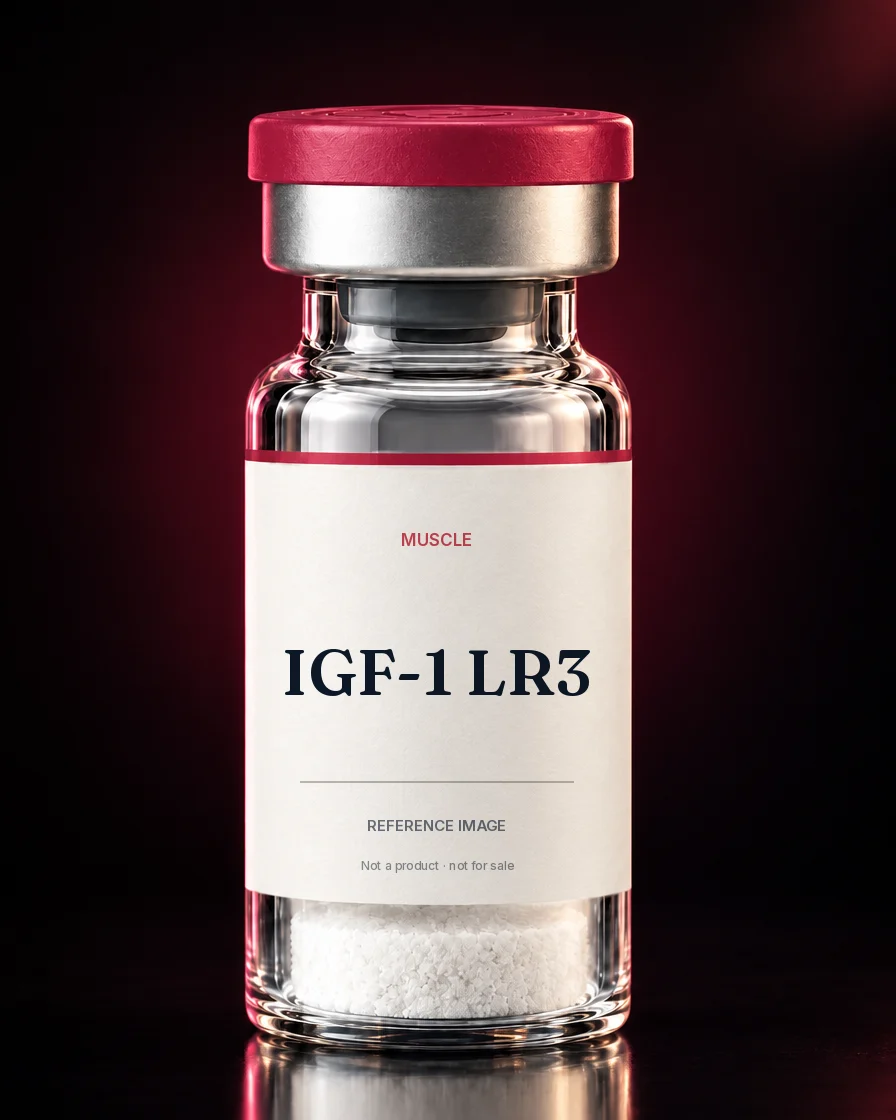
Unbranded reference image. Amiravo does not produce, supply or sell this compound.
Specifications
- Sequence
- N-
terminal 13- residue extension (the first 11 amino acids of methionyl porcine growth hormone followed by Val- Asn) fused to human IGF- I with Arg substituted for Glu at position 3 ([Met1]- pGH(1- 11)- Val- Asn- [Arg3]- IGF- I) - Format
- Lyophilized vial
- Vial sizes seen
- 0.1 mg · 1 mg
- Type
- Single compound
Chemical identifiers are shown only when verified against PubChem.
Research stats
How much has been published, not how good it is.
- PubMed records
- 102
- Indexed as human research
- 35
- Animal-only research
- 65
- Randomized controlled trials
- 0
- Registered trials
- 0
- Trials with posted results
- 0
- NIH-funded projects naming it
- 3
Counts from title/abstract searches of PubMed, ClinicalTrials.gov, openFDA and NIH RePORTER, checked 2026-10-24. Names shared with other substances can inflate counts. FAERS reports are spontaneous and do not establish cause. Funding shows interest, not evidence. Method
Follow IGF-1 LR3
See every new citation, evidence-grade or status change and correction in My Research, with optional email alerts. Free account.