Matrixyl
Also known as Palmitoyl pentapeptide-4 · Palmitoyl pentapeptide-3 · Pal-KTTKS · C16-KTTKS · Palmitoyl-Lys-Thr-Thr-Lys-Ser · Lipopentapeptide 3
Matrixyl is the trade name of palmitoyl pentapeptide-4 (pal-KTTKS), a cosmetic ingredient based on a fragment of type I procollagen with a palmitic acid tail; the main human study is a 12-week industry split-face trial in 93 women reporting reduced fine lines versus the same moisturizer without it, with cell work suggesting collagen stimulation and skin studies showing poor permeation.
- US status
- Not approved — research use only
- Evidence
- Grade B
- Half-life
- Not located in the sources reviewed. In skin extracts and homogenates both the unmodified pentapeptide and the palmitoylated form were rapidly degraded, with the palmitoylated form more stable; protease inhibitors improved the stability of both (mouse skin preparations) 4.
- Class
- Palmitoylated synthetic pentapeptide (peptide amphiphile); cosmetic ingredient derived from a type I procollagen fragment
More
Research reference, not advice. No administration data. Amiravo sells nothing; some links are referrals.Read the full notice
Key takeaways
- Matrixyl is palmitoyl pentapeptide-4 (pal-KTTKS), a cosmetic ingredient based on a type I procollagen fragment with a palmitic acid tail, not an approved drug 7,9.
- The main human evidence is a single 12-week double-blind, split-face randomized study in 93 women, conducted by the ingredient's manufacturer, which reported reduced wrinkles and fine lines versus the same moisturizer without the peptide 1.
- Cell work supports a collagen-stimulating action: in human fibroblasts the palmitoylated peptide increased collagen production in a concentration-dependent way tied to its self-assembly into nanotapes 2.
- Skin-permeation work is less encouraging: in excised mouse skin the palmitoylated peptide reached the stratum corneum, epidermis and dermis but did not permeate into the receptor compartment, and both forms degraded rapidly in skin preparations 4.
- No FDA approval exists and it is not named individually in the WADA sources reviewed; S0 covers substances without governmental approval for human therapeutic use 9,10.
Development stage
Where Matrixyl sits between laboratory work and regulatory approval.
- Preclinical (current)Animal and cell work
- Phase 1First human safety studies
- Phase 2Early efficacy signal
- Phase 3Confirmatory trials
- ApprovedCleared by a regulator
Stage comes from the regulatory record and ClinicalTrials.gov studies naming the compound (for compounds approved nowhere, only completed trials or trials with posted results count) (checked 2026-10-24). A registered trial is not a result.
Mechanism of action
Palmitoyl pentapeptide-4 joins the pentapeptide Lys-Thr-Thr-Lys-Ser, a sequence corresponding to a fragment of the type I procollagen propeptide, to palmitic acid at the N-terminus 2,7. The stated rationale is that such collagen fragments act as feedback signals to dermal fibroblasts, so that applying the fragment stimulates new extracellular matrix production; the palmitoyl tail is added to improve passage into the lipophilic stratum corneum 1,2.
Evidence for the mechanism
- Fibroblast response: in human dermal and corneal fibroblasts, collagen production rose in a concentration-dependent manner close to the peptide's critical aggregation concentration, which the authors interpreted as linking self-assembly into nanotape structures to the collagen effect 2.
- Wound models: in rats, the peptide was associated with greater collagen density, angiogenesis and epitheliogenesis than untreated wounds 5, and a separate rat study related its effect to connective tissue growth factor and alpha-smooth muscle actin expression during wound contraction 8.
Delivery
In excised hairless mouse skin, neither the unmodified pentapeptide nor the palmitoylated form was detected in the receptor solution; the palmitoylated form was recovered from the stratum corneum, epidermis and dermis, while the unmodified peptide was undetectable in any layer, indicating the palmitoyl tail helps the peptide enter but not cross skin 4. Microneedle treatment of excised human skin increased signal for pal-KTTKS by several fold, and liposome encapsulation has been characterised as another delivery strategy 6,11.
Molecular structure
PubChem CID 9897237 ↗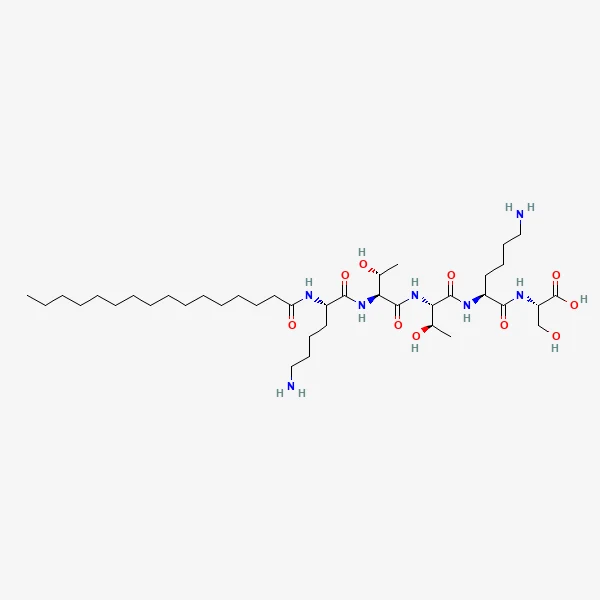
2D depiction generated from the PubChem record. Depictions are schematic and do not show salt form, counter-ions or conformation.
- Formula
- C39H75N7O10
- Molecular weight
- 802.1 g/mol
- CAS
- 214047-00-4
- InChIKey
- WSGCRSMLXFHGRM-DEVHWETNSA-N
Published adverse-event data
Reported in the cited trials or product labels. Frequencies apply to the stated population and do not transfer to other settings.
Emerging safety signals
- In the 12-week manufacturer-run split-face study in 93 women, the authors reported no skin tolerability problems; the study was not sized to detect uncommon events and was conducted at a cosmetic formulation concentration 1. 1 (2005)
- No independent human safety assessment of palmitoyl pentapeptide-4 was located in the sources reviewed, and the ingredient does not appear in any category of FDA's 503A bulk drug substances list 9. 9 (2026)
What is not known: The size and durability of any cosmetic effect are uncertain: the one substantial human study was conducted by the ingredient's manufacturer and has not been replicated independently at that scale, and the later independent trial had 21 participants and was described by its authors as preliminary 1,3. Whether enough peptide reaches the dermis from an ordinary topical vehicle is unresolved, since in excised skin it entered the skin layers but did not cross, and both peptide forms degrade rapidly in skin preparations 4,6. No human pharmacokinetic or half-life data were identified. No independent published safety assessment, no long-term use data and no comparison against established dermatologic treatments were located 9.
Background viewing
We haven't found a clinician video focused on Matrixyl yet. Meanwhile, this widely watched talk covers the science of aging in general. It does not discuss Matrixyl.
These creators are not affiliated with Amiravo and do not endorse Amiravo or any product linked on this site. Nothing here is medical advice. Video views counted on YouTube as of Oct 24, 2026.
Regulatory status
- Status
- A cosmetic ingredient, not an approved drug. Cosmetic ingredients in the United States are not subject to FDA premarket approval, and palmitoyl pentapeptide does not appear in any of the three categories of FDA's 503A bulk drug substances list as updated May 14, 2026 9. The principal human study was conducted by the ingredient's manufacturer 1.
- United States (FDA)
- Marketed as a cosmetic ingredient rather than a drug. Cosmetic ingredients in the United States are not subject to FDA premarket approval, and palmitoyl pentapeptide does not appear in any of the three categories of FDA's 503A bulk drug substances list as updated May 14, 2026 9. Absence from drug databases is therefore expected and says nothing about efficacy.
- Sport (WADA)
- Not named individually in the sources reviewed; S0 covers substances without governmental approval for human therapeutic use, prohibited at all times 10. Cosmetic status does not by itself place a substance outside the List, so athletes should seek a ruling from their anti-doping organisation.
Status varies by country and changes over time. How we describe regulatory status.
Quality and testing notes
A certificate of analysis should state the exact sequence, confirm palmitoylation and say which residue carries the palmitoyl group, since the unmodified pentapeptide behaves differently in skin [4]. Expect identity by mass spectrometry against the calculated mass for C39H75N7O10 (average mass about 802 Da), purity by reverse-phase HPLC with the trace and integration shown, net peptide content separate from gross weight, counter-ion identity (acetate or trifluoroacetate; PubChem also lists a Matrixyl acetate form) and water content [7]. Because the molecule is a peptide amphiphile that self-assembles above a critical aggregation concentration, solution behaviour is concentration-dependent and physical appearance alone is not a purity indicator [2]. For a cosmetic raw material, microbial limits and heavy-metal testing are conventional.
How purity testing works · Reading a certificate of analysis
Check a Matrixyl certificate of analysis against its expected mass (802.1 Da)Storage and handling
General research-context handling only. Lyophilised lipopeptides of this type are generally kept dry, cool and protected from light and moisture; aqueous preparations are treated as short-lived, and the peptide is rapidly degraded by proteases in skin preparations [4]. Finished cosmetic formulations follow the manufacturer's own stability data. Defer to supplier documentation for the specific lot.
Frequently asked questions
What is Matrixyl?
What human evidence exists?
How is it supposed to work?
Does it get into the skin?
How does it compare with Argireline in a head-to-head study?
What does the animal work show?
Is it FDA-approved?
Is it banned in sport?
Latest indexed research
No new studies were filed in the last sweep.
Search all studies on Matrixyl (PubMed, Europe PMC, ClinicalTrials.gov)Listed by publication type from the index record. Inclusion is not an endorsement; open the source to read the findings.
Revision history
Meaningful changes to this entry, with dates and sources. Last reviewed Oct 24, 2026. Typo and layout fixes are not listed.
- New section· entryOct 24, 2026
New research reference added: Matrixyl.
Last reviewed October 24, 2026 by the Amiravo editorial team.
Need the math?
Laboratory arithmetic with every formula shown.
For research use only. Not for human or veterinary use. Not a drug, food, or dietary supplement. This page is educational and is not medical advice.
Unbranded reference image. Amiravo does not produce, supply or sell this compound.
Specifications
- Molecular formula
- C39H75N7O10
- Molecular weight
- 802.1 g/mol
- CAS number
- 214047-00-4
- PubChem CID
- 9897237
- ChEMBL
- CHEMBL451881
- Sequence
- Palmitoyl-
Lys- Thr- Thr- Lys- Ser (pal- KTTKS) - Type
- Single compound
Identifiers from PubChem. Verify against the supplier’s documentation for your lot.
Research stats
How much has been published, not how good it is.
- PubMed records
- 33
- Indexed as human research
- 18
- Animal-only research
- 2
- Randomized controlled trials
- 2
- Registered trials
- 0
- Trials with posted results
- 0
- FDA adverse-event reports (FAERS)
- 1
Counts from title/abstract searches of PubMed, ClinicalTrials.gov, openFDA and NIH RePORTER, checked 2026-10-24. Names shared with other substances can inflate counts. FAERS reports are spontaneous and do not establish cause. Funding shows interest, not evidence. Method
Follow Matrixyl
See every new citation, evidence-grade or status change and correction in My Research, with optional email alerts. Free account.